
Stopping at the L1 Lagrange point of the Earth-Moon system at the end of a Mars-Earth journey would be an extremely useful stopover.
The dangers
The dangers of returning to Earth after a Mars mission are well known. They concern the astronauts as well as the people on Earth. A stopover at the L1 Lagrange point of the Earth-Moon system, at a rotating space station, would be of great interest to everyone. The main difficulties lie in the aerocapture and then docking.
Those opposed to manned missions to Mars often cite the need for “planetary protection,” evoking the risk of contamination of people remaining on Earth, by microbes that may have infected the astronauts during their stay on Mars. This risk will diminish over time as we learn more about the planet. Currently, while it is unlikely – no life forms have been detected so far – it cannot be ruled out on principle. The return journey, necessarily long (six months on average), will itself serve as a quarantine period. But an additional examination at a location close to Earth, such as L1, far more accessible to our equipment, pharmaceuticals, and specialist physicians, would provide a valuable added “layer” of safety.
Another major danger is the condition of the spacecraft before the most challenging phase of any deep-space mission, the EDL (Entry, Descent, and Landing). This involves facing Earth’s atmospheric pressure at a speed so great that the air turns to plasma, exceeding 2,000 degrees Celsius, while exerting tremendous mechanical stress on the structure of the ship as well as on the heat shield components – potentially causing one or more to detach from the assembly. Checking everything before this ordeal would obviously be a wise precaution. Of course, an inspection could be performed on Mars. But verification under gravity, even minimal (Mars’s 0.38g), without a service tower, would not be easy – especially on the upper section of a Starship standing 50 meters tall. Furthermore, the ascent through the Martian atmosphere, thin as it is (0.6% of Earth’s at the surface), and the escape from Martian gravity, would have put certain mechanical stresses on the vehicle at departure. A check-up near Earth (again at L1) in weightless conditions would allow for inspection and replacement of any components showing signs of weakness and inspecting the entire spacecraft would pose no difficulty. The space station could maintain a stock of thermal tiles and 3D printers to fabricate small replacement parts. If a required part falls outside this inventory or these capabilities, it could be delivered very quickly from Earth – something impossible as long as the spacecraft is not in its vicinity, and especially when it is on Mars, since physical communication windows open only for a few weeks every 26 months. Should the spacecraft have an irreparable flaw, it would also be possible to launch within a few days, a new vessel from Earth, even a medium-sized one (a Falcon Heavy, for example), to retrieve the astronauts and bring them back to Earth. Note that the Moon could not offer the same advantage (launch, landing, and gravity).
The benefits of a stay at L1
As you may have read in my previous articles, a rotating station with a radius of 60 meters, spinning at 2.73 revolutions per minute (rpm), would recreate a gravity of 0.5g within its 377-meter torus. The crew will be returning from a world where, for 18 months, they lived under 0.38g, a stay bracketed by two six-month journeys, possibly in weightlessness and certainly not in 1g nor even in 0.5g (volume and mass necessary). The return to 1g will be painful and potentially dangerous, especially if abrupt. Spending some four weeks under 0.5g would be an excellent preparation and a perfectly suitable environment for receiving medical care if needed. Imaging, biological sampling, intravenous infusions, surgery, and physical rehabilitation could all be carried out there, without difficulty.
Furthermore, at the distance of L1, there would be virtually no time lag, since on its halo orbit the station would be approximately 326,000 km from Earth – 85% of the Earth-Moon distance – immediately accessible on an interplanetary scale. All conversation, public or private, with or without video, would once again be possible, as would participation in meetings or television panels, whereas until then only delayed (3 to 22 minutes on Mars, one way) or pre-recorded audio messages or written documents could be exchanged.
One final benefit: after 30 months (two six-month journeys and 18 months on site) of wholesome but limited fare – understandably so – the astronauts would regain access to a rich and varied diet that they can order from Earth according to their own tastes.
In a way, upon returning to the Earth-Moon system, the astronauts would practically have returned to Earth (consider the distances: Earth-Moon, 385,000 km; Earth-Mars, 56 million to 400 million km). Psychologically, they would feel they had “come back home.”
In effect, a psychological dimension that should not be overlooked must be added to physiological benefits. Thirty months of isolation, forced proximity, constant danger, and utter distance from loved ones will have left their mark. In L1, not only will communications have become instantaneous again, but geographical details of the Earth will once more be visible to the naked eye. This audio and visual return will precede and prepare for the astronauts’ physical return, and this gentle transition will likely be as necessary as muscular rehabilitation.
Reaching L1 from the Mars-Earth Trajectory
One final issue is to consider: reaching L1 from the Mars-Earth trajectory. This is a delicate moment, as it requires braking while expending as little propellant as possible (the Starship’s propellant capacity is obviously limited). Several solutions have to be considered.
Let us first examine the orbital context.
A spacecraft returning from Mars reaches near L1 at a relative speed of some 3000 m/s. But the more it approaches Earth, the more gravity makes it fall towards it and it reaches the atmosphere at a speed of some 11.467 km/s at the entrance of the aerocapture (120 km altitude).
The advantage of a direct atmospheric re-entry is free braking. Propellant is required only for trajectory or attitude adjustments. But anyway, this comes at a cost: the stiffness of the aerobraking (high number of g incurred) and the heat generated.
The L1-first alternative, before descent to Earth, requires reducing to zero the relative velocity of 3000 m/s at 500,000 km from perigee, as mentioned above. This can only be achieved by propulsive braking, lunar gravitational braking, or Earth atmospheric aerocapture.
The first option requires a propellant expenditure incompatible with the strict mass constraints of the Mars mission. Indeed, only what is absolutely essential can be put on board at departure towards Mars.
The second option involves a very close lunar flyby, extremely difficult and dangerous to plan and execute.
The third option is less demanding in energy, though still risky. The spacecraft skims the upper reaches of Earth’s atmosphere (entering at 120 km down to 93 km altitude) to shed 489 m/s (i.e. 11,488 km/s at the altitude of 93 km – 10,999 km/s coming out of the aerobraking), then climb back out towards L1. This means that the vehicle after being slowed down, exits the Earth atmosphere with a residual velocity just sufficient to reach L1 (resulting apogee of 300,000 to 400,000 km), and insufficient to escape the Earth-Moon system. The additional delta-v needed to circularize at L1 would be on the order of 500 m/s – comprising 100 to 300 m/s of fine trajectory adjustment and 200 to 400 m/s of residual braking for halo orbit capture.
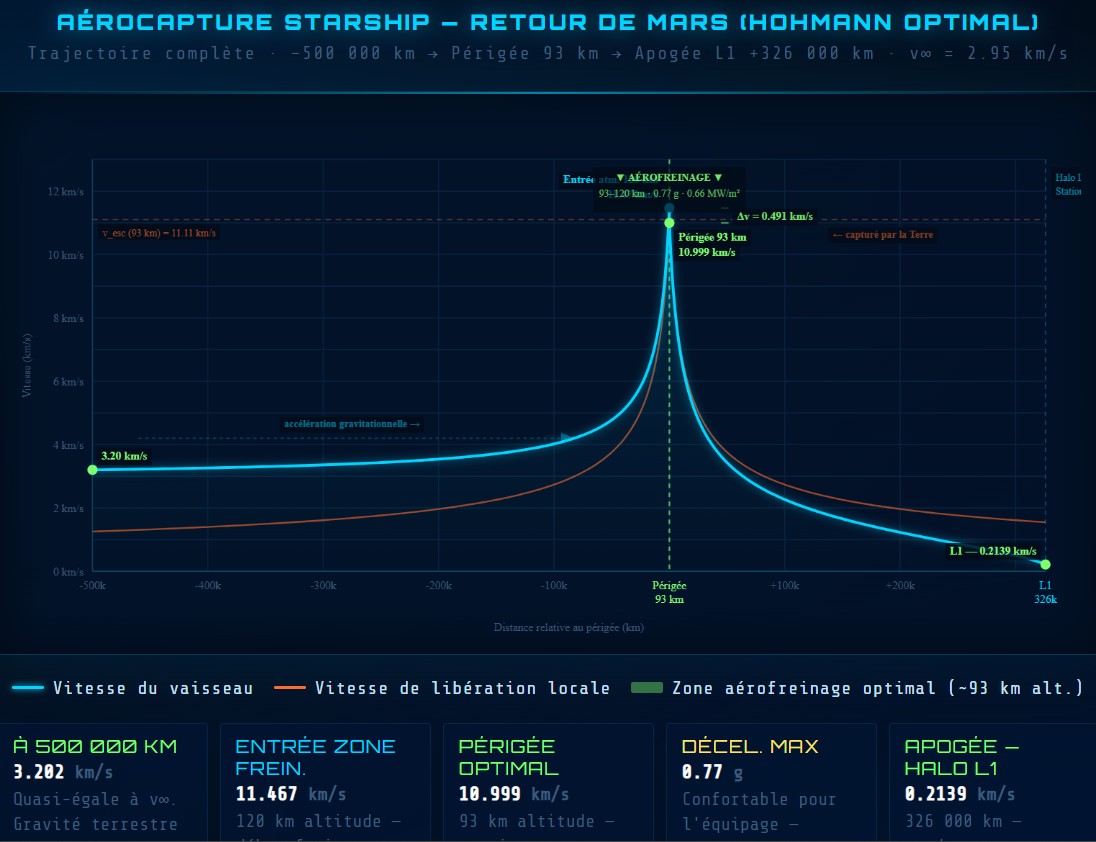
This propulsive effort will be more than compensated by reduced entry velocity into Earth’s atmosphere. This velocity will drop from 12 -13 km/s to 10.999 km/s, significantly reducing the thermal and mechanical stresses of EDL. The marginal ones are the toughest. Indeed, since kinetic energy varies as the square of the speed, a reduction of ~15% in speed reduces the dissipated thermal energy by about 28%, which will very significantly reduce the stresses on the heat shield. The real technical challenge lies in the guidance of the aerocapture: the tolerated atmospheric corridor is narrow (like entering the eye of a needle) with a 3.8° entry angle – requiring a precision comparable to the EDL itself, but one that modern autonomous guidance systems are now capable of achieving.
NB: There is a fourth and last option to join the station orbiting L1 and it is the best one. It would be braking at the distance of L1 and not at the entrance of the Earth atmosphere i.e. before Earth gravity pull the spacecraft into a too high speed. I will develop it in another article to be published soon.
From L1 to Earth:
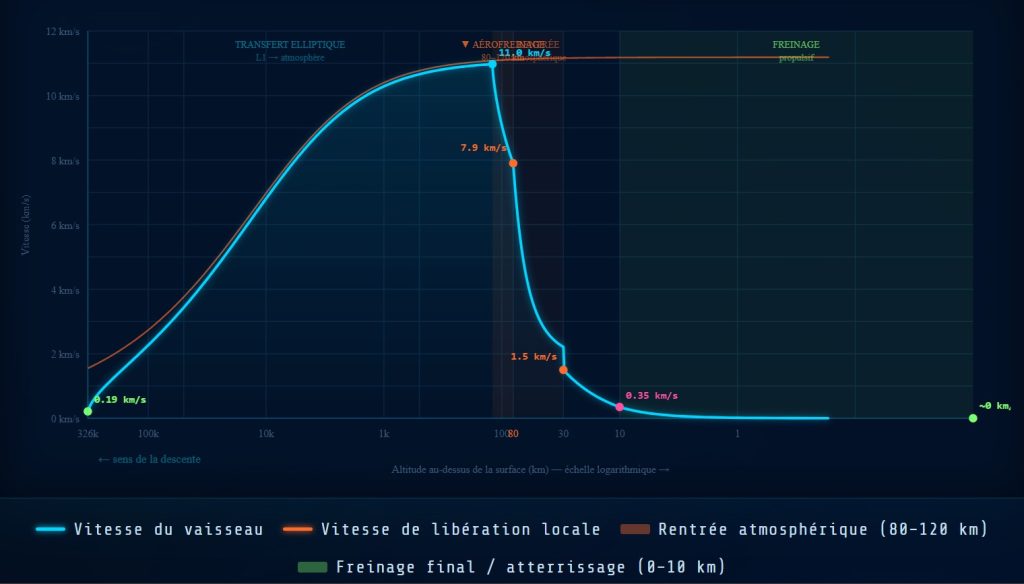
The subsequent re-entry to Earth, which must still be faced after staying in L1, will remain demanding, but at a slightly reduced speed (and therefore reduced friction) of 10.9 km/s, it will be less dangerous. Without aerocapture, canceling the ~3000 m/s relative velocity at 500,000 from Earth by pure propulsive braking would have led to an important use of propellant. Thanks to aerocapture, the residual delta-v required will drop to only 300–500 m/s (adjustments in L1 and docking, which Starship can handle without carrying additional dedicated propellant.
The Stopover: Not Wasted Time
The time spent at the station will be far from a useless extension of the mission.
The station will be made habitable with maximum radiation shielding. This protection will be insufficient against HZE particles from galactic cosmic rays (GCRs), but sufficient against solar protons and the lower-energy components of GCRs. This does not mean astronauts could remain there for months — and none would wish to. But a stay of four weeks would be quite feasible. It would provide ample time for all necessary medical examinations, partial but significant musculoskeletal rehabilitation, recalibration of the vestibular system, and stabilization of bone density (bones respond over weeks, not days).
Meanwhile, it will be possible to scrutinize the ship coming from Mars, and repair what needs to be, or ask for a replacement ship from Earth to come in L1.
The final return to 1g on Earth would thus be far less dangerous than at the end of a direct return from Mars.
Now, let us get to work on this space station! It must be fully operational by 2035 when the first crewed mission departing Earth in 2033 will come back home.
Computations graphs and illustrations were produced with the help of claude.ai
Copyright Pierre Brisson

