Living in the Martian Environment? Methodology of the Approach
On this blog, we have seen the potential long-term dangers of living under low Martian gravity (0.38g). It has been observed that at zero g (ISS), this risk is unacceptable due to the severity of SANS (Spaceflight Associated Neuro-ocular Syndrome), induced by a hydrostatic gradient within the human body that is 100% lower than that on Earth. Does this mean we should give up the idea of physically going to Mars (where the hydrostatic gradient is lower by 62%)? Certainly not. But living there indefinitely is another issue that must be seriously studied before making potentially unrealistic plans.
Testing Living on Mars
The first step is to prepare and conduct an “inhabited” mission to Mars (i.e. with humans on board). We know that when we go, (1) the journey will take at least 6 months (it could be longer but let’s assume this), (2) the stay cannot be less than 18 months because Mars needs to be in a favorable position relative to Earth for the return launch, and (3) the return journey will have to take at least 7.5 months to avoid arriving near Earth at a speed that would make the braking before atmospheric entry unbearable.
This mission could reasonably start in the summer 2033 if a robotic Starship is ready for launch on time for the 2029 window. Indeed, we need to « prepare the ground, » on Mars, and it should take two robotic missions. Preparing the ground means: creating a proper landing zone by ensuring the soil’s stability and leveling it as much as possible, digging a shelter nearby in order to protect the astronauts from radiation, and securing a supply of water ice. A second mission should be planned for 2031 to prepare the habitat for use, deliver a power source (nuclear reactor), set up a telecommunications station (with a relay in geostationary orbit), begin a propellant production using local resources (ISPP), and, of course, bring storage tanks. This second robotic flight should also bring several Optimus humanoid robots for necessary delicate maneuvers, including finalizing various installations (filters for atmospheric CO2 pumps) and connections (from propellant production equipment to the tanks). The inhabited mission itself would therefore be launched in 2033 with a crew large enough to operate the various systems but also as small as possible to minimize risks. Ideally, there should be six people, including four medical doctors. Indeed, the goal is to determine as quickly as possible the actual consequences of a stay on Mars for the human body and what solutions should be considered for living there and potentially for surviving several 26-month synodic cycles. Engineers and technicians are also needed to ensure that the various pieces of equipment necessary for life on Mars and for the return to Earth do function as they should.
To be clear, the goal of this first inhabited mission cannot be to prepare for the construction of a city on Mars, but rather to determine whether human life on Mars can be seriously considered beyond an 18-month stay of a small number of people (the maximum number corresponding to the passengers that can be taken on board a Starship and returned to Earth). Indeed, there is no point in investing further in the prospect of a settlement in case living proves impossible. And at this stage, no Martian « city » can be seriously considered (like Elon Musk’s one million people colony).
A New Space Station at L1 of the Earth-Moon System
As discussed in other articles on this blog, developing a rotating space station that recreates a pseudo-gravity of 0.5 g, producing its components, assembling them, and placing this station around the L1 Lagrange point of the Earth-Moon system would be a logical step after exploiting the ISS, which is nearing the end of its operational life. This new station would offer the following advantages: (1) being located above the Van Allen Belts (a should be below or above them to avoid excessive radiation exposure, and it would be more stable above); (2) allowing rapid and relatively easy access to both Earth and the Moon; (3) enabling teleoperated actions on the Moon without significant time latency; (4) being possibly used for a stopover on the way back from Mars or even the Moon, to check and repair the spacecraft and allow astronauts to « recover » in a higher gravity than on the Moon or Mars (and at a distance from Earth-based medical personnel, enabling interventions without significant time lag) in order to be in a capacity to face the challenges of Earth’s Entry Descent Landing (EDL); (5) last but not least, to prepare for the next phase of the first inhabited mission, testing the effect of 0.5g gravity on the body’s internal fluids, their circulation, and the adapting capacity of the heart muscle.
A space station rotating in Martian Orbit
After setting up the above rotating space station close to Earth, we can begin building another one in orbit around Mars. It is highly likely that a long stay (18 or 44 months) in low gravity (the Martian 0.38g) will not be « healthy. » A one-month stay in a rotating space station providing adequate gravity, properly wrapped up in regolith (approximately 3 meters) to shield the inside against radiation, will very likely be necessary for human residents on Mars to recover their physical fitness, for women to give birth and for children to spend the first years of their lives (until the end of adolescence) in near-terrestrial physiological conditions.
The problem is determining the required number of « gs » (1g representing the intensity of gravity on Earth) for this station. It will be necessary to consider the g number required for the proper functioning of human fluids and the heart to prevent SANS syndrome, while also limiting as much as possible the difference with the 0.38g required on Mars (because it will be necessary to go back and forth between the ground and the station and avoid too long or difficult periods of readaptation to the environment). Thanks to the new station orbiting the Earth-Moon L1 system (see above), we will know if 0.5g is sufficient, but it may be necessary to choose a higher number. 0.7g would be ideal because the weights carried by the human body would not be too heavy. This would allow for the use of AstroRad protection (22 to 27 kg for the vest + 1 kg for the hat). We can’t say anything definitive today since the scientific study on the gradation of the g effects hasn’t been done!
From an engineering point of view, the constraints are known. A number below 1g would prevent to have to build rapidly a space station too large. The lower the required gravity, the smaller the station’s diameter will be, the more resistant it will be to mechanical stresses, and the easier it will be to build. A choice must be made between the diameter and the number of rotations, without approaching too closely the minimum for the diameter and the maximum for the rotation number. We have to avoid an excessively high head-to-toe gradient or an overly disorienting Coriolis force. Of course, a « Stanford Torus » like the one in « 2001: A Space Odyssey » (diameter 1.8 km; circumference 5.6 km; torus diameter 130 meters; rotation 1 revolution per minute; gravity 1g) would be more pleasant and easy to live in, but the mass is enormous (10 million tons). It is therefore completely unrealistic to consider building it now. Since we will have gained experience with the new rotating station in L1, we can replicate it in Martian orbit. It is possible to somewhat accelerate the rotation (for example from 2.73 rpm to 3 rpm) or to build it with a larger diameter (70 m instead of 60) so as to bring up internal gravity in the torus up to 0.7g.
The station could be located in a geostationary orbit above a base on the Martian surface, so as to maintain constant contact with the people who will have landed there for a short period of time or the robots that will operate it. It could also be made up of modules (initially built on Earth) assembled on site. Note: assembly at this location would be no more difficult than at L1 of the Earth-Moon system. The only (significant) constraint would be the requirement to launch within the proper windows from Earth, which only open every 26 months. The material needed for the radiation shield could come from Phobos or Deimos (very low energy consumption).
The day after tomorrow
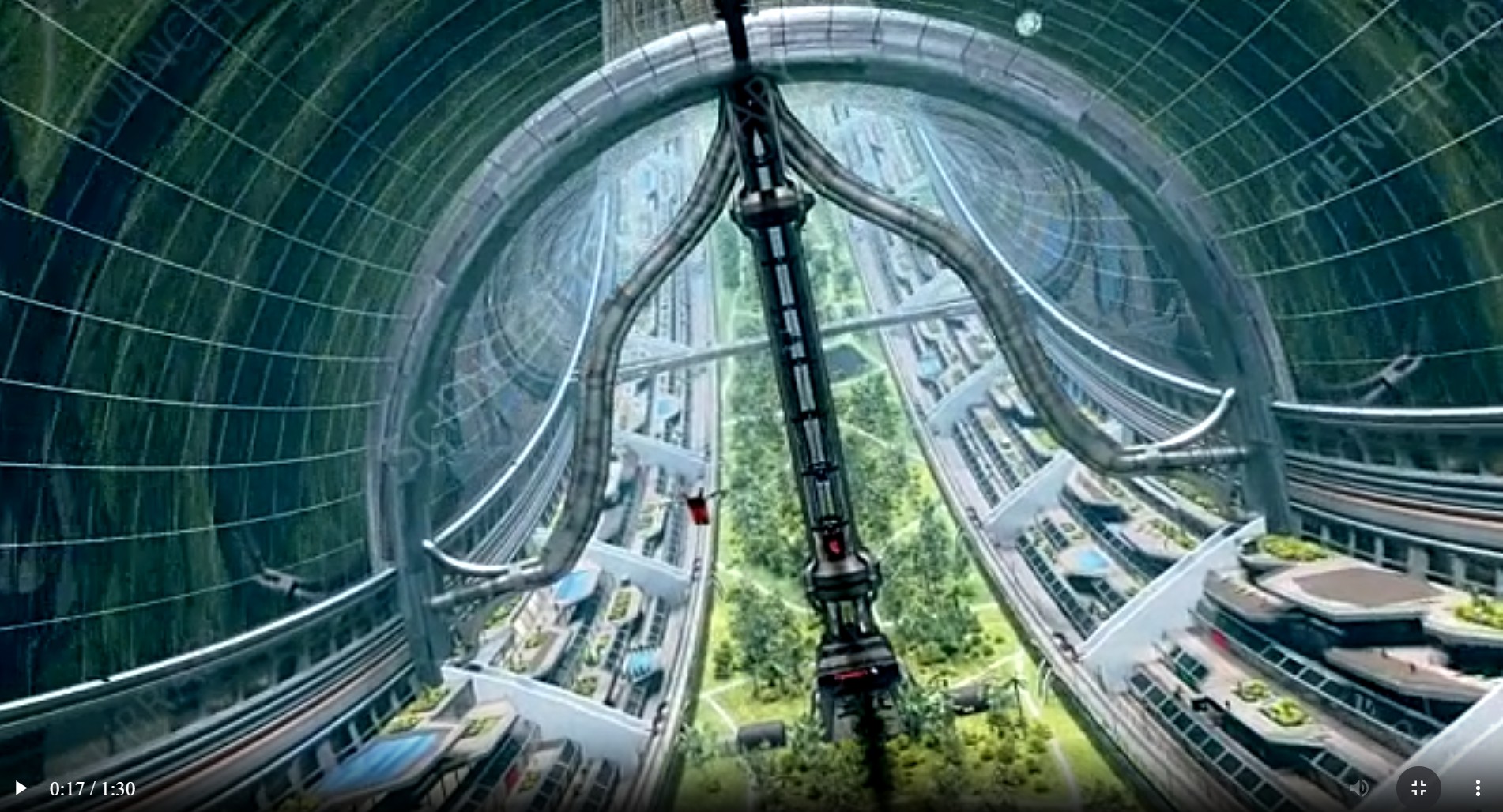
This first station would be a first step towards larger stations that would become the residence of a large population. According to studies on the subject, 10,000 people could live in a Stanford Torus. After the Stanford Torus, a « World Ship » could be built, which would be made of four Stanford Torus stacked one on top of the other. For the future, we can dream of a pair of « Island 3 » cylinders (Gerard O’Neill). But given the dimensions of the cylinders: 3.2 km in diameter, 32 km long, 10 billion tons (NB: Deimos is only 15 x 12 x 10.4 km in diameter, but it is slightly more massive since it is « solid »: 1.4815 kg), it’s not for tomorrow!
Mars will be a place where we can stay and work (industrial zone or field of exploration, study, or recreation), but where we cannot live indefinitely. This aligns with the vision expressed by Jeff Bezos for colonizing space, on May 9, 2019, at a conference on his Blue Moon Lunar lander. At the same time, we depart from Elon Musk project.
Links:
https://en.wikipedia.org/wiki/Stanford_torus
https://en.wikipedia.org/wiki/O%27Neill_cylinder
Copyright Pierre Brisson

