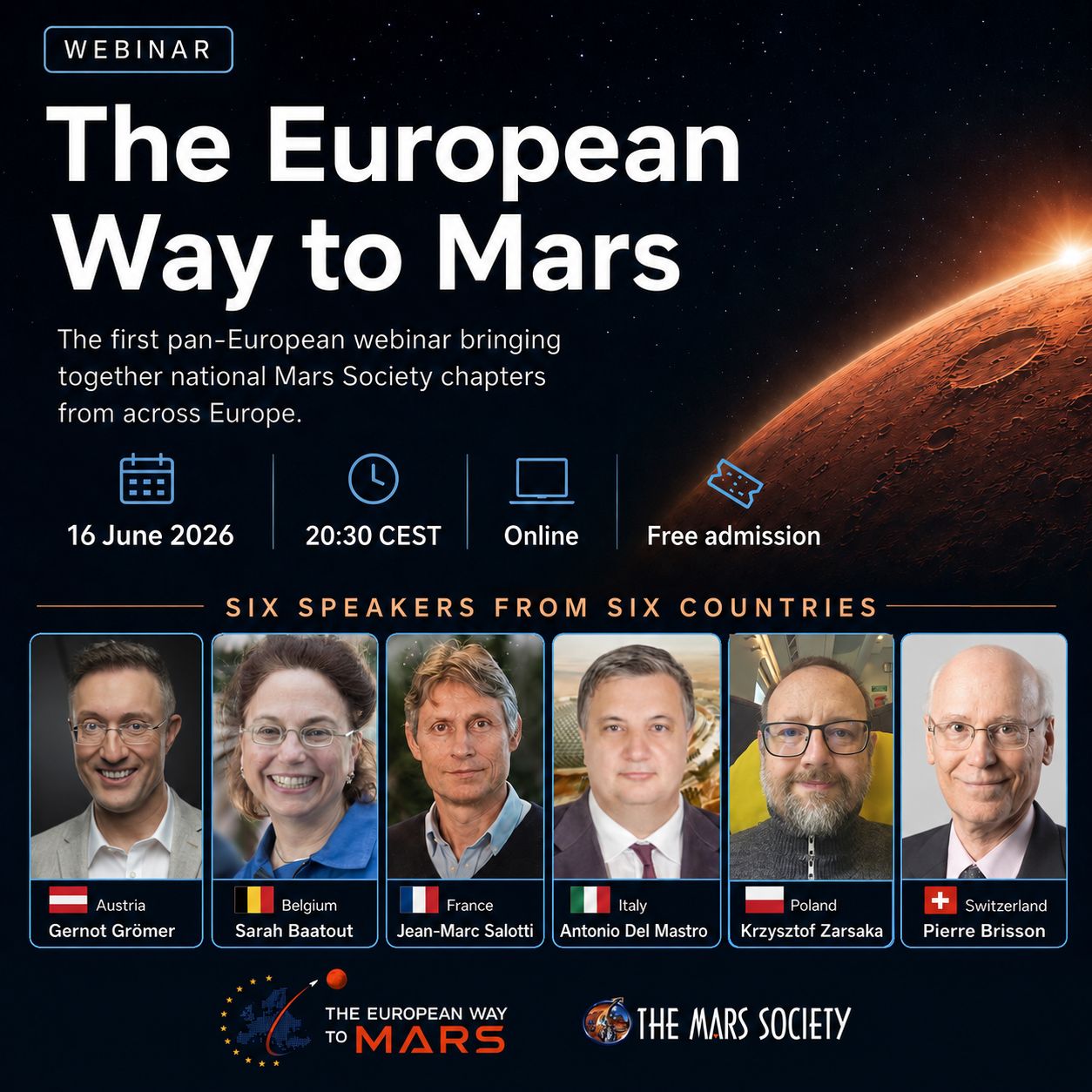
The European Way to Mars
This week I just want to draw your attention to a webinar (in English) that will take place on June 16th, and which will bring together, for the first time, the European associations that are members of the international Mars Societies “family”.
As you will see, « many paths lead to Mars. » Each European association within the family has its own vision and cultivates it independently. This freedom is a considerable strength because each one can exist without the others, yet each benefits from the others. But what is most important in the current time, when the Martian objective is not (yet) recognized by everyone in the Society, particularly in Europe where reservations about inhabited deep-space flights are still very strong, is to share the same goal: establishing another branch of Mankind on Mars. The importance felt by each of our members for this objective brings our paths together.
program to be presented:
Analog Mars Simulations as a Gateway to Mission Success, by Gernot Grömer, Austria
Space Medicine and Cosmic Radiation: Understanding Risks and Enabling Human Space Exploration, by Sarah Baatout, Belgium
Comparison of Propulsion Systems for Mars Missions, by Jean-Marc Salotti, France
Mars and the European Industry, by Antonio Del Mastro, Italy
Production of Oxygen and Hydrocarbons on Mars via Plasma Conversion of CO₂, by Krzysztof Zarsaka, Poland
Approach Methodology for a Permanent Human Presence on Mars, by Pierre Brisson, Switzerland.
Book your seat now after clicking on this link:
Note: My topic is based on the questioning I have regarding the long-term viability of a gravity of 0.38g rather than the 1g gravity in which we were born and in which we perpetuate ourselves generation after generation by giving birth.
I am not giving up the project of establishing a human colony « on » Mars, but I think we must consider an alternative to living on the surface in case experience demonstrates that long-term human life is not compatible with this low gravity.
This alternative would be to live, as many of us as possible, in a ring of rotating space stations that would provide the gravity we need. The stations, placed in geostationary orbit around Mars, would become progressively larger, up to the size of Stanford Torus. Since we would then be living « off » Mars through robotic ground stations exploiting its resources, remotely operated from our stations…and since we could descend onto the planet from time to time, we would still be true Earthlings but we would also have become true Martians.
title illustration: announcement of the Webinar

