Strategy and Working Conditions on the Moons of Mars Toward Settling in Its Planetary System
I. Why the Moons of Mars, Rather Than the Surface of the Planet
The Starting Point: A Fundamental Uncertainty
We do not know whether a gravity of 0.38g (the surface gravity of Mars) is sufficient for acceptable long-term human health. We do know that 0g (as aboard the ISS) is biologically incompatible with multigenerational habitation. Beyond the bone and muscle degradation that can be countered by load-bearing exercise, weightlessness causes internal disruption of bodily fluids and the development of SANS (Spaceflight Associated Neuro-ocular Syndrome) affecting vision. This phenomenon is extremely difficult to counter, to a degree that appears incompatible with a permanent settlement. Between 0 and 1g, the question of harm caused by sub-Earth gravity remains open, but the likelihood of body tolerance seems high approaching 1g (0.7g?) and low at 0.38g. Until science can answer this question, committing heavy investment to a permanent Mars surface installation would be unreasonable. The planet’s two moons, Phobos and Deimos, offer the means to conduct the experiment that will yield a definitive answer and open a path toward an alternative solution.
Six Arguments for the Moons
Accessibility from Earth. It is the most decisive argument in favor. The 26-month synodic cycle applies to everyone equally, whether based on the moons or on the surface. But from the moons, you would wait for the departure window in an energetically and mechanically more favorable position. The delta-v Earth→Deimos (~3.9 km/s) is lower than the delta-v Terre→ Mars surface (~5,6 km/s descent and landing included). We will therefore need less propellant to return to Earth. Initially, this will be crucial because we won’t be as dependent on local ISPP (In Situ Propellant Production) on the planet (using its water and carbon dioxide). Indeed, at least a supplementary supply could be brought from Earth. Later, the ISPP-produced propellant on the surface of Mars could be regularly transported to Phobos or Deimos by small conveyors. These will be much smaller and less massive, and therefore less energy-intensive and difficult to maneuver, than starships.
Operational Posture: from Phobos (~40 ms latency), the Martian surface can be teleoperated in near-real time. The position is that of a control tower, not a base camp. We would be able to prepare the surface, conduct experiments, and build infrastructure from a reversible position without entering too deeply into the planet gravitational well.
Assembly of Large Structures: the advantage of microgravity is not primarily about not using cranes — inertial mass remains unchanged, as we will see. The advantage is deeper: a structure being assembled does not sag under its own weight. A torus 160 meters in diameter, radial tubes 80 meters long, cannot be assembled on the surface of Mars planet without massive scaffolding. In the vacuum of microgravity, they are assembled segment by segment without gravitational deflection. This is a decisive advantage not only for building the rotating station anchored on Deimos but also for all the other free rotating stations to follow, that are the long-term objective.
No Meteorological Disturbance: no dust storms, no wind. Mechanisms remain unobstructed, and whatever is placed somewhere stays exactly where it was put.
Freedom to Choose Gravity Level: on Mars, the 0.38g gravity is inescapable around the clock. But once the Deimos-II torus is operational, the crew will live at 0.7g — a level chosen for its strong likelihood of being sufficient to protect the body on the long-term, without requiring an oversized station.
Deimos-II as a Transitional Step: anchoring a massive rotating structure in regolith subjected to intense thermal cycling generates permanent and increasing mechanical stresses — bearings, junctions, tripod anchors in a ground that expands and contracts. The structural service life of Deimos-II is estimated to last from 15 to 20 years. This is sufficient for entering the process of inhabiting free stations in space, if the sequence is initiated without delay. This means that during this time we will have to undertake the construction of the next one, the first station in areostationary orbit, free of any anchoring constraints and mechanically sound over the long term. Deimos-II is a school, not a permanent home.
The Resulting Roadmap
Step 0 — Rotating station with an 80-meter radius at the Earth-Moon L1 Lagrange point: learning to assemble and inhabit a torus in cislunar space before committing resources to the Martian system. This station will replace ISS.
Step 1 — Phobos Base: base buried in the regolith, radiation-shielded, logistics hub and teleoperation center for the Martian surface, low return cost to Earth — strategically flexible position.
Step 2 — Deimos-II: toric station anchored on Deimos, artificial gravity at 0.7g, first lasting human presence in the Martian system. Service life deliberately limited to 15-20 years by anchoring constraints — a school, not a permanent home.
Step 3 — Areostationary Orbit Stations: free of anchoring, mechanically sound, progressively built from Martian materials produced on-site, permanently suspended above a Martian territory they control and exploit. The true horizon.
II Dust
Nature of the Regolith
Extremely fine powder (a few microns to a few hundred microns), ~30% porosity, nearly cohesionless, electrostatically charged by UV radiation and solar particles. In microgravity, nothing falls back in the terrestrial sense: a particle launched at 1 cm/s takes over 30 seconds to fall one meter on Phobos. Raised dust clouds persist, migrate, and contaminate everything — optics, seals, connectors, visors.
Sources of Disturbance
Landings and takeoffs (ejecta projected over kilometers — remote landing zones with mandatory deflectors required), robot and human movement (continuous, diffuse contamination), mechanical operations (vibrations propagated through the ground raising dust at a distance).
The Elevated Walkway
The primary solution for transit routes between Phobos Base and the depot in Stickney crater (or other facilities): an elevated walkway supported by paired gantries screwed into the regolith, forming a permanent physical break between the disturbed surface and the transit zone.
Structure from Bottom to Top: 70 cm helical anchor complemented by a flared base plate (inverted mushroom) working in lateral compression in the loose regolith; recovery trough suspended below the rails passively catching any dropped object; mesh grating stretched above the trough, providing a footing surface for operators (the trough itself, sloping toward the ground, is not directly walkable); load-bearing rails on which robots pull themselves; longitudinal safety lines onto which every human operator clips with a self-locking carabiner before stepping onto the walkway.
Dimensions:
| Element | Dimension |
| Buried anchor | 70 cm |
| Flush base plate | 10 cm |
| Ground-to-trough clearance | 30 cm |
| Trough (slope height) | 45 cm |
| Rail | 15 cm |
| Mesh footwalk (width) | ~2,5 m |
| Safety line swan-neck bracket | 30 cm |
| Total gantry height | ~200 cm |
| Rail height above ground | ~100 cm |
| Safety line height | ~135-140 cm |
| Overall width | ~3 to 3.5 m |
| Longitudinal spacing of gantry pairs | 8 to 10 m |
| Transverse span of a gantry pair | 2 to 2.5 m |
The airlock giving access to the buried modules of Phobos Base opens at rail height (~100 cm), with a transition platform allowing operators to clip onto the safety line before opening the outer door. The airlock height is therefore an architectural constraint set by the geometry of the walkway.
Swan-neck bracket and safety line: the swan-neck bracket is a support fixed to the top of the gantry post, laterally offset beyond the rail. It carries the safety line to the side of the walkway rather than above the rail, so that the operator’s carabiner can be clipped without obstructing movement along the rail itself.
Longitudinal tie between gantry pairs: a bar or tension cable links successive gantry pairs along the full length of the walkway. This tie prevents an individual post from being pulled out by an eccentric load — particularly during transport of a heavy item whose inertia, if poorly controlled, could exert a lateral pull on a single gantry.
Materials: rails and mesh footwalk in titanium alloy (mesh in braided titanium, to withstand intensive use over 15 to 20 years); nets, safety lines, and trough in Dyneema/Spectra — the same supply chain as the artificial-gravity tether used in interplanetary transit.
Protection of Fixed Equipment: mechanically actuated covers for optics and connectors; two-stage dedusting airlock (active electrostatic discharge first, then mechanical suction — the order is imperative).
III. The Inertia of Mass
The Fundamental Paradox
A 2-ton object weighs only ~11 N on Phobos, but its inertial mass remains exactly 2 tons. Microgravity makes it easy to set things in motion but does nothing to help control that motion. It is control that matters in construction and assembly work.
The Three Dangerous Situations
The departing mass — a heavy object receives an unintended impulse and drifts with no friction to stop it. The arriving mass — a 500 kg module at 0.1 m/s carries 2,500 joules of kinetic energy, invisible to the naked eye without a fixed reference. The reaction on the operator — any force exerted on a mass is fully returned to whoever exerts it if they are not anchored.
Management Principles
Any mass over 50 kg must be on a rail, guided cable, or controlled winch — never in free motion. Speeds must remain below 0.02-0.03 m/s for assembly operations, measured by instrument and not estimated by eye. Stopping systems (viscous-fluid dampers, progressive bump stops) must absorb kinetic energy at the maximum rated speed with a safety factor of 3. Human operators must never physically interpose themselves — an operational culture rule as much as a technical one, unlearning a terrestrial reflex that is dangerous here.
Specific Equipment
Cable winches with integrated braking and speed control on the walkway gantries; progressive bump stops at the end of every rail; soft-capture systems for modules arriving from space (modeled on the ISS Canadarm); Optimus robots reprogrammed in active damper mode with real-time measurement of received force.
The Case of Deimos-II Torus Assembly
Segments of 15 to 25 tons must be decelerated to near-zero velocity relative to the structure in progress, guided over the final meters with millimetric precision (residual speed below 0.005 m/s), and immobilized during bolting despite the vibrations generated by the operations themselves. Each bolting operation generates a reaction torque that the executing robot must absorb through its anchor — otherwise it is the robot that rotates around the bolt.
IV. Material and Joint Wear
A System of Cross-Aggression
These stresses are not independent — they combine and amplify one another. A material weakened by thermal cycling resists radiation less well. A joint embrittled by electrostatic dust yields more easily under mechanical stress. Wear must be understood as a system, not a checklist.
Thermal Cycles
On Phobos: over 1,100 cycles per year between −40°C and +80°C. In metals, differential thermal expansion between joined materials creates play, then fatigue, then cracks. In polymers (seals, sheaths), loss of elasticity and accelerated cracking — an O-ring rated for 10,000 cycles on Earth can reach that limit in under 10 years. In composites, cumulative micro-delaminations invisible to the naked eye. Responses: materials with close thermal expansion coefficients in all bimetallic assemblies; controlled-clearance joints where differential expansion is unavoidable; design life oversizing by a factor of 3 to 5.
Radiation
Effects on electronics: total accumulated dose progressively degrading components; single-event upsets causing instantaneous, catastrophic bit flips in a control system. All external electronics must be shielded and redundant with integrated error correction. Effects on polymers: molecular chain scission by UV and ionizing particles — external Dyneema cables must be sheathed or periodically replaced. Titanium remains the most radiation-resistant metal.
Dust as Abrasive
Electrostatically charged particles a few microns in size depositing on surfaces in relative motion act as a continuous ultra-fine abrasive. The magnetic bearings of Deimos-II, with no direct mechanical contact, eliminate this wear mode — one of their essential advantages.
Joints: Points of Concentrated Stress
Bolts: thermal-cycle fatigue, cyclic variation of preload, progressive loosening — response: systematic self-locking bolts and oversizing of diameter. Seals: the most critical point for human survival — C- or W-profile metal seals preferred over elastomers, or double-lip seals with a monitored interstitial space detecting failure of the first lip before the second gives way. Electrical connectors: hermetic feed-through connectors for permanent links, gold contacts and protective covers for disconnectable connections. Deimos-II rotating interfaces: full redundancy of magnetic bearings mandatory, with mechanical backup bearings in retracted position.
V. Conclusion
Service life of Deimos-II: 15 to 20 Years
This is the central conclusion of this analysis. The tripod anchor in the Deimos regolith — subjected to ~2,900 thermal cycles over ten years, to the vibrations of rotation, to the progressive settlement of the regolith under the anchors — is the irreplaceable foundation of the station. When it reaches end of life, the entire station must be reconceived. The torus modules can be replaced one by one; the radial tubes can be inspected and reinforced; the anchors cannot.
This limit is not a design failure — it is an accepted physical constraint. It is sufficient if the sequence is initiated without delay: during the 15 to 20 years of Deimos-II operation, the time, accumulated experience, and Martian materials needed to build the first areostationary station will be available. Areostationary stations, free of anchoring constraints, have a much longer structural service life — limited essentially by radiation-induced material fatigue and internal rotating system wear, two far more manageable problems.
Next week we will look at natural lighting and thermal cycles at the sites.
Deimos-II is not a final destination. It is the first step that makes all the following ones possible.
copyright Pierre Brisson
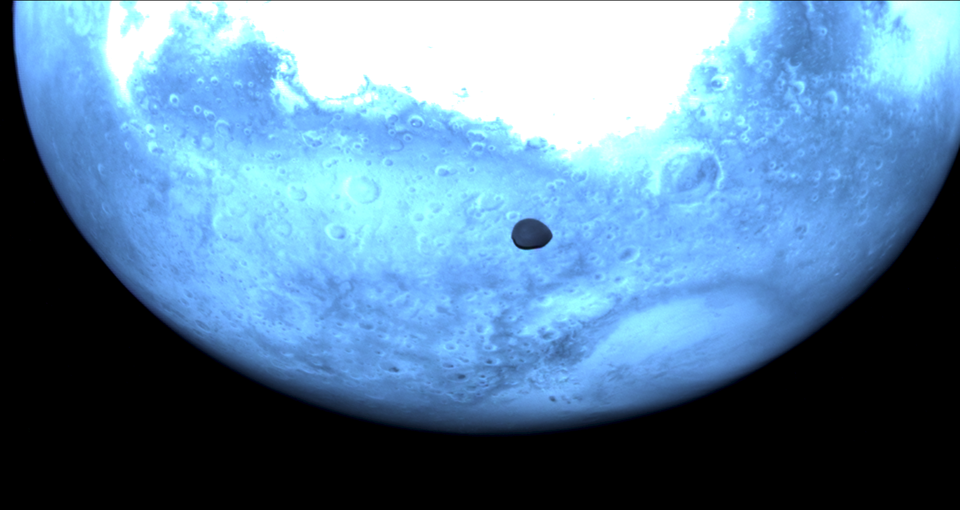
Title illustration: Deimos moon as seen by Hera, ESA space probe on March 12th 2025 on its way toward the Dimorphos asteroid.
Do not forget that the first webinar organized by the European Mars Societies will take place on Tuesday evening June 16th. There will be six presentation (including mine) on various Martian subjects. You still can register to participate. Click on: