Circulation between space rotative stations on the areostationary orbit
In the previous article, we saw what will remain irreplaceable at Deimos after the Eagles (space rotating stations) are put into areostationary orbit, and how transportation between the small moon and the « necklace » of these stations will be organized. Let’s now turn to travelling within the same orbit, i.e. between the Eagles themselves.
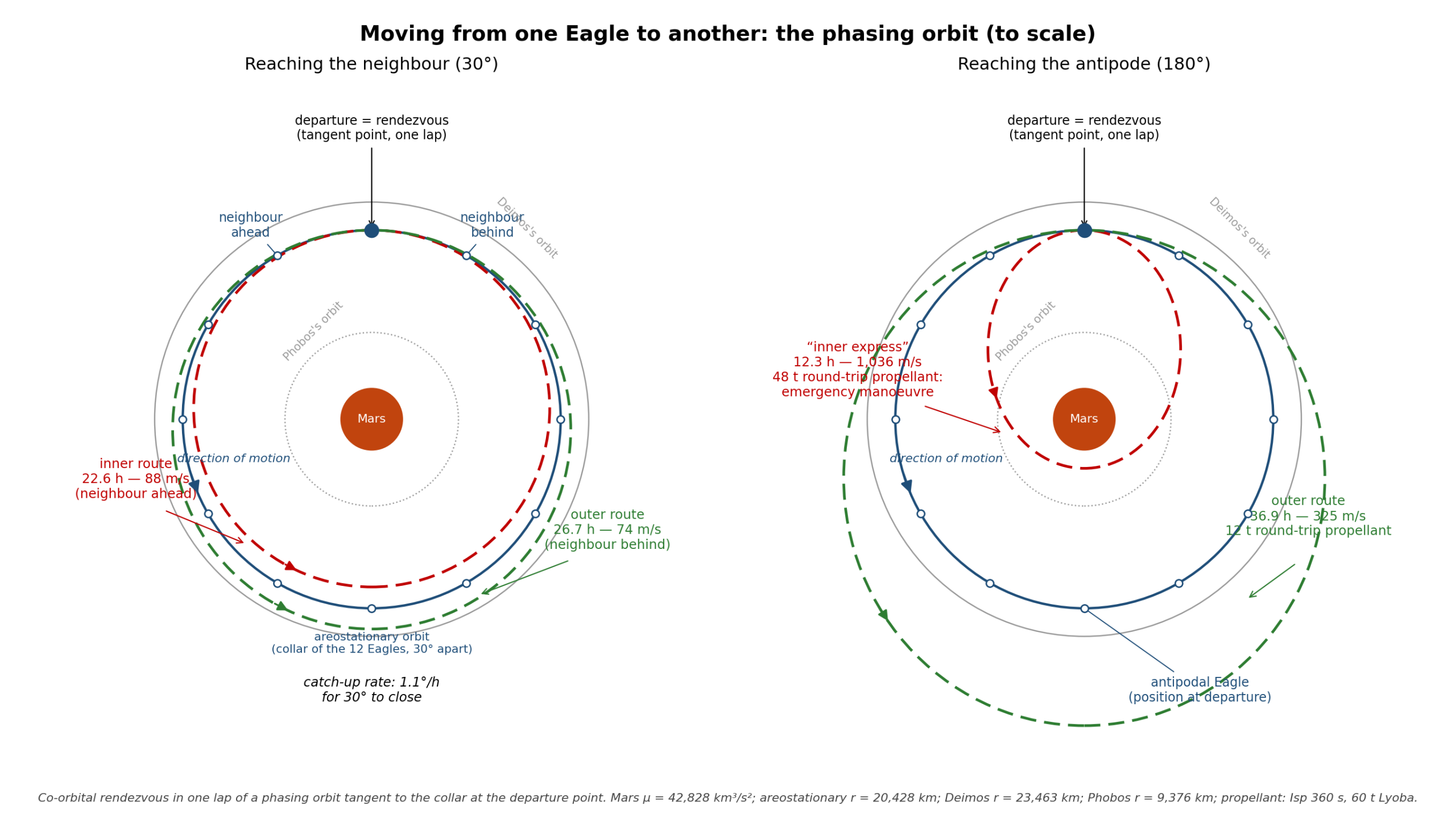
At this level, travel obeys a mechanics entirely different from that of Deimos–Eagle journeys. Two stations sitting on the same circular orbit turn at the same angular speed: they never draw closer to nor farther from one another — the collar of the twelve is a frozen figure. There is therefore neither a departure window nor a synodic period: one can leave at any moment. But neither is there any natural drift to take advantage of: it is up to the traveller to create his own relative motion. The classic manoeuvre is the phasing orbit. To catch up with an Eagle ahead, one descends slightly: the inner orbit, of shorter period, overtakes it from below. To reach an Eagle behind, one climbs: the outer orbit, of longer period, lets the collar catch up with you. In both cases one rejoins the areostationary orbit at the rendezvous point, one lap later. The journey therefore takes roughly one orbital period — about a day, a little less by the inner route, a little more by the outer — whatever the Eagle targeted; only the propellant expense grows with distance.
That the journey should take a full lap even to an Eagle just behind will come as a surprise: is it not enough to climb, go slower, and let oneself be caught up? That is indeed what one does — but the catching-up plays out on the difference between angular speeds, and it is tiny: the neighbour’s phasing ellipse revolves in 26.7 h against 24.62 h for the collar, a gain of barely 1.1° per hour. Now two neighbouring Eagles stand 30° apart — each with its own segment of longitude; closing 30° at 1.1°/h is where the twenty-seven hours come from. Nor can one simply “ease off” and be caught up on the spot: in orbit, braking makes you descend, and descending makes you go faster. The rendezvous, finally, can only be concluded at the single point where the ellipse touches the collar’s orbit, once per lap. One can certainly force the issue with an oblique interception, in the manner of the fast Deimos–Eagle transfers — 12 h of flight for 458 m/s, i.e. 18 t of round-trip propellant instead of 2.6 — but that means paying seven times more to arrive half a day earlier at one’s neighbour’s.
Transfers between Eagles on the areostationary orbit — rendezvous by a phasing orbit closed in one lap (μ Mars = 42,828 km³/s², radius 20,428 km, Isp 360 s):
| Angular separation | Inner route (Eagle ahead): duration — outbound Δv | Outer route (Eagle behind): duration — outbound Δv | Round-trip propellant, 60 t Lyoba (inner / outer) |
| 30° (neighbour) | 22.6 h — 88 m/s | 26.7 h — 74 m/s | 3.1 t / 2.6 t |
| 60° | 20.5 h — 194 m/s | 28.7 h — 138 m/s | 7.0 t / 4.9 t |
| 90° | 18.5 h — 324 m/s | 30.8 h — 194 m/s | 12.1 t / 7.0 t |
| 120° | 16.4 h — 491 m/s | 32.8 h — 243 m/s | 19.3 t / 8.8 t |
| 150° | 14.4 h — 714 m/s | 34.9 h — 286 m/s | 29.9 t / 10.6 t |
| 180° (antipode) | 12.3 h — 1,036 m/s | 36.9 h — 325 m/s | 47.9 t / 12.1 t |
Two lessons. First, the asymmetry between the routes: the inner one is faster but distinctly more expensive — diving into the gravity well to overtake is paid for in cash, and increasingly so as the separation grows. For the antipodal Eagle, the “inner express” closes the trip in 12.3 h, but at the price of 1,036 m/s: the phasing orbit then dives to 5,310 km from the centre of Mars, below Phobos’s orbit and less than 2,000 km from the surface, and the round trip would swallow nearly 48 t of propellant for a 60 t Lyoba — an emergency maneuver, not a mode of transport. The outer route, by contrast, stays gentle: even the antipode costs only 325 m/s and 12 t of round-trip propellant, for 37 h of flight — the phasing orbit then peaks at 33,100 km, beyond Deimos’s orbit. For a distant Eagle ahead, the “wrong-way” outer route (closing 360° minus the separation) becomes competitive again: 360 m/s in 39 h for the Eagle 150° ahead, against 714 m/s in 14.4 h by the inner route. In practice, each traveller will choose between time and propellant; only the deep inner dive will remain reserved for emergencies.
In radiation terms, every traveller will ride under the cabin’s HDPE (High Density Poly-Ethylene) sleeve — about 1.2 mSv per day of flight instead of 1.8 unshielded — and the one-way trip will cost from 1.1 mSv (neighbour, inner route) to 1.8 mSv (antipode, outer route), this last one being the equivalent of two to three Deimos–Eagle round trips under the same sleeve (0.65 mSv). The saving the shielding provides — 0.6 to 1 mSv per outbound leg depending on the route, doses that without it would reach 1.7 to 2.8 mSv — is no luxury on flights lasting up to a day and a half. These visits will therefore remain occasional, which is just as well: they are not meant to be a daily affair. Unhurried freight, for its part, can cut the bill further by spreading the phasing over several laps: reaching the neighbour in two laps (51 h) then costs only 39 m/s, or 1.3 t of round-trip propellant for a 60 t Lyoba; the antipode in three laps (86 h) falls to 138 m/s and about 5 t.
These slow transfers assume, obviously but better stated than left unsaid, that no human being is aboard: freight on the great plateau will be fully automated. This is not a bet on progress yet to come. Automatic rendezvous and docking have been mastered for decades in Earth orbit — Progress vehicles have been docking unmanned since the 1980s, followed by the European ATVs and the Dragon — and the Lyoba is precisely designed as an automatic conveyor, the passenger version being the variant, not the other way round. The plateau is, moreover, about the most favourable ground one could imagine for automation: perfectly known circular orbits, repetitive routes programmed long in advance, neither atmosphere nor weather, and cooperative, instrumented docking targets. Above all, the communication latency between any two points on the plateau is measured in tens of milliseconds: a supervisor, at Deimos or on the destination Eagle, can take over by teleoperation at any moment — the recourse so sorely lacking on interplanetary trajectories exists here permanently. Automating freight on the plateau will therefore be simpler than automating the interplanetary shuttle run, already taken for granted. From there, the maximum durations are not a constraint but an optional saving, costing only time — the one commodity automated freight has in unlimited supply. And should a shipment exceptionally require a human presence (delicate equipment to monitor, plants or live animals en route to an Eagle’s greenhouses), it would fly on a crew trajectory, in a shielded Lyoba, formation-flying with the cargo if need be.
The reader will then ask the following question: if deliveries are automated, why shouldn’t human travel be too? It will be. The precedent already exists: a Crew Dragon flies and docks in a fully autonomous fashion, its astronauts being supervised passengers — the Inspiration4 mission flew with no professional pilot aboard at all; Victor Glover, »pilot » of Artemis-II, was simply « there just in case » — more prosaically, automatic metro trains have carried humans without a driver since Lille’s VAL in 1983; and the plateau is exactly that, a perfectly known track (without uncertainty linked to atmospheric reentry or landing). The real question is not whether professional skill is needed to handle the unexpected — it is — but where it is best placed. In an aircraft, the pilot is on board because the environment is dynamic and no ground-to-cockpit link could substitute for his hands on the controls. On the plateau, the controls are electronic in any case, there is neither weather nor traffic, and a latency of a few tens of milliseconds means a supervisor stationed at Deimos acts on the vehicle exactly as fast as a pilot sitting inside it — without absorbing the dose. Skill will therefore be present on every flight, but remotely: a single supervision centre at Deimos, permanently staffed, watching over all the plateau’s flights at once — a pooling of resources far more economical than a corps of pilots spread across twelve Eagles for occasional flights. Loss of contact itself is guarded against by redundant relays (Phobos, the other Eagles) and by an autonomous fallback mode: a vehicle that loses all contact completes its transfer alone or places itself in a safe holding orbit. What does genuinely require a human presence is the unexpected inside the cabin — a medical incident, solar-flare procedures, children aboard. But that is a cabin-crew role, not a piloting one: every crewed flight will carry one or two crew members of a new kind, augmented commercial cabin crew — a sort of cabin chief, trained in the plateau’s emergency procedures (depressurisation, sheltering, liaison with supervision, first aid) — the only “crew” aboard a vehicle that will never need to be piloted. The distinction between cargo and passenger Lyobas will therefore never turn on the presence of a pilot: it lies in the sleeve, the speed, and the priority given to supervision.
Distant visits and the journey to Deimos — comparison for a 60 t Lyoba (outer route for distant Eagles, Hohmann for Deimos):
| Destination | Outbound Δv | Flight duration | Round-trip propellant (60 t Lyoba) | Outbound dose (under sleeve) | Wait at departure |
| Deimos (Hohmann) | 97 m/s | 13.7 h | ~3.5 t | ~0.65 mSv | synodic: ~60 h on average |
| Eagle at 150° (outer route) | 286 m/s | 34.9 h | ~10.6 t | ~1.7 mSv | free, at any moment |
| Antipode, 180° (outer route) | 325 m/s | 36.9 h | ~12.1 t | ~1.8 mSv | free, at any moment |
What will a visit to the most distant Eagles cost — the antipode and its two neighbours at 150°? The right yardstick is the journey to Deimos, the benchmark for every trip on the great plateau. On every cost criterion the verdict is unambiguous: more than three times the Δv (325 m/s against 97), nearly three and a half times the propellant (12 t against 3.5), and nearly three times the dose, sleeve included (1.8 mSv against 0.65). These distant visits will therefore be costly, and consequently rare. But it must be said honestly: in door-to-door time, it is the reverse. Since inter-Eagle departure is free at any moment, the antipode is reached in a guaranteed 37 h; the journey to Deimos, hostage to the 131 h synodic cycle, requires on average 60 h of waiting before 14 h of flight — about 74 h door to door, and up to 130 h in the worst case. The antipode is expensive but immediate; Deimos is cheap but by appointment. The direct distant visit will therefore be reserved for cases where the calendar is pressing; for everything else, meeting at Deimos will prevail — all the more so as it pools the expense: two travellers converging from two antipodal Eagles towards Deimos together consume about 7 t of propellant, against 12 t for the lone visitor who would go halfway round the collar, and the advantage grows still further once the gathering brings together more than two stations. Deimos is the collar’s optimal meeting point precisely because it shares among everyone the cost that a direct visit places on one alone.
The detour via Deimos, finally, will never be worth taking for its own sake. In pure Δv terms, the Eagle A – Deimos – Eagle B route costs admittedly only 2 × 97 m/s = 194 m/s, less than the direct antipode (325 m/s); but one must wait at Deimos for the synodic alignment towards the destination Eagle — 60 h on average — and direct phasing spread over three laps does better anyway (138 m/s), with no wait at all. One will pass through Deimos only if one has business at the depot, the yard, or the supermarket — in which case the stopover will not count as a detour.
Even though radiation exposure can be limited and physical travel is possible, circulation on the areostationary orbit will cost a non-negligible amount of energy and, above all, a good deal of time. Exchanges and consultations between Eagles will first take place over the airwaves, and no doubt on an equal footing thereafter by home visits (for specific close-neighbourhood needs) and meetings at Deimos (for supply needs and general business).
After these rather counterintuitive explanations rooted in the laws of astrophysics and astronautics, we shall next week, look at what needs to be planned for docking. Its proper functioning and safety are obviously vital.
Copyright Pierre Brisson.
Illustration: journey time between Deimos and the areostationary stations, created by claude.ai upon request of Pierre Brisson.
xxxx
To find another post in this blog which could be of interest for you, click on:
xxxx
And, if you enjoy this blog, subscribe (it’s free)!

