The Flight of Eagle-One: from Deimos’s Dust to the Areostationary Orbit
The project starts from a simple observation: a station anchored to Deimos’s ground accumulates three mutually reinforcing handicaps. Deimos’s dust — fine, porous, and electrostatically charged — rises at the slightest movement and, in near-zero microgravity, never settles back down: it coats everything, wearing out seals and optics, and can only be contained, never eliminated, as long as the station remains on the ground. Lighting there is intermittent and beyond control: a 30h18 day–night cycle with 15 hours of total darkness, unpredictable eclipses by Mars, and terrain that can create permanent shadow zones with no possibility of reorientation. Thermal tension follows directly: with no atmosphere, an anchored structure simultaneously presents sunlit and shadowed faces, fatiguing seals and wiring. Together, these constraints bound an anchored station’s useful lifespan to 15–20 years, beyond which a generation of free-flying stations becomes economically preferable. The first of these free-flying stations will be Eagle One.
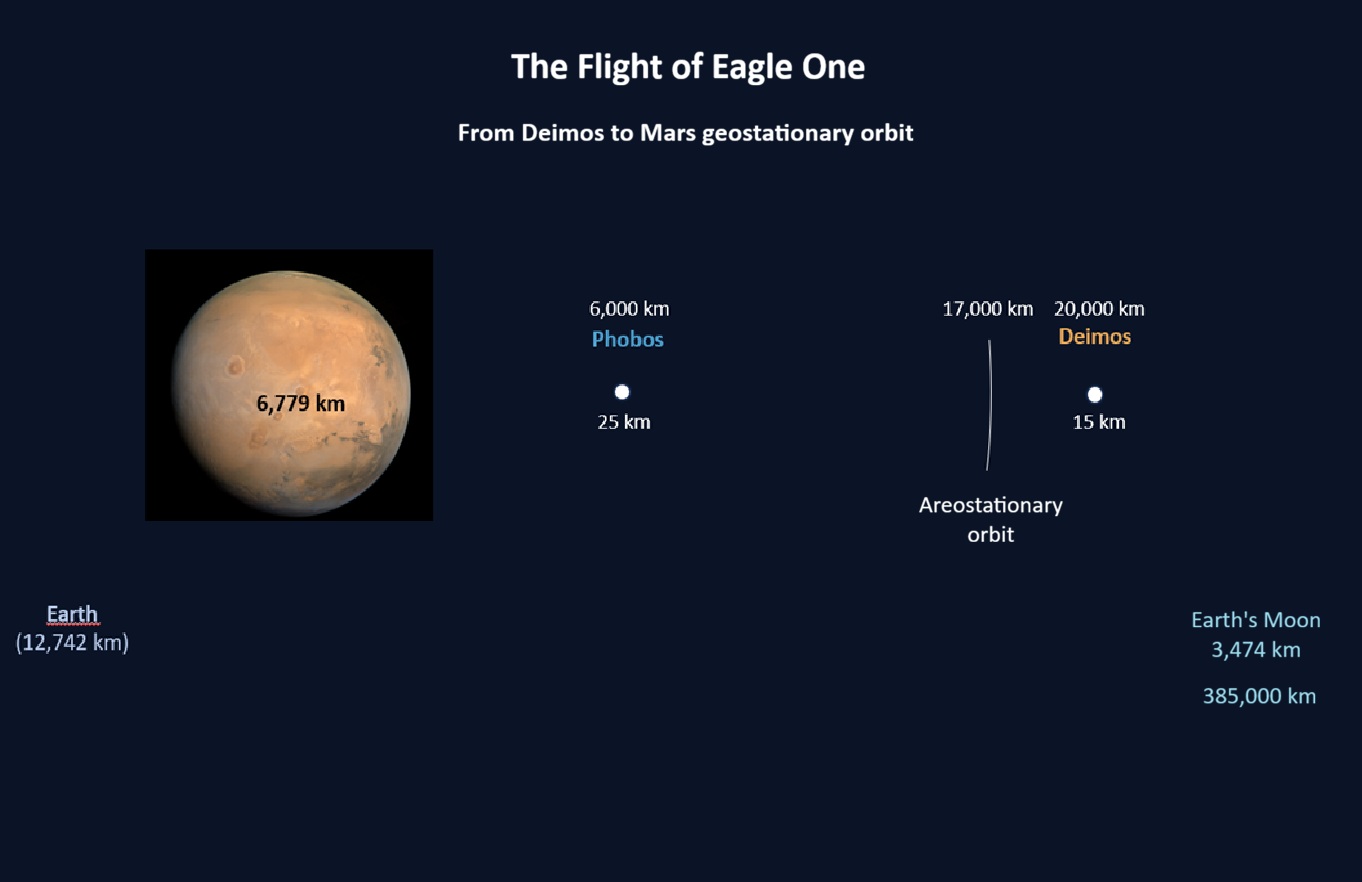
Eagle One’s liberation from Deimos’s ground will follow a precise sequence: separation of the torus from its anchoring, then two transfer maneuvers (departing Deimos’s orbit, circularizing at the areostationary altitude — the Martian equivalent of geostationary — 17,032 km above the surface, between Phobos* and Deimos*), then drifting to the chosen longitude, and only then beginning full rotation (it will never start it before this point, to avoid any precession). The chosen site, above which Eagle One will station itself and from which robotic operations can be conducted at any time by remote control (114 ms round-trip latency), will be the ice sheets of the Medusae Fossae Formation. This site meets the criteria of equatorial location (minimum temperature variation and easier rocket access and ascent), position below the Martian datum (thicker atmosphere and slightly better radiation protection), and the presence of ice — water being essential to life, in an areostationary station as much as anywhere else — confirmed by radar soundings from satellites, notably Mars Express. This ice is buried (otherwise it would sublimate) but should be readily accessible. Various robotic vehicles will handle the extraction.
*Remember that orbit distances to the surface are 6,000 km for Phobos and 20,068 km for Deimos.
Once stabilized, Eagle One will remain subject to modest external perturbations. Phobos and Deimos exert a pull of only about one billionth of a g, the Sun somewhat more through tidal effect — but it is Mars’s own gravitational field irregularity that dominates the correction budget, at an annual cost of about 152 tonnes of propellant using electric propulsion (propellant produced on the Martian surface). On the communications side, each Eagle will cover a cap of about 80° of arc around its site. After Eagle One, three further identical stations will be placed, each separated by 90°. As soon as circumstances allow, the constellation will be expanded to twelve stations. The network of stations will form a complete mesh among themselves. It will be twelve eagles flying in concert, communicating with one another, with the Martian surface, and with Earth, forming a necklace encircling Mars. The link with Earth, never permanent for an isolated Eagle, will be made continuous by the constellation’s redundancy.
Rotation and comfort — a design given, not an open question. The torus rotates at 2.80 rpm at 80 m from the axis to produce 0.7 g. This is not an arbitrary choice: this exact triplet of values (radius, speed, gravity) was chosen precisely because it keeps the head-to-foot gradient at 2.3% and the Coriolis coefficient at 0.13, both under recognized comfort thresholds — a compromise designed from the outset for permanent habitation over years, not a temporary tolerance to monitor. The only point still open on this topic is purely procedural: how to welcome and support new arrivals during their first few days of vestibular adaptation to the cross-coupled Coriolis effect.
Structural architecture — three distinct functions. The torus, made of 10 m modules, rotates inside a fixed, double-walled carbon-fiber shell, whose modules open on hinges to receive regolith bags between the two walls. Three structural systems coexist, each addressing a different geometric problem, without overlap:
The rail, at the torus–shell interface, maintains the 1.80 m gap needed for maintenance — preferred over magnetic bearings, which are insufficient to keep the shell from drifting in rotation (lacking ground to absorb residual torque, unlike Deimos-II).
The struts, six in total, connect the fixed shell to the central hub at an angle — a geometry doubly necessary, both to provide leverage against the shell’s rotational drift and to avoid the disk swept by the four radial tubes. Their sizing targets a safety margin of roughly 5 to 10 against buckling* — a margin not dictated by the propulsion choice (electric alone would require far less), but by independent factors: manufacturing imperfections in a beam of this length, dynamic and transient loads from maneuvers and rotation, cumulative fatigue over decades, and resistance to micrometeorite impacts and assembly handling.
*Buckling: deformation of a structural member caused by excessive compressive load, which may lead to its collapse.
The stays and lattice, together, form the third function: they stiffen the four radial tubes along their length, like the spokes and rim of a bicycle wheel, independently of the two prior systems.
Radiation shielding — the retained configuration. The torus’s main band (270°) carries 2 m of regolith between the shell’s two walls; a 90° band, facing the axis, is closed by a glazed 40 cm potable water tank, which also serves as a lit ceiling along the entire 502 m circumference; the storm shelter and axis modules, including the four radial tubes (transit zones rather than prolonged habitation areas), share a common standard of 40 cm polypropylene + 15 cm water. A minor but real detail adds to this: wastewater, collected at the torus’s outer floor before being routed to several treatment stations distributed around the ring, provides a localized, modest, and intermittent shielding boost on that side of the cross-section — a robustness bonus rather than a calculation variable. The shield’s total mass comes to about 56,200 tonnes, for a total Eagle One mass of about 62,250 tonnes. This mass remains entirely negligible compared to Deimos’s own (1.48 × 10¹⁵ kg), and will have no impact on the moon’s own balance.
The figure of 56,200 tonnes, which may seem surprisingly large, stems from geometry rather than thickness: the regolith mantle, shaped as a partial annulus (270° of the tube’s local cross-section, between 5.05 m and 7.05 m from its axis, just beyond the 1.80 m maintenance gap), is swept around the torus’s full circumference (502.7 m) — a torus-shaped solid rather than a simple slab, accounting alone for about 51,600 tonnes. The remainder — the shell’s carbon-fiber walls, the torus-shell rail, the 90° band, and the radial tubes — adds only 4,600 tonnes more.
Protection philosophy — informing rather than confining. The question of pregnancy initially seemed to call the whole project into question: the terrestrial occupational standard of 5 mSv for an entire pregnancy appeared unreachable through shielding alone. But this standard turned out to be a cautious regulatory choice, not a real danger threshold: deterministic effects have a demonstrated threshold around 100 mSv, and stochastic effects remain statistically modest even at doses well above 5 mSv. A realistic target of 50 mSv for an entire pregnancy preserves the project’s founding goal: no pregnant woman confined, no child restricted, individual informative dosimetric monitoring rather than a segregation-based architecture.
Natural light — a single-component system. The station remains continuously sun-pointed along its rotation axis, like the reference station at the Earth–Moon Lagrange point L1. Sunlight falls directly onto the solar panels. A crown of mirrors — more precisely, a cone with a 45° slope — integrated in the plane of the torus and fixed to the non-rotating part of the station (its hub), intercepts this axial beam and redistributes it radially through 360° toward the glazed ceiling of the torus. No intermediate relay is needed: light travels directly from the Sun to the mirror cone, and from the cone to the torus ceiling. The rotation-maintenance thrusters remain positioned near the torus (beneath the radial tubes); those for station-keeping on the areostationary orbit occupy the opposite, anti-Sun end of the central axis.
Logistics calculations. Annual station-keeping (Δv ∼60 m/s/year) requires about 152 tonnes of propellant using electric propulsion, for an average thrust of ∼118 N and a continuous power of ∼2.64 MW. The Deimos → Eagle transfer (Δv ∼96.6 m/s) would cost about 1,680 tonnes of propellant chemically, versus only ∼245 tonnes electrically spread over six months (thrust ∼381 N, power ∼8.5 MW). The robotic fleet needed to extract and bag the 51,600 tonnes of regolith remains to be precisely costed, but an illustrative estimate puts the need between 2 and 8 units for an 18-month build — a modest number, to be confirmed once actual robot productivity is established.
With Eagle One, humanity will begin a new era: the colonization of another planet. It will not be what Elon Musk once dreamed of — vast cities on the Martian surface and evening strolls under the clarity of the stars. But it will be a life independent of Earth, with production on the ground and a life in the stations that will watch over it from above. Their presence from those heights will be as effective as that of a person on Earth today who, working remotely, directs — without any perceptible time lag — a machine in a factory, or asks a robot to carry a load. Life on Mars will be the continuation of life on Earth, under different skies.
Title illustration: distances and masses.
Copyright text and illustration Pierre Brisson
xxxx
To find another post in this blog which could be of interest for you, click on:
xxxx
And, if you enjoy this blog, subscribe (it’s free)!

