First inhabited Mission to Mars: Gravity implies a Stopover at L1 Before Returning to Earth
When I presented the study that I went through with the help of claude.ai on the subject of an inhabited mission to Mars returning to Earth, I didn’t fully develop the constraints of such mission and their consequences. Today I’m doing so with a very important one, namely “gravity”, because it is important for a better understanding of the necessity of a stopover at an orbital station around the L1 Lagrange point of the Earth-Moon system (« L1 »).
We’ve already seen that the stay at this station is necessary to check the astronauts’ health, to begin reacclimating them to Earth’s gravity, and to potentially treat them for contamination by some possible Martian life forms (planetary protection); to check the condition of the spacecraft and potentially repair it before the ultimate test, i.e. the Entry Descent Landing (EDL) to Earth’s surface. Letting the others apart, I would like today to emphasize the necessity of this stopover due to gravity constraints. These are related to life in weightlessness during the previous months, as well as to the environment in which the astronauts will evolve approaching Earth.
The problem
To stop at L1, the spacecraft will have had to reduce the excessive speed resulting from its departure from Mars. More precisely, it will have slowed by 900 m/s its “speed at infinity” (v∞), which at this distance was 3.2 km/s. Some might think that going from 3.2 km/s to 2.3 km/s doesn’t change much. This is wrong because the spacecraft and the astronauts will be in an extremely tense gravitational situation in several respects.
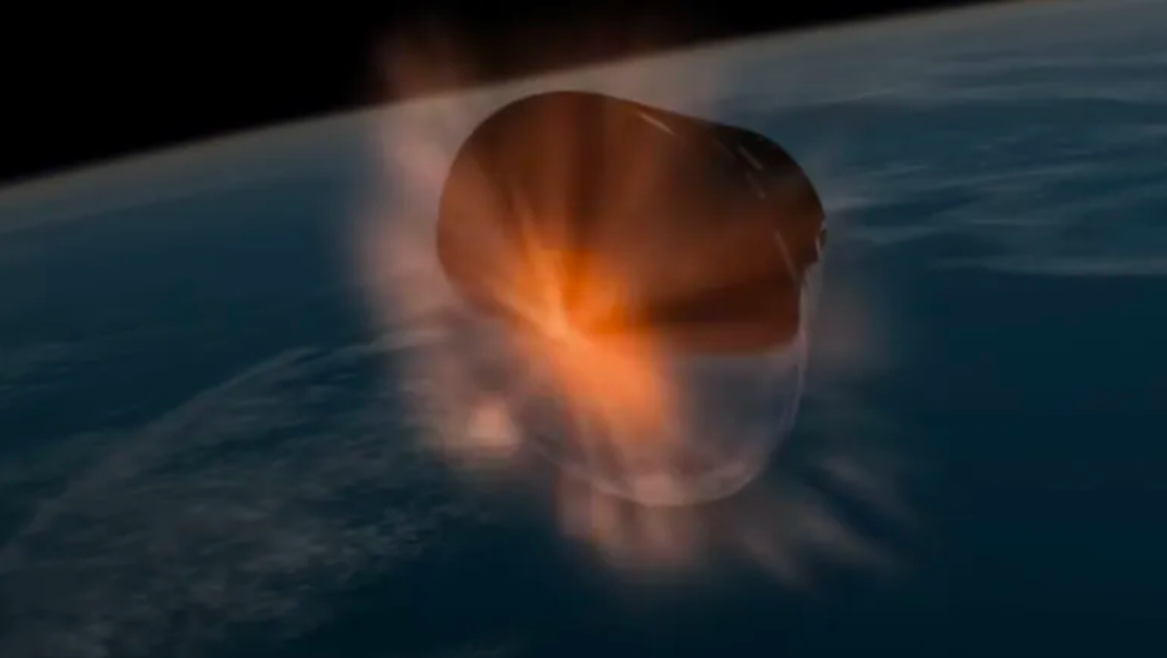
By leaving L1, disregarding the speed acquired to come from Mars (since the spacecraft is making a stopover), the astronauts will find themselves somewhat like the astronauts of Artemis II returning to Earth after orbiting the Moon. And like them and their capsule, the Martian astronauts and their spacecraft will be increasingly pulled by Earth’s gravitational force, reaching very rapidly a speed of 11.2 km/s at the top of the Earth’s atmosphere (strongest pull between 100 and 90 km altitude). For an Orion or Dragon capsule (ballistic coefficient ~350 kg/m²), the peak deceleration will be ~4–5 g for ~4–6 minutes (identical to an Artemis/Apollo lunar reentry). Astronauts who will have lived 18 months in a 0.38 g gravity on Mars and 7.5 months in weightlessness will endure this force with great difficulty (serious risk of orthostatic hypotension due to stress, or fractures). Their tolerance at the distance from L1 upon arrival from Mars would be low, only 2 or 3 g.
This is why a return in less than 7.5 months (versus the ideal Hohmann 8.5 months trajectory) cannot be considered. This is why a spacecraft returning from Mars after a 7.5 months journey must absolutely reduce its velocity at around L1. And this why a spacecraft returning from Mars after such a journey should rather split its braking maneuver into two, in order to spread out the gravitational force endured. However, it is to be noted that this implies a slightly higher propellant consumption, and that, technically, one maneuver is always safer than two.
L1 Hypothesis
If the astronauts stay, as I recommend, in an orbital station rotating around L1 for one month under a gravity of 0.5g, they will acquire an improved tolerance capacity that can be estimated at 3.5–4.5g (which makes a very brief peak at 5g possible). This could be vital before the final ordeal that is entering the Earth atmosphere.
The stop at L1 will also allow the astronauts to change vehicles, that is, to transfer from their Starship to a capsule (likely an Orion or Dragon-type one).
It’s not that a Starship’s return to Earth isn’t possible nor desirable. It will be crucial to get it back on Earth in order to be in a capacity to examine it thoroughly to see how it performed during the mission and to recover it for reuse (the economic context must not be forgotten). Furthermore, this spacecraft will have enabled a round trip in conditions of volume that are incomparable in terms of viability versus a capsule’s, during the many months of the journey. The astronauts will also have benefited from a good radiation protection (storm shelter, and Ethylene HDPE or water shielding), which is impossible to get at the same level in a capsule. Finally, the spacecraft will certainly bring back carefully selected samples of the Martian soil and subsoil (which otherwise would clutter the capsule, where volume is very limited, i.e. 9 m³ in the Orion capsule). Note: since the astronauts on the first Mars mission will likely be a dozen, three capsules will already be required (which by the way, will spread the risks).
This very high g-force, not escapable, for the return to Earth, will always be difficult to endure and dangerous for the astronauts, even from L1. Therefore, this final segment of the journey must absolutely follow the gentlest possible profile since they will be coming from a low gravity area. A light capsule like the Orion/Dragon (with a more favorable ballistic coefficient for a human body and a controlled profile) rather than a heavy and bulky Starship spacecraft allows for greater maneuverability together with a specially adapted internal environment (seats/couch).
Of course, the risk would be greatly reduced if an artificial gravity of a reasonable number of g’s (for example, the Martian’s 0.38g) were generated by the rotation of two habitable masses, after launch from Mars and maintained throughout the journey. Such « artificial gravity » (two rotating spacecrafts linked together by tethers) was theorized as early as 1990 by Robert Zubrin. However, at NASA, SpaceX, and elsewhere, no one looks to be interested in this concept. Therefore, unfortunately, we must consider this first mission without it!
Why not the Moon?
Since we’re talking about an almost lunar distance for this stage, some might say we should rather stop on the Moon than in a L1 station.
They forget that there are two fundamental differences between this celestial body and the space station orbiting at L1: (1) The Moon generates a gravity of 0.16g, which is a very weak preparation for the return to Earth where gravity is 1g, not to mention the prior reentry into Earth’s atmosphere at 4-5g. (2) Despite its low gravity, the Moon, like Earth, is a “gravity-well” that must be entered into and then exited from. This implies additional propellant consumption (and it has to be saved as much as possible since it would have had to be produced on Mars or brought from Earth). It also implies additional mechanical stress for both takeoff and landing. Furthermore, it implies an extra risk during landing (landing a cylinder approximately fifty meters high, with a barycenter about twenty meters above the ground on a surface that may not be well prepared). It’s important to remind the reader that this return trip will be the return trip of the first mission to Mars (2033-2035?), and that we will have performed only a few flights from Earth to the Moon.
This makes inspecting the spacecraft even more important to ensure it has the best possible chance of successfully completing its final Earth Descent Landing (EDL). On the Moon (as well as on Mars), it would be quite difficult to « climb » along the surface of the spacecraft and a gravity of 0.16g wouldn’t prevent falls. These difficulties and risks, with their potential consequences, would exist all the more if there is need for repairing the spacecraft’s nose, towering at about 50 meters above the lunar surface.
xxxx
More than ever considered, a space station in L1 of the Earth-Moon system, orbiting some 340,000 km from Earth and generating a gravity of 0.5g in its torus but enjoying only zero g at its central rotation axis where the Starship will have docked and be safely attached, seems to be an excellent solution for a stopover from Mars before the last leg to Earth.
Copyright Pierre Brisson
Title illustration: Integrity reentering Earth atmosphere. Credit NASA.

