To live on Mars, the weak internal hydrostatic gradient resulting from a 0.38g gravity will be a problem
On this blog, we’ve discussed the problems posed by radiation and gravity during the journey. Today, I’ll address the issue of gravity during a stay on Mars. The reality we must face is that this stay will be possible for one synodic period (18 months on Mars) and perhaps two (44 months on Mars – 18 + 26) but, with current technology, it will likely be impossible for an unlimited duration due to fundamental physiological properties and capacities of the human body. I will, however, offer a glimpse of a solution.
The Problem
Gravity on Mars (generated by the planet’s mass, and therefore unchangeable) is 0.38g, to be compared to 1g on Earth. We will therefore be lighter on Mars. This won’t necessarily be a disadvantage, especially since, apart a spacesuit, radiation protection will be required (an Astrorad vest weighs 22 to 27 kg depending on body size and a hat, 1 kg) and, given the risk of decompression (caused by an asteroid or a malfunction of the life support system), it will always be wise to carry a small oxygen cylinder and a mask.
The real problem is that a person’s terrestrial weight reduction isn’t the only consequence of lower gravity. In fact, the body’s internal pressure gradient is completely unaffected by the load one carries; or more precisely, adding weight to an astronaut doesn’t induce a stronger gravitational effect on their bodily fluids.
At 0.38g, the heart works less, and at the same time, our hydrostatic gradient (an expression of our hydrostatic balance) is reduced by 62% compared to that experienced on Earth. Venous return is therefore slowed down, and the heart muscle gradually atrophies. The result is a « chronic cephalic shift » (poor lymphatic and venous return from the skull to the heart, causing excess fluid in the brain). This physiological disorder is the cause of “SANS” (Spaceflight Associated Neuro-ocular Syndrome). On Mars, it will be less severe than in total weightlessness (0g) as in the ISS, but continuous and potentially cumulative over months or years.
The main aspects of SANS:
(1) Flattening of the posterior pole of the eyeball—the fundus of the eye deforms under pressure; (2) Optic disc edema (papilledema)—swelling of the area where the optic nerve enters the eye; (3) Choroidal folds—abnormal undulations of the deep layers of the retina; (4) Intracranial hypertension — elevated pressure of the cerebrospinal fluid, which compresses the optic nerve within its sheath; (5) Visual disturbances ranging from mild blurring to visual field loss in severe cases.
Note: SANS was only formally identified, and named, in 2017, despite decades of spaceflight. Astronauts had been reporting visual disturbances since the 2000s, but it was systematic OCT (optical coherence tomography) imaging on board the ISS that allowed the objective detection of structural damage.
Before going any further, it must be said that we have no living experience in Martian gravity. We only have experience of living in weightlessness aboard the ISS. We can therefore only deduce the former, knowing that it will be less severe than the second.
Corrective measures
(1) Performing a daily session in a LBNP (Lower Body Negative Pressure) chamber: The chamber creates a negative pressure around the legs, which mechanically draws blood downwards. Studies on the ISS have demonstrated its effectiveness. (2) Wearing graduated compression suits (similar to adapted compression stockings but for the whole body): These provide mechanical compression to the lower limbs to promote venous return, similar to the effect of anti-varicose stockings on Earth. The effect is real but modest. (3) Performing short centrifugation sessions: A compact centrifuge subjects the astronaut to 1g for 30 minutes per day and can theoretically recreate a terrestrial-type hydrostatic gradient. Its practical application is currently being studied. (4) Performing daily physical exercise in an upright position: The muscular contraction of the legs acts as a « pump » on the veins, accelerating venous return, but this is still limited by the low g-force. (5) Using pharmacology: vasoconstrictors or pressure modulators can be considered, but with significant long-term systemic side-effects.
In practice
LBNP
Ideally, LBNP suits should be worn, but their design is not yet known. The chamber (bulky and immobile) remains the only device for creating negative pressure around the legs. Its use can only be occasional during the day.
Compression suits
These are a « second best » option. Research in this area relies on two distinct legacies:
1. The Russian Penguin suits. Developed in the 1970s for the Mir cosmonauts, these are full-body elastic suits that create an axial load across the entire body—simulating slight resistance when standing. They are still worn for several hours a day on the ISS today. They primarily affect postural muscles and the skeleton, with only a side effect (beneficial) on the venous return.
2. Graduated medical compression stockings. These are very well documented in terrestrial medicine (venous insufficiency, prevention of thrombosis in airplanes). They exert decreasing pressure from the ankle to the knee or thigh: typically 30-40 mmHg at the ankle, 15-20 mmHg* at the knee. However, their internal effect is even more limited than that of pressurized suits. Their adaptation to the space environment is conceptually feasible, but calibration for 0.38g remains to be determined.
*The number of mmHg (millimeters of mercury) expresses blood pressure.
Institutions are working on both types of corrective devices:
Colorado University, Boulder / NASA, on a portable LBNP. Researchers are working on lightweight versions of LBNPs that can be integrated into a suit, combining compression of the lower limbs and slight negative pressure around the pelvis. There is not yet any operational prototype.
MIT Media Lab / MIT AeroAstro, on a BioSuit. This is the most advanced program on mechanical counterpressure suits. Dr. Dava Newman (director of MIT Media Lab) has been working on it for two decades. The principle is to replace gas pressurization (current suits inflated like balloons) with mechanical compression of the tissues using shape-memory fibers. For circulation, the benefit is twofold: uniform pressure that can be adjusted according to the body area.
Use
Unfortunately, a suit covering the legs, thighs, and potentially the abdomen with effective graduated compression presents several problems:
(1) Donning: Effective compression (~30-50 mmHg) requires significant effort, especially in a full-body suit. (2) Wearing time: To be effective, it must be worn for most of the day, so it must be comfortable enough. (3) Heat: Compression reduces perspiration and skin thermoregulation. (4) Hygiene: Prolonged daily wear implies the need for frequent washing. (5) Individual calibration: People’s body shapes change over time and compression must be adjusted very precisely for each area. (6) Movements: If too rigid, compression could hinder walking, squatting, and manual labor.
Thermal shape-memory materials (which you put on when warm and that tighten when cool) are a promising prospect for solving the donning problem; this is what the MIT BioSuit is exploring. But the durability of these materials over several years remains an obstacle.
Practically, for a multi-synodic stay (3 to 5 years), a combined solution must be considered: a lightweight compression suit (leggings + socks + abdominal belt type) worn continuously inside the base; 30-minute LBNP sessions 1 to 2 times a day, combined with recumbent cycling; regular ophthalmological monitoring (optical optic disc OCT) as an early marker of SANS; and a short centrifugation per day.
Environment
On Earth, in their « earthly paradise, » humans live with other life forms and feed on them. We know that we will be able to cultivate plants on Mars, but we also know that animals will be subject to the same problems as humans in terms of gravity, and we are not going to make them live inside BioSuits or portable LBNPs. Fish would also have great difficulty living on Mars because the low water density would cause them to lose their sense of up and down. What is left is just a few crustaceans or mussels. But could we live on nothing but that?
Conclusion
It’s clear that under these conditions, we can conceive of a manned mission to Mars for a synodic period or two, but not for a continuous life from birth to death. Furthermore, can we imagine what we would do with children?
Humans are terrestrial animals. They are the product of evolution within the context of planet Earth. It would take an indeterminate amount of time to change their physiological parameters. We know, of course, that evolution can allow this, but we also know that there are no automatic process in this area. Imperfect genetic replication will be necessary to allow for better adaptation, but it is impossible to live as if nothing were amiss while waiting for it to occur.
I conclude that in the controversy between Elon Musk and Jeff Bezos, living on Mars or in a rotating space station as envisioned by Gerard O’Neil after Hermann Oberth, Jeff Bezos’s got the lead. Planets that did not form us within their evolution are not ours. We must recreate our terrestrial environment to live elsewhere.
It is not utterly impossible, though:
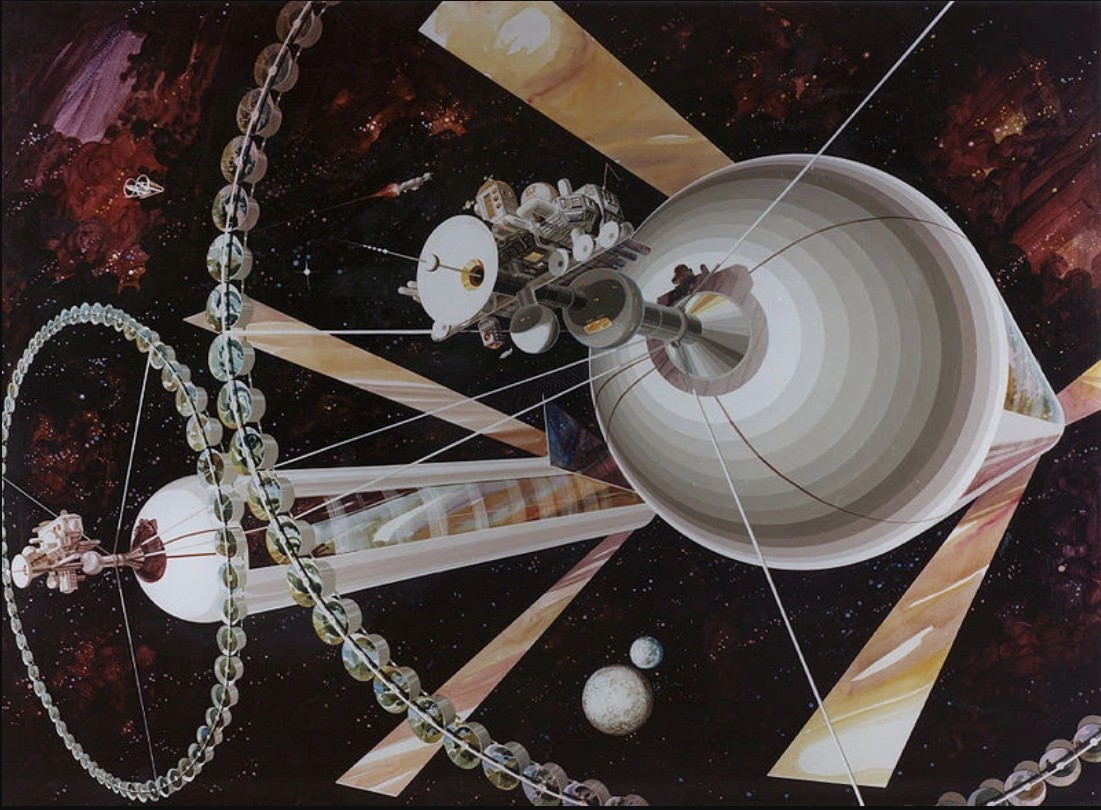
We may imagine a rotating space station, like in ‘2001, a Space Odyssey’, or pairs of Island-3 cylinders rotating in opposite directions, recreating a 1g gravity inside their torus or on the inner wall of their cylinders. They would be positioned in geostationary orbit around the planet. From there, human residents would obtain from the ground, all the materials needed to maintain the station’s structure, and would obtain from the Sun, the energy they need via large panels illuminated all the time. They would operate in real time through remotely operated robots, humanoids and others. The station would be protected from radiation by a thick layer of rock and regolith sent from the planet at L4/L5 using electromagnetic ramps, assembled there and sent to the location of the station. And from time to time, the Islanders would « stretch » their legs by conducting an expedition on the Martian surface (each with their own Geiger counter in their pocket to avoid exceeding their ALARA radiation dose).
Establishing a human presence beyond Earth won’t be easy. We have to admit that that a phase of research, particularly on the long-term consequences of low gravity on our internal fluid circulation, and efficient countermeasures, have to precede any serious attempt at establishing a permanent settlement on Mars.
Copyright Pierre Brisson
Title illustration: Gerard O’Neill Island 3.
Links:
https://www.academie-medecine.fr/modifications-physiologiques-en-microgravite
LBNP : https://link.springer.com/rwe/10.1007/978-3-319-10152-1_138-1

