The Principles of an Earth–Mars–Earth Inhabited Journey
Today, I would like to start presenting, as precisely as possible, the opportunities for inhabited Mars missions. You will see in the coming weeks that a departure in 2033 is the most promising window on our current horizon, and that it has the advantage of aligning well with the stage of development of Starship and with the intermediate lunar priority that Elon Musk has recently set.
Let us begin by considering the trajectory
As you know, the optimal path to travel from one planet to another in terms of energy is a so-called « Hohmann transfer orbit ». It is the best in terms of transported mass, energy expenditure, and mechanical and thermal constraints at departure and arrival. It implies that the spacecraft departs tangentially from the planet being left (Earth or Mars) and arrives tangentially within the gravitational environment of the destination planet. It thus travels half (180°) of the ellipse around the Sun that connects the two planets. This makes use of the planet’s orbital velocity around the Sun, to which the impulse needed to reach the other planet is added. When travelling from Earth to Mars, the departure point is the periapsis (maximum velocity) of the spacecraft’s orbit, and the arrival point is the apoapsis (minimum velocity). The relative velocity of the spacecraft with respect to Mars is then at its lowest, which facilitates its capture — but braking remains necessary, whether propulsive or through aerobraking, in order to enter orbit or land. When travelling from Mars to Earth, the departure point is the apoapsis and the arrival point is the periapsis. Acceleration of speed then represents a significant disadvantage, independently of Earth’s gravitational attraction (i.e. descending into its gravitational well down to the surface).
Between Earth and Mars, the distance to be covered varies because Mars’s orbit is eccentric (distance from the Sun ranging from 206.6 to 249.2 million km), whereas Earth’s orbit is nearly circular (distance from the Sun ranging from 147.1 to 152.1 million km). Furthermore, the distances between the two orbits at the same solar longitude (the line drawn from the Sun to the planet) vary on a 15-year cycle, because the planets travel around the Sun at different speeds (21.975 to 26.503 km/s for Mars, and 29.29 to 30.29 km/s for Earth) and only align at the same solar longitude every 26 months (synodic cycle), but at varying distances depending on the eccentricity of Mars.
A word of caution, however: this does not mean that one simply « jumps » from one planet to the other when they are at their closest — a common misconception. Only light, which has no mass, can travel in a straight line. Between Mars and Earth, it does so in 3 to 22 minutes (but during this transit, both planets continue moving along their orbits: the signal arrives at the position the destination planet occupied at the moment of transmission, not where it is at reception). The trajectory of matter, on its side, is all the more curved by the Sun’s gravitational force as its mass is greater and its energy insufficient to overcome that gravitational force. Given the respective orbital velocities of the celestial bodies, the mass of our spacecraft, the propellant on board, and the velocity they can achieve, it is therefore impossible and inconceivable to head straight from one planet towards the other and reach it when they are at their closest.
Note: Given Mars’s lower orbital velocity, one must depart from Earth before opposition (the moment when both planets share the same solar longitude) and depart from Mars after opposition. The phase angle is approximately 44° for a pure Hohmann ellipse. Looking towards the other end of the trajectory, when one departs, the destination planet is not at all where it will be upon arrival. Its position must be anticipated, since its orbit and its orbital velocity are known.
The duration of the stay on Mars
To depart from Earth with minimum energy and find oneself near Mars’s orbit when Mars is there, it is necessary to wait till the end of the 26-month synodic cycle, as said above. The same applies when on Mars. This period of opportunity is referred to as a « launch window ». The window remains open for approximately one month, and no longer. There is no question of « chasing » the destination planet if it has already passed, or of braking because it has not yet arrived — the orbital velocities of both planets are enormous compared to that of the spacecraft and the spacecraft is not in the same orbit (it either touches it or crosses it). To travel a pure Hohmann transfer trajectory, a heliocentric ΔV of 3.6 km/s is required when departing Earth’s gravitational environment after escaping its gravity well, and a heliocentric ΔV of 2.10 km/s when departing from Mars after escaping its gravity well. No amount of on-board energy would allow any catch-up after trajectory modification if the target planet were not at that point in its orbit at the right moment (except very marginally).
Likewise, it is pointless to attempt to return to Earth immediately after arriving (at the end of an 8-month journey). The return Hohmann transfer window has not yet opened; one must wait 18 months (18 + 8 = 26, the duration of the cycle). If one truly wished to return earlier, he would have to travel across the solar system towards the Sun, to be captured by Venus’s gravity and then redirected towards Earth. However, the gravitational assist from Venus would add so much acceleration that the arrival velocity near Earth would become unmanageable. One must therefore wait those 18 months to be in a favorable position, i.e. at the start of another available Hohmann transfer trajectory (a new window), this time from Mars to Earth.
The inbound journey will then last approximately 8 months (between 236 and 289 Earth days, with an average of 259 days), like the outbound journey.
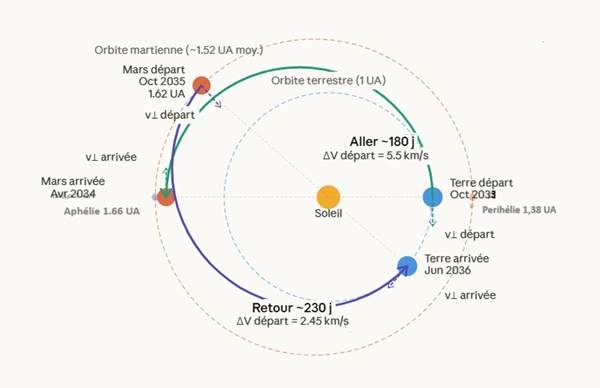
On this illustration I am anticipating the shorter trajectories that I will present next week. The curves geometry is accurate regardless of the trajectory followed (Hohmann or accelerated).
Three key challenges:
(1) Journey duration
Travelling through deep space to reach Mars — the most accessible planet from Earth — takes a long time. This raises human challenges, as astronauts will be far from home, confined in a closed environment with limited resources. It also raises health concerns, as these individuals will be subjected to weightlessness, which is highly detrimental to health — unless, of course, the journey is made with artificial gravity created by rotation- and it also raise a radiation concern.
(2) Radiation
Above all, crew members (as well as certain equipment) will be exposed to radiation — both solar (SEP, Solar Energetic Particles) and galactic (GCR, Galactic Cosmic Rays) — and can only safely (cancer risk!) tolerate limited doses, per the « ALARA » principle (As Low As Reasonably Achievable), both at any given moment and over time. To complicate matters further, not all radiation is equally hazardous, and levels are not constant. To give an order of magnitude (dose without shielding):
| Context: | Approximate dose: |
| Outbound transit (~6 months, near solar maximum) | ~330 mSv |
| Outbound transit (~8.7 months, near solar minimum) | ~470 mSv |
| Stay on Mars, 18 months (thin atmosphere, no magnetic field) | ~340 mSv |
| Stay on Mars, 18 months (near solar maximum) | ~220 mSv |
| Major unprotected SPE (e.g. August 1972 type) | 1,000–10,000 mSv |
| NASA astronaut career limit (3% fatal cancer risk) | ~600–1,200 mSv depending on age |
Ordinary SEPs and ordinary GCRs can be reasonably well shielded against, as they consist of protons (hydrogen atoms stripped of their electron) and we can counter them with protons (water, polyethylene). However, SEPs become increasingly difficult to manage as they grow in intensity (solar storms, Solar Particle Events or « SPEs », which can escalate to Coronal Mass Ejections or « CMEs »), and the HZE component of GCRs (heavy nuclei of ionised atoms) penetrates all shielding, additionally producing gamma rays upon impact — which are highly harmful. GCRs and their HZE component are constant; SEPs follow minima and maxima in line with the solar activity cycle (11 years). SPEs are unpredictable. One can only note that they are more frequent near solar maximum. Solar maximum does, however, offer one advantage: the pressure of the solar wind then reduces (increasingly so as the cycle peaks) the density of GCRs.
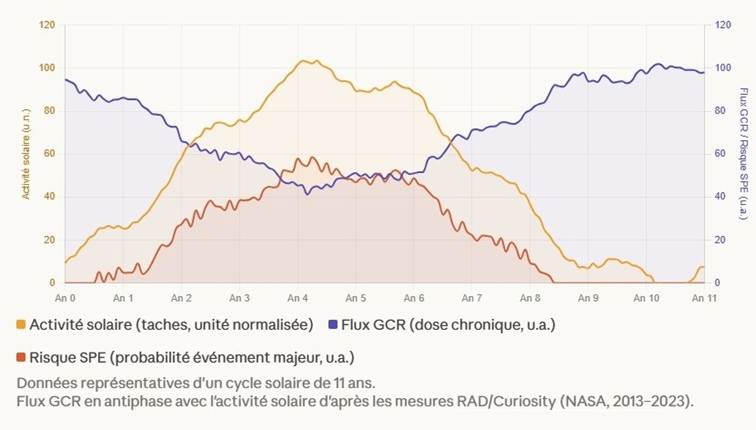
Note: On this graph, the last starting window was in September 22 (year 10). As you can see, the SeP flow was at its minimum and the GCR flow at its maximum.
(3) Propellant requirements
As noted above, when approaching Earth, the spacecraft is at the periapsis of the ellipse to be traveled and when it is there, it is at its maximum velocity. If one wishes to travel faster than the Hohmann velocity in order to shorten the journey — and in particular to reduce radiation exposure — braking will be required, and braking demands energy, hence additional propellant mass.
To put this in perspective:
Following the purest Hohmann velocity for the return to Earth, the Mars–Earth journey would take 259 days. This journey would require approximately 215 tonnes of propellant to achieve a departure heliocentric ΔV of 2.10 km/s, with an Earth entry velocity of 11.3 km/s.
If one wished to shorten the journey to 180 days, approximately 520 tonnes of propellant would be required at Mars departure (for reference, the Starship’s tank capacity is 1,200 tonnes) to achieve a departure heliocentric ΔV of 3.80 km/s — 1.7 km/s more than in the pure Hohmann case. The Earth entry velocity would then be 12.1 km/s.
The difference at arrival, 0.9 km/s, may seem small, but it is well known that the thermal and mechanical pressure on a spacecraft returning at 11.3 km/s is already a major challenge (as seen the stress endured by Starship, at a 7.8 km/s reentry speed at the end of IFT6 or 10). Furthermore, producing propellant via ISRU on Mars using equipment brought from Earth requires considerable time (likely more than one synodic cycle).
Next week
Next week we will examine the solutions — or rather the strategy to adopt: (1) reducing journey duration; (2) choosing the departure dates for outbound and return journeys based on solar activity; (3) during the stay on the planet, making appropriate use of humanoid robots for operations outside the habitat.
NB: The graphs were produced at my request by claude.ai
Copyright Pierre Brisson
If you like this blog, register to be notified of new posts.

