The interplay of mass and gravity makes Deimos the necessary gateway to living on Mars
Gravity is 0.38g on Mars, 0.0005g on Phobos, and 0.0003g on Deimos. It is also because of this weak gravity that Deimos is the only place where the elements of an anchored space station, Deimos-II, can be assembled — a station designed to recreate, through rotation, a minimum gravity (0.7g, as a starting assumption) that allows human beings of any age and physical condition to live in conditions acceptable for their health. It is also on Deimos that the next station, Eagle One, will be built, using almost all the same elements as Deimos-II, before being sent to a chosen site in areostationary orbit (the Martian equivalent of geostationary orbit) and spun up there. This relocation will be carried out at minimal energy cost, despite the mass involved. Once positioned in that orbit, Eagle One will make it possible to work on Mars “as if one were there,” since the round-trip latency will be a mere 0.114 s.
Let’s get into the details, starting with the mass we’re actually talking about.
Like Deimos-II, Eagle One must have a radius of 80 meters and spin at 2.80 revolutions per minute (rpm) to recreate a gravity of 0.7g inside its torus. We stay within this size and rotation speed because we don’t want to spin too fast (Coriolis ratio < 2.5%) and we want to limit the overall size of the structure (head-to-foot gradient < 0.15). Even so, the mass resulting from these constraints will be substantial: roughly 6,000 tonnes for the station itself with its shielding, 52,730 tonnes for the radiation-shielding fill of the outer shell, and 3,520 tonnes for the carbon-fiber shell that contains that shielding — 62,250 tonnes in total. For reference, the largest American aircraft carrier, the Gerald R. Ford, has a mass of 100,000 tonnes. The 6,000-tonne figure is reached despite the bare structural mass of the station alone amounting to only about 200 tonnes. A closer look at the details explains this difference:
What does the structure and its shielding consist of, apart from the torus’s own protection?
The torus modules (6.5 m diameter, 10 m long, ~50 modules over a 502.7 m circumference); the four radial tubes (4 m diameter, ~8 modules of 10 m each, with a 40 cm HDPE layer on the outside, a 20 cm circular water envelope — a “water wall” — on the inside, and a 40 cm ring for cable/fiber runs and pumps); the central-axis elements above and below the hub sphere (storm shelter, cupola, zero-g cylinder, data center, telecom, argon tank, storage, Optimus robot quarters, sanitary facilities, EVA airlock — all in 6 m-diameter cylinders); two 8 m spheres (docking, propulsion), and the hub sphere connecting to the radial tubes and the torus, whose 10 m diameter was set by the need to firmly anchor the bases of the four radial tubes). NB: the station’s total pressurized volume is 23,643 m³ (compared to 932 m³ for the ISS).
Two separate calculations were carried out:
First, the mass of radiation shielding for all the specified elements (HDPE + water) setting the torus apart (more protected as the place where people will mostly live): about 2,920 tonnes, dominated by the radial tubes (~1,978 t).
Second, the mass of the load-bearing metal shell itself, in aluminum-lithium alloy (the material used on the ISS, chosen over carbon fiber, which suits the shielding’s unpressurized enclosure but not pressurized, inhabited spaces), at a thickness of 4-5 mm. This second mass amounts to only 174 to 218 tonnes for the whole station. A telling result: a thin-walled container is inherently light; most of the mass of an inhabited structure comes from elsewhere — reinforcements, floors, partitions, and above all the fixed equipment (life support, electrical systems, furnishings).
Breakdown of the bare shell mass of the serviced modules (aluminum-lithium, 4-5 mm):
| Element | 4 mm | 5 mm |
| Torus (50 modules × 10 m) | 110.2 t | 137.7 t |
| Radial tubes (32 modules × 10 m) | 43.4 t | 54.2 t |
| 8 standard axial cylinders (6×6 m) | 9.8 t | 12.2 t |
| Axial sanitary facilities (2 × 6 m × 2.5 m) | 1.0 t | 1.2 t |
| Storm shelter (6 m × 10 m) | 2.0 t | 2.5 t |
| 2 spheres, 8 m (docking + propulsion) + 1 hub sphere, 10 m | 7.7 t | 9.7 t |
| Total | 174 t | 218 t |
To bridge the gap between bare mass (2920 + 218) and fully equipped mass (6000) without resorting to an arbitrary factor, the total-mass-to-pressurized-volume ratio of several real ISS modules was used as a calibration benchmark (Destiny: 137 kg/m³; Harmony: 204 kg/m³; Nauka: 252 kg/m³; Zvezda: 271 kg/m³; Pirs: 275 kg/m³). Applied to Eagle One’s total pressurized volume (~23,640 m³, including the 10 m hub sphere), this ratio yields a range of 3,200 to 6,440 tonnes depending on the equipment profile chosen. The 6,000-tonne figure falls within the range of the most systems-dense modules (Zvezda, Nauka, Pirs) — consistent with a permanent, multigenerational habitat with self-sufficient life support, as Eagle One will be, far more heavily equipped than a simple laboratory module like Destiny (even though residents’ private quarters will be comparatively sparse).
Left unresolved, as a minor and unquantified contribution, are the support rings for the guy-wires and struts, and the 1.5 m vertical service tube between the two halves of the central axis (that goes through the hub) — probably negligible at this scale.
As we can see, the torus’s radiation shielding — 52,730 tonnes — is by far the largest contributor to the total mass. How can this be explained?
The shielding shell is made of carbon fiber. It wraps around the torus over 270° and is 2 m thick. The radiation-absorbing insulation is Deimos regolith, compacted to 1,800 kg/m³ (versus 1,500 kg/m³ uncompacted). This requires 1,026 tonnes per 10 m module. Since the shielding shell sits 1.80 m away from the torus, its circumference is larger (514 m versus 502 m). It is from this mass and this length that we get the very high figure of 52,730 tonnes. This mass corresponds to the regolith insulation alone; it does not include the mass of the carbon-fiber structure that contains it, 3,520 t — a separate term that accounts for the 58,730 t gap with the 62,250 t total.
Some might think 2 meters of shielding is excessive. They would be wrong. On Mars, life-detection missions — such as the 2 m drilling depth planned for the ExoMars rover — target precisely this depth, because that is roughly the threshold beyond which cosmic radiation stops destroying organic biosignatures. In open space, without the partial protection offered by a planet’s own mass, exposure is even higher: more than these 2 m of shielding would be needed to achieve protection comparable to Earth’s. In fact, despite these two meters, one would still receive a dose considered high by Earth standards (220 mSv per year, versus the 20 mSv annual occupational limit) — yet still acceptable. This is why this mass cannot be dispensed with, and why the idea of settling on Deimos, where regolith is so abundant and gravity so weak, is absolutely unavoidable.
The shielding shell will therefore need to be loaded with this mass before launch. Extracting this quantity of regolith poses no risk to Deimos’s stability, since it represents an extremely small fraction of it (Deimos’s mass: 1,476 billion tonnes). A crew of Optimus robots (about ten of them), calibrated for Deimos’s gravity, will handle the extraction and loading. These robots will be operated by the human crew who brought them down to Deimos from the anchored rotating station Deimos-II. There will be roughly ten years after Deimos-II’s spin-up (and before the station begins to show fatigue) to carry out the operation: delivering the robots, building Eagle One, and releasing it into space. Naturally, the work will begin as early as possible. The teleoperated robots will extract regolith through a tarp that prevents it from dispersing, using an auger turning inside a casing that feeds into a bag, with only the casing’s spout passing through. Each bag will hold 500 kg (they must be portable by the robots, which means their volume must be proportionate and the inertia of their mass not too great). The extraction site will be moved as often as needed. This works out to bags roughly 0.37 × 0.37 m in cross-section and 2 m long, deformable — so they can adapt to the settling caused by spin-up, which can only happen once in place, in areostationary orbit — for a total of about 105,400 bags for the entire shielding shell (~2,050 per 10 m module). Assuming a productivity of 0.5 to 2 t/h per robot, all the bags can be placed in the shell within the 18 months leading up to the end of the synodic period that dictates the return to Earth — a period that will have begun with the delivery of the robots and bags. NB: for loading, the shell’s outer wall will open on a hinge at its lowest point, like a book. For a substantial (and reasonable) safety margin, one could deploy 20 robots instead of 10, or ask the crew to stay an extra 26 months on Deimos in the anchored rotating station (though they might not be too happy about it!).
Next, the new station, Eagle One, must be released from the surface of Deimos. Next week, I will tell you how to do it as well as what could be the best way to build the station.
Deimos is therefore the ideal assembly platform for these rotating stations. If Deimos didn’t exist, we would have had to dream it up. In any case, after a first station, a second will be built, and then another, with standardized modules and a well-rehearsed routine, always using Deimos’s regolith. Earthlings wishing to come work on Mars — whether to extract and refine rare raw materials (such as the “rare earths” currently controlled by China) or for science (we are far from done studying Mars) — will be able to come without difficulty and stay in a station in areostationary orbit. Most will remain only 18 months (including a few surface excursions by light shuttle). Others will stay longer, because they will have found that they like it there, and/or because they will have met a soulmate — in that station, in another, or on the surface of Mars.
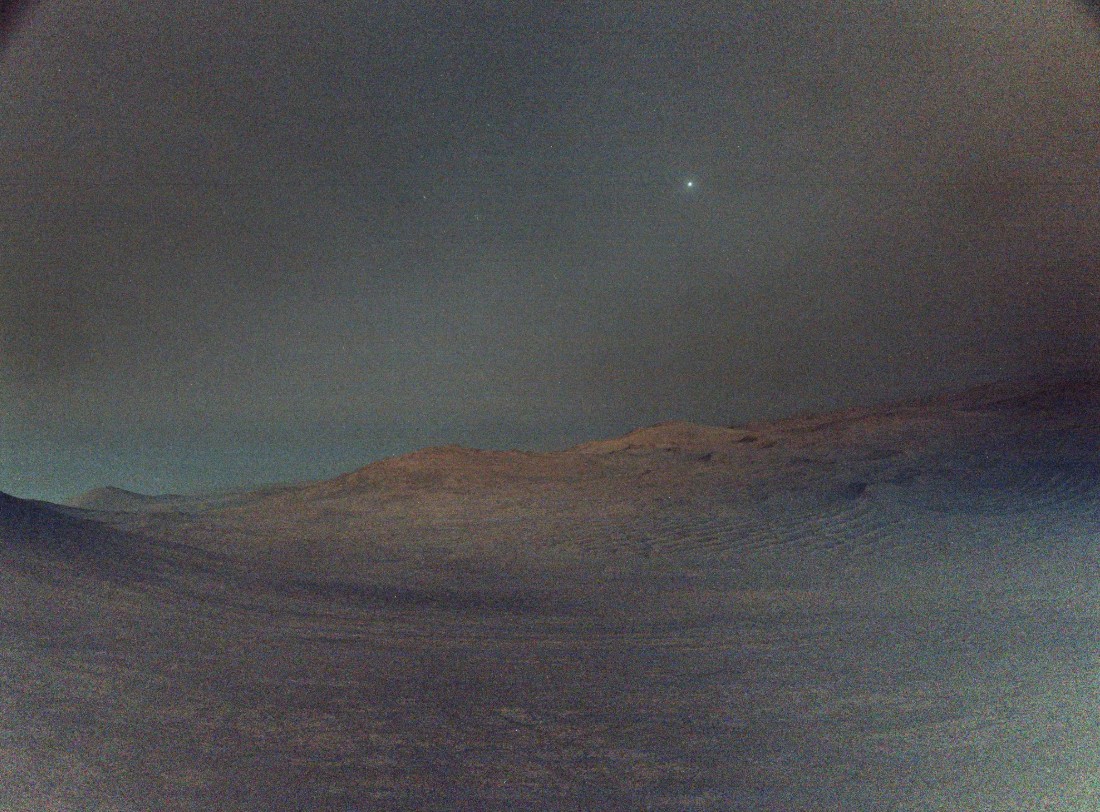
Title illustration: Deimos as seen from the ground of Mars. Photo NASA (Perseverance), 2025. The moon appears very small because it is (15 km at its longest dimension) and because it is relatively far away without being too far (20,000 km). That’s what makes it interesting.
Copyright text, Pierre Brisson
xxxx
To find another post in this blog which could be of interest for you, click on:
xxxx
And, if you enjoy this blog, subscribe (it’s free)!
xxxx
If you are interested in Mars exploration and settlement, you will find the most up to date and relevant information in the « Red Planet Pulse Newsletter » edited by the Mars Society USA:
It is packed with updates on everything happening throughout The Mars Society, as well as news from the world of space exploration.
The newsletter is free to anyone who subscribes—you do not have to be a paying member of The Mars Society to receive it.
If you would like to continue receiving future issues, simply click the link below to subscribe.
Thank you, and enjoy the newsletter!
On to Mars!

