Propulsive Braking AND a Space Station at Earth-Moon L1 are keys to success for the return of a crewed mission to Mars in 2033
Last week we examined the principles of a crewed mission to Mars. Today I would like to develop the fourth option to comme back to Earth (and the prefered one).
A direct return from Mars to Earth using atmospheric aerobraking is dangerous on several counts. The entry angle must be extremely precise (± 0.1°): too shallow and the spacecraft skips off into space; too steep and it burns up. At the arrival speed from Mars, braking through the upper atmosphere (from an altitude of 120 km) lasts approximately 2 minutes and 21 seconds — several g imposed over just a few minutes on a crew already weakened by a 7.5 months spaceflight. All of this must unfold within an average (hence theoretical) atmospheric density, so that the resulting trajectory has its apogee at precisely 326,000 km — the distance of Earth-Moon L1 (EM-L1). One small miscalculation or a missed entry angle, and the outcome is either incineration or an uncontrolled orbit at 500,000 km.
Fortunately, there is an alternative — and this is where the value of a space station orbiting EM-L1 becomes clear.
1. Gravitational acceleration of the spacecraft
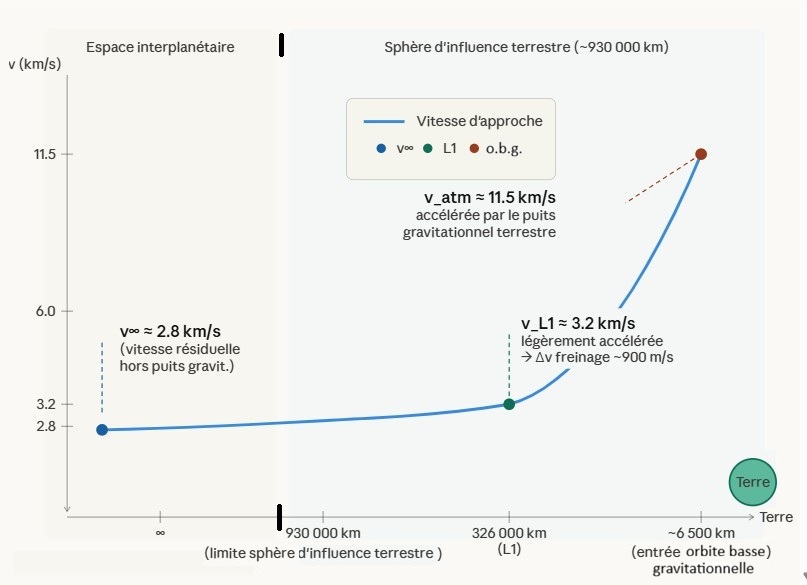
When a spacecraft leaves Mars on a transfer trajectory to Earth, it arrives with what is called a hyperbolic excess velocity (v∞), i.e. the velocity it would retain if Earth did not exist — the residual velocity in the heliocentric reference frame. For a trajectory slightly faster than Hohmann (7.5 months), this v∞ is on the order of 2.5 to 3 km/s.
Note: the 7.5-month transit duration was chosen as a compromise — shorter than Hohmann (and therefore less radiation exposure), but not too short either, since a faster trajectory would impose a higher v∞ and therefore a far more propellant-costly braking manoeuvre on arrival.
The problem is that Earth accelerates the approaching spacecraft. The actual velocity at closest approach (perigee) is calculated by conservation of energy:
v_perigee² = v∞² + 2 × μ_Earth / r_perigee
μ is the standard gravitational parameter of the planet i.e. GxM where G is the gravitational constant and M is the mass of the planet.
At 6,500 km from Earth’s centre, μ/r yields approximately 56 km²/s², so the velocity climbs to ~11–12 km/s. This is the kinetic energy accumulated by « falling » into Earth’s gravitational well. At EM-L1 (326,000 km), however, the spacecraft is still outside the deep gravitational well. Its velocity there is close to v∞, slightly increased by Earth’s gravity but far less than at perigee:
v_L1² = v∞² + 2 × μ_Earth / 326,000 km
μ_Earth / 326,000 km ≈ 1.22 km²/s²
So for v∞ = 2.8 km/s: v_L1 ≈ √(7.84 + 2.44) ≈ 3.2 km/s
The velocity at EM-L1 is only slightly greater than v∞, compared to 11–12 km/s at gravitational entry. The difference is enormous. But the goal is not to stop: it is to transition from a hyperbolic trajectory (open — the spacecraft would escape back into space) to a stable halo orbit around EM-L1. That halo orbit has an intrinsic velocity of approximately 2.3 km/s — so it is sufficient to brake by 3.2 − 2.3 ≈ 900 m/s to switch from an escape trajectory to a captured orbit. This is why braking at EM-L1 costs « only » ~900 m/s of Δv, whereas capture into low Earth orbit without aerobraking would require ~3.2 km/s (this point is developped after part 2 just below).
2. Why not use gravitational capture?
Capture via successive passes (the technique known as ballistic capture or low-energy transfer) does exist, but it has very specific constraints:
It requires arriving with an extremely low v∞, ideally < 0.5 km/s, so that the trajectory is nearly parabolic and lunar or solar perturbations can progressively « close » the orbit. With v∞ ≈ 2.5–3 km/s as in our scenario, the trajectory is too hyperbolic: Earth cannot « catch » the spacecraft without a propulsive manoeuvre. The vehicle would swing past Earth and head back into space.
Other modes, theoretically possible, are excluded:
Multi-pass atmospheric aerobraking (aerobraking over many orbits) requires dozens of close atmospheric passes over several weeks — repeated thermal loads, high g forces, and a total duration entirely incompatible with a crew already weakened after 7.5 months of spaceflight.
Direct access to the low Earth elliptical orbit (~120 km) by a single aerobraking maneuver is, however, totally excluded due to its difficulty (precision of the entry angle) and its violence.
Atmospheric aerobraking in a single orbit with drift to L1-TL is a variant of the above mode. It would be slightly less violent since, instead of continuing to brake, the spacecraft would fly to an apogee at L1-TL. However, it is best to forgo this option due to its difficulty (precise entry angle) and the high g-forces the passengers would experience during the ultra-short braking maneuver (2 minutes 21 seconds).
Propulsive capture into high Earth orbit (~6500 km) without aerobraking (Δv needed ~3,200 m/s) would require at least ~150 tonnes of propellant and an intolerable g loading (several g over just a few minutes), not to mention the risk of trajectory error.
3. The remaining option: propulsive braking approaching L1-TL
(development of the end of Part 1 above)
The spacecraft enters Earth’s sphere of influence (radius ~930,000 km) on a hyperbolic trajectory whose « natural » perigee is not EM-L1. To be captured into a halo orbit around EM-L1, a propulsive braking manoeuvre must therefore be performed at a precisely calculated point on the trajectory. This is not a passive gravitational capture — it is a deliberate orbital insertion. And the distance of EM-L1 from Earth offers an excellent braking opportunity.
At this distance, the spacecraft is still outside the deep gravitational well. Its velocity of 3.2 km/s (calculated above) is only slightly greater than v∞, compared to 11–12 km/s at Earth’s gravitational entry. The difference is immense. This is why braking at EM-L1 costs « only » ~900 m/s of Δv, whereas capture into low Earth orbit without aerobraking would require ~3.2 km/s.
Some will point out that the Moon will not necessarily be « there » when the spacecraft arrives at 326,000 km from Earth — and they would be right. But it does not matter. The position of the Moon in its orbit is irrelevant because L1 is not a fixed point in space: it is a point that rotates with the Moon around the Earth, always located on the Earth-Moon axis, at ~326,000 km from Earth, completing one orbit every 27 days — just like the Moon.
All that matters for the braking manoeuvre is the distance from Earth’s centre (~326,000 km) and the velocity at that moment (~3.2 km/s). The Moon can be anywhere in its orbit. The Starship is not heading towards the Moon — it is heading towards a point 326,000 km from Earth along its own hyperbolic trajectory. The precise sequence is as follows:
In the month before arrival: trajectory engineers calculate the departure window from Mars so that, at the time of the braking manoeuvre at ~326,000 km, the insertion point lies within a reasonable proximity of EM-L1 — or failing that, on a halo orbit accessible from a slightly offset position at a cost of only a few tens of m/s.
On approach: the ~900 m/s braking manoeuvre captures the spacecraft not at L1 exactly, but into a halo orbit around EM-L1 (radius ~25,000 km in the configuration assumed for our space station). This halo orbit is itself a dynamic object that rotates with the Moon (always on the Earth-Moon axis).
If the Moon is « on the other side »: the spacecraft simply performs one or two additional transfer orbits around Earth (a highly elliptical orbit, very inexpensive in propellant — a few tens of m/s) before inserting into the halo orbit once the geometry is favorable. This delay is at most a few days, since the Moon completes one orbit in 27 days.
The braking maneuver required to shed those 900 m/s will demand only 40 to 50 tonnes of propellant, and the gentle, gradual deceleration will produce only a very slight increase in g loading (0.05 to 0.1 g). Nothing remotely comparable to the alternatives.
4. Advantages of this orbital braking approaching EM-L1
Propellant: 40–50 tonnes of methane/oxygen produced by ISRU on Mars is technically feasible using a laboratory, a compressor and an electrolyser to get the above gaz from the Martian atmosphere and hydrogen extracted from Martian water ice. This raises the mission demand in terms of in-situ production, but remains « manageable ».
Journey segments Masse
Injection from Mars towards Earth ~120 t
Propulsive braking approaching L1-TL ~50 t
From L1-TL down to Earth (teleoperated) ~50 t
Total propellant needed ~220 t
G-forces: deceleration can be spread over 10–20 minutes at very gentle levels, with no shock whatsoever to the crew. This is incomparably more tolerable than atmospheric aerobraking.
Controllability: the maneuver is calculable, interruptible, and correctable. If an anomaly occurs mid-braking, a rescue trajectory can be computed. Aerobraking at 11 km/s is, by contrast, irreversible.
5. Once at EM-L1, the return to Earth turns to routine
Option A — the Starship returns to Earth uncrewed (teleoperated)
From EM-L1, the Starship performs a re-entry injection (~1.5 km/s of Δv) towards a controlled atmospheric entry trajectory (following the necessary checks and repairs at the space station). Without crew on board, wider deceleration tolerances can be accepted, and the vehicle can subsequently be inspected in detail on the ground by SpaceX engineers using equipment unavailable at EM-L1.
Option B — the crew returns by capsule (Dragon or Orion)
A lightweight capsule is sent to EM-L1 from Earth (~1.5 km/s of Δv from low Earth orbit — achievable by a Falcon 9 or SLS). The crew, following quarantine and medical rehabilitation in the halo orbit (~1 month at 0.5 g rotation), boards the capsule for a conventional atmospheric entry (~11 km/s, 6–8 g over a few minutes, acceptable after readaptation). These two options are complementary by design: no human return depends on the condition of the Starship after 31.5 months in space.
6. Artemis 2 as a reference for this final segment
Artemis 2 sends an Orion with 4 astronauts on a free-return circumlunar trajectory (passing ~8,000 km from the lunar surface without entering orbit). For sending an empty capsule (or one with a minimal ferry crew) to a halo orbit around EM-L1, the injection Δv is comparable — approximately 3.1 to 3.2 km/s from low Earth orbit, the difference being that the target is EM-L1 rather than a free circumlunar trajectory. It belongs to the same family of manoeuvres.
This scenario is actually less demanding than Artemis 2:
| Parameter | Artemis 2 | Capsule to EM-L1 for this mission |
| Outbound crew | 4 astronauts | 0 to 2 (ferry crew, or teleoperated capsule) |
| Mass to inject | Full Orion (~26 t) | Dragon (~13 t) or lightened Orion |
| Transit duration | ~10 days | ~4–5 days |
| Required launcher | SLS Block 1 | Falcon Heavy or SLS — either works |
| Launcher recovery | Stage expended | Falcon Heavy: recovery possible |
The SpaceX Dragon capsule, much lighter than Orion, can be sent to EM-L1 by a Falcon Heavy, reducing costs further compared to a full Artemis mission.
xxx
There is therefore no hesitation. On return from Mars, the route must pass through EM-L1. And of course, construction of a rotating space station at EM-L1 must begin now! The timing is all the more opportune given that NASA has just canceled its Lunar Gateway project, and the ISS is nearing the end of its life. While NASA has stated that it will instead focus on developing a lunar base between 2029 and 2036, since no significant expenditure has yet been committed to the new lunar base project, American leaders have time to consider the matter. All ground operations on the Moon could be carried out by remotely operated robots, without any time lag. Operators could work within the station’s torus under a gravity of 0.5g, far preferable to the lunar 0.16g. They wouldn’t have to endure 24-hour nights or fear the risks of accidents during EVAs!
It’s (almost) Easter and we know that before being resurrected, one must die.
Note: Calculations and tables produced with claude.ai
Copyright Pierre Brisson

