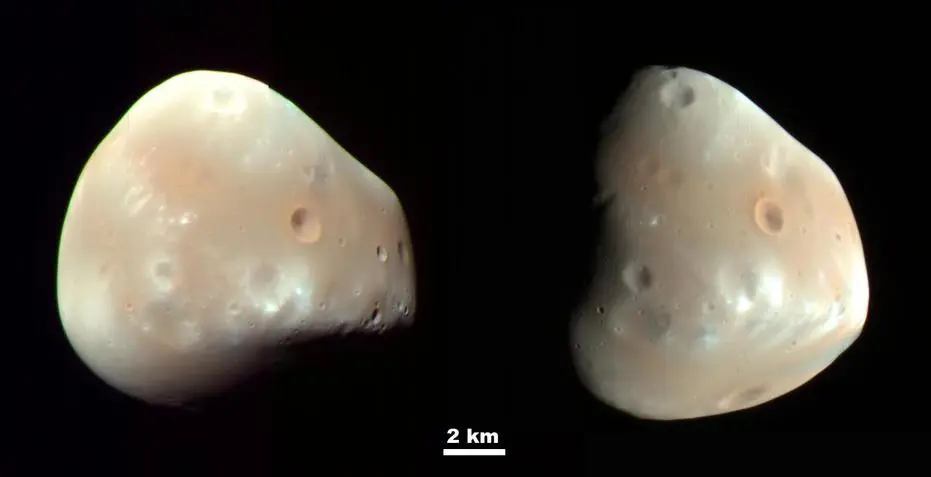
A first Martian space station on Deimos
Those who follow me are familiar with my newfound interest in Mars’ moons. This shift stems from the fact that these moons seem to offer more promising possibilities for establishing life within the Martian system than building cities on its surface. Indeed, it is on these moons, and more specifically on Deimos, that we could undertake the construction of the first rotating station, which would allow us to recreate conditions that are acceptable for the human body in the long term. Today, I would like to further justify the project I am proposing by detailing the characteristics and, above all, the accessibility of the two moons.
Before, let’s remember that Mars’ mass generates a gravity of 0.38g, and we don’t know, because we haven’t experimented or studied it scientifically, whether this force would be sufficient for multigenerational human life. What we know for certain is that (1) weightlessness as experienced on the ISS would not allow for this, on account of disruptions in the circulation of internal fluids in the body, and (2) the 0.38g gravity on the surface of Mars is a constraint that cannot be modified. Therefore, we must find the most accessible site possible that is more easily adaptable by humans to their gravitational needs.
Let’s us now look at the Martian moon.
The dimensions are 25.9 km x 22.6 km x 18.32 km for Phobos and 16.08 km x 11.78 km x 10.22 km for Deimos. The average mass density is 1.86 g/cm³ for Phobos and 1.46 g/cm³ for Deimos (for reference, the density of Earth’s crust is 2.7 g/cm³). The small size and low density imply a low mass, which in turn implies a very low gravity. Indeed, the surface gravity of Phobos is 0.000584 g and that of Deimos is 0.000306 g.
The distance to the surface of Mars is approximately 6,000 km for Phobos and 20,000 km for Deimos (compared to 17,000 km for Mars geostationary orbit). This implies a time latency with the Martian surface of 40 ms from Phobos and 133 ms from Deimos (which remains very low and compatible even with surgical operations if some were to be performed on the surface from this moon).
The orbital period is 7 hours 39 minutes for Phobos and 30 hours 31 minutes for Deimos. This means that Phobos is very often visible from several points on the Martian surface, while Deimos follows the planet’s rotation much more closely. This also means that any point on Mars is more frequently seen from Phobos than from Deimos but that from Deimos we could have a much longer link with any such point.
Regarding the energy required for the Earth-Mars journey, the Δv (speed of departure from Earth) is 3.6 km/s for a pure Hohmann transfer orbit (cargo Starships) and 4.2 km/s for a shortened Hohmann transfer orbit (human passengers). Nothing will change thereafter, until entry into Mars’ gravitational or « Hill” sphere (574,000 km), except for a long and gradual deceleration (influence of the Sun). At this point in the journey (entry into Mars Hill sphere), the speed has decreased to 1.23 km/s for the pure Hohmann transfer orbit and to 3.07 km/s for the accelerated Hohmann transfer orbit.
Speed then increases again due to this new gravitational attraction, slowly at first, then more and more rapidly, until reaching Mars. Upon arrival, at approximately 25,000 km from Mars (speed of 2.10 km/s in pure Hohmann and 3.34 km/s in accelerated Hohmann), the following Δv must be added at the end of the pure Hohmann trajectory: ~0.6 km/s to reach the Martian environment, ~0.4 km/s to reach Phobos orbit, ~0.9 km/s to stabilize in geostationary orbit, and ~0.3 km/s to reach Deimos. At the end of the accelerated Hohmann trajectory, the following must be added: 2.6 km/s for the Martian environment, 1.8 km/s for Phobos orbit, 1.7 km/s for geostationary orbit, and 1.4 km/s for Deimos orbit.
It is at this critical distance of approximately 25,000 km that the final destination must be definitely chosen. This point is, in a way, the logistical boundary of the journey—not that every ship ignites its engines at precisely this distance, but it’s the last point beyond which a change of destination would become impossible without prohibitive fuel costs. In reality, the ship bound for Phobos must begin braking first, since it needs to slow down more than the others, gradually descending to approximately 6,000 km and circularizing at Phobos’s altitude (at the deepest point of the three ships into Mars gravitational pit). The ship destined for areostationary orbit brakes just a few hundred kms before 17,000 km to enter into a circular orbit at that altitude. The ship for Deimos, on the other hand, continues its natural trajectory to approximately 20,000 km before braking slightly to dock—it’s the least disturbed of the three, which explains its low insertion gradient despite its greater distance. It should be noted that it takes more energy to reach the areostationary orbit at 17,000 km than to reach Deimos at 20,000 km, because descending deeper into Mars’ gravitational well to circularize at a low altitude requires more braking power than remaining at altitude where the natural orbit is already quasi-stationary.
Deimos is therefore the ideal location for establishing a base due to the low Δv (altitude difference) required to reach it from Earth. Phobos is preferable as an intermediary, serving as a storage and control point. It is better suited to shuttling to Mars because of its lower altitude, and to Deimos because of the low Δv between the two (0.5 km/s for ascent, slightly more for descent), with a consistently low Δv required to reach it from Earth, and especially because of its frequent passes over the same point on the Martian surface.
It is also on Deimos that the lower gravity will allow to build the larger rotating station.
copyright Pierre Brisson
title illustration: https://science.nasa.gov/photojournal/martian-moon-deimos-in-high-resolution/

