The MMX Mission, First Step Toward Mars
The launch of the MMX (Mars Moons eXploration) mission to Mars, aboard a Japanese H3-24L rocket, was a complete success tonight, October 19. Sequence: (1) 9:41 PM (CEST), liftoff on time; (2) 10:45 PM, second stage reignition at 27,500 km/h; (3) 10:52 PM, maximum speed reached, 38,850 km/h, and payload separation onto the Martian trajectory.
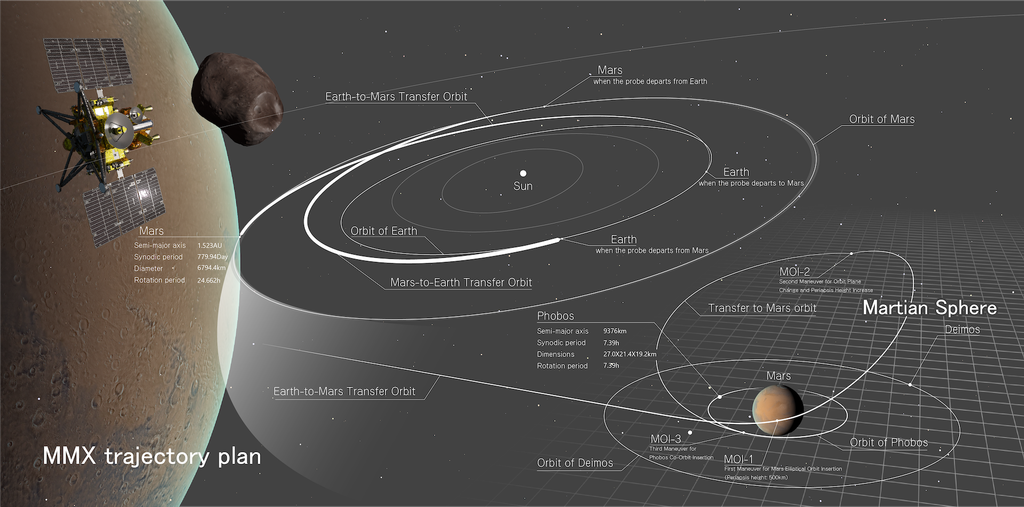
MMX purpose is to study Mars’s two moons, Deimos and Phobos, and in particular to collect samples from Phobos and bring them back to Earth. It will observe Deimos only from a distance, using its onboard instruments. The mission, led by JAXA, is international (a first for Japan): it is a “collaboration” with NASA, CNES, DLR, and ESA. It will be the first mission to land on either of the two moons, and also the first to bring back “something” from the Martian world.
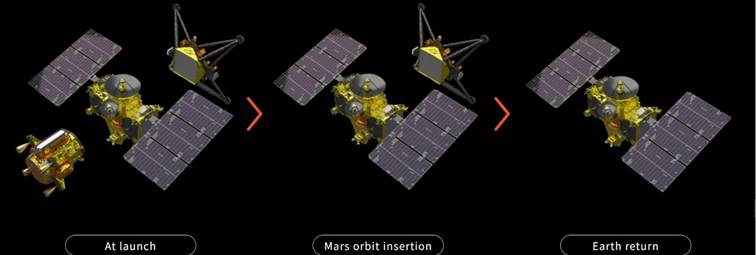
In terms of power, the H3 launch vehicle is a bit below the Falcon 9, since it can place 6.5 t into GTO versus 8.3 t for the Falcon 9. That power is needed because everything sent toward Mars will have a mass of about 4.9 metric tons: 1,800 kg for the propulsion module, 1,050 kg for the return module with the sample capsule, 150 kg for the exploration module, 25 kg for the precursor rover Idéfix, and 1,900 kg for propellant. The dimensions of the payload (housed in a special fairing to accommodate its size) are 9 m long, 5.3 m high, and 4.5 m wide. The capsule carrying the samples that will return to Earth, which is part of the return module, weighs only 16 kg and measures just 60 cm in diameter.
MMX will use chemical propulsion for major space maneuvers, trajectory adjustments, and attitude control, and solar power for its electrical systems. Solar power will be captured by steerable solar panels (“paddles”).
The H3’s first test flight took place in March 2023 and was a failure. The second took place in February 2024 and was a success. Since then, seven flights have taken place, with only one failure (followed by two successes). This is why this 10th launch was relatively safe. It was obviously very important for this mission, whose preparation began 10 years ago.
The MMX mission is of great scientific interest. The aim is to find out what Mars’s two moons are made of and how they formed, and thus also to better understand the history of our solar system. Furthermore, those who follow me on my blogs know that I recommend using these moons so that we can one day settle in the Martian world. In that respect, the density of the soil, its consistency, its topography, the amount of dust in the environment, and the radiation received—all things that will be observed and analyzed—interest me enormously. Finally, the Exploration Module will take advantage of its position (rapid orbit (11h) around Mars in equatorial position much lower than any other satellite,) to observe the planet and in particular the evolution of its clouds.
For these observations and analyses, MMX will be equipped with eleven scientific instruments, four of them on the Idefix rover, which will descend onto Phobos to prepare for the descent of the main module and to test moving on the ground in extreme low-gravity conditions. The latter will carry the instruments that will collect the samples, part of which will then head back to Earth. Idefix will run on solar power (panels).
We will not have the samples until 2031 (only 10 grams, but you can do a lot with 10 grams), when the SRC sample capsule lands in the Australian desert under its parachute. That is because the second stage of the H3 rocket (exploration module + return module + propulsion module) will “dawdle” on its way to Mars (a trip of nearly a year, to save energy). It will be placed in orbit around Mars in September 2027, then around Phobos in December 2027 (in what is called a “QSO,” for Quasi-Satellite Orbit, given Phobos’s very weak gravity and the need for continuous propulsion). It will release Idefix toward Phobos in early 2029, after studying Phobos and Deimos from a distance (a simple “flyby”). The little rover’s mission will be to prepare for the arrival of the exploration module, which will land on Phobos in 2030.
There is good reason to hope for success, because JAXA is probably the most experienced and capable space agency when it comes to studying small bodies with microgravity and to sample return, thanks to its successful missions Hayabusa and Hayabusa2.
The instruments onboard Idefix, the precursor, are as follows:
RAX (Raman Spectrometer for MMX): This Raman spectrometer (provided by the German space agency, DLR) uses a laser located under the body of the rover. It will be used to study the crystal structure and precise mineralogical composition of surface rocks.
miniRAD (Miniaturized Infrared Radiometer): This miniaturized thermal radiometer (also developed by DLR) will measure the infrared radiation from the surface. It will make it possible to determine the temperature of the rocks and deduce their thermophysical properties.
NavCam: A pair of cameras on the front of the rover that will produce stereoscopic images. They will be used both to map the surrounding landscape for scientific purposes and to provide Idefix’s autonomous navigation.
WheelCam: Two downward-facing cameras pointed directly at the rover’s wheels. Their purpose will be to observe up close the direct mechanical interaction between the wheels and the ground, which will help in understanding the consistency of the regolith and the physics of Phobos’s dust.
Note: IDEFIX was developed jointly by the Centre National d’Études Spatiales (CNES) and the German Aerospace Center (DLR). Note that its 25 kg mass will amount to a weight of only 15 grams on Phobos, which raises many problems for its stability.
The instruments onboard the Exploration Module will be as follows:
TENGOO (“TElescopic Nadir imager for GeOmOrphology”), a high-resolution telescopic camera to observe the overall surface and topography of Phobos.
OROCHI (“Optical RadiOmeter composed of CHromatic Imagers”), a wide-angle multi-wavelength camera to capture the distribution of material on the surface of Phobos in visible light.
LIDAR (“Light Detection And Ranging”), a laser rangefinder capable of continuously measuring the distance between the spacecraft and the moon’s surface.
MIRS (“MMX InfraRed Spectrometer”), a near-infrared spectrometer to study the mineral composition of the surface of Phobos. MIRS was developed by LESIA–Observatoire de Paris, in collaboration with four other French laboratories (LAB, LATMOS, LAM, IRAP-OMP) and in partnership with the French space agency (Centre National d’Études Spatiales—CNES).
MEGANE (“Mars-moon Exploration with GAmma rays and NEutrons”), a gamma-ray and neutron spectrometer to study the elemental composition of the surface of Phobos. MEGANE was developed in partnership with NASA and the Johns Hopkins University Applied Physics Laboratory.
CMDM (“Circum-Martian Dust Monitor”), a dust monitor to detect dust rings around Mars.
MSA (“Mass Spectrum Analyzer”), a mass spectrometer to measure the ion environment around Mars and its moons.
Surface operations (sample collection and retrieval):
CSMP (Corer Sampling Mechanism), a coring mechanism that will collect material by digging into the surface of Phobos to a depth of about 2 cm.
P-SMP (Pneumatic Sampler), a second, pneumatic sampling mechanism for collecting surface material by injecting nitrogen. The P-SMP uses pressurized gas to pick up samples from the surface of Phobos and deposit them in a container in a fraction of a second. This device, provided by NASA, was built by Honeybee Robotics in Altadena, California.
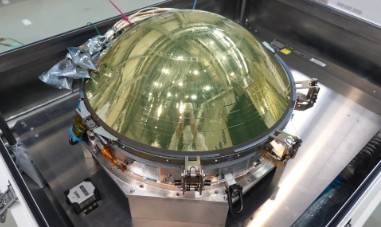
SRC (“Sample Return Capsule”), the capsule that is to come back to the Earth’s surface:
Development of exploration technologies, an eye on the future:
IREM (Interplanetary Radiation Environment Monitor). The instrument will measure space radiation. It will acquire the energy spectrum of high-energy protons (solar energetic particles, or SEP) generated by solar flares, or of galactic cosmic rays (GCR).
SHV (Super Hi-Vision). Two ultra-high-definition cameras for capturing images of the Martian moons in 4K and 8K resolution, developed in collaboration with NHK (Japan Broadcasting Corporation).
xxxx
Once the study of this mission’s results is complete, we will know whether a relay inhabited base on Phobos and Deimos, as I advocate, can be envisioned, and what must be done to anchor the equipment essential to that installation (rotative station). We will also be able to assess the consequences of surface soil movements on the displacement of dust. In short, we will know whether my project is feasible. That is no small matter!
Copyright Pierre Brisson
Follow the video at https://x.com/jaxa_en
Japanese site: https://www.mmx.jaxa.jp/en/
ESA: https://www.esa.int/Science_Exploration/Space_Science/Mars_moon_lander_set_to_launch_on_19_October
xxxx
Title illustration: MMX trajectories, credit JAXA
To find another post in this blog which could be of interest for you, click on:
xxxx
And, if you enjoy this blog, subscribe (it’s free)!

