First Crewed Mission to Mars: How to Reduce Radiation Dose
One of the major problems facing the first crewed mission to Mars is the radiation dose received. We are, in fact, at the limit of what a human being can be exposed to. It is absolutely essential to find ways to reduce this dose. Fortunately, several solutions exist—a whole range, in fact—and we will have to use them all. However, we will be constrained to not significantly increase the mass transported and the energy required for the spacecraft’s propulsion compared to a robotic flight. Ultimately, the dose could be reduced by 50%.
Radiation
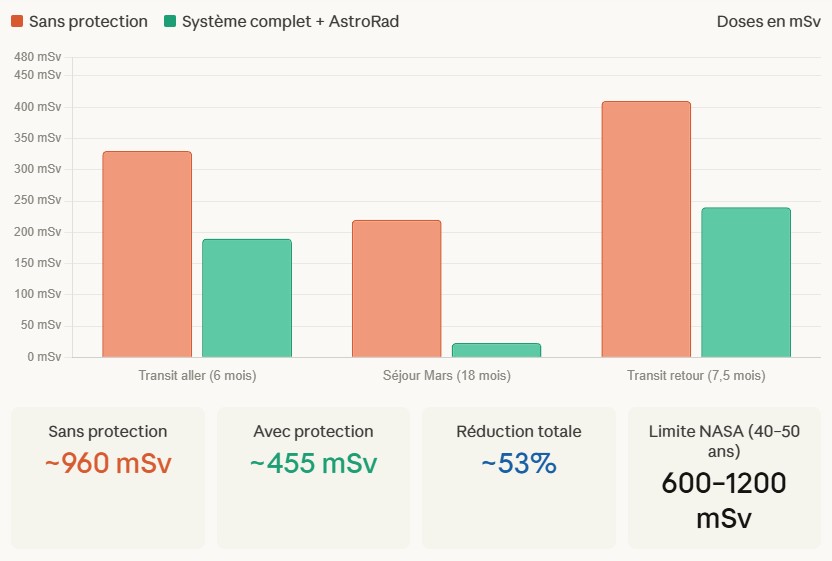
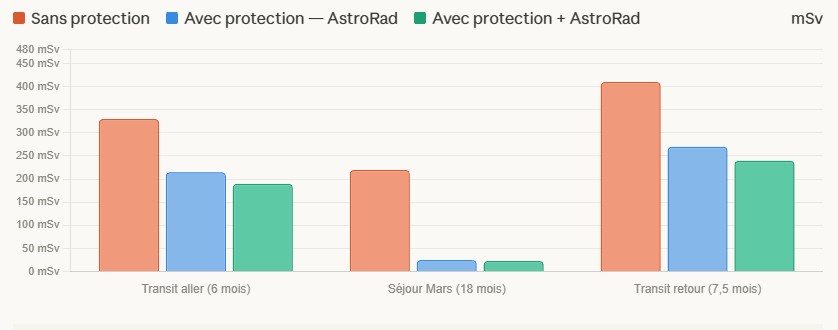
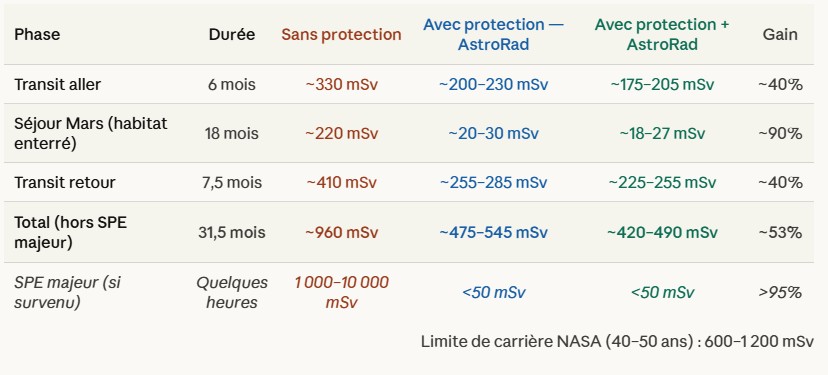
Without protection, the radiation dose received would be approximately 960 mSv (330 mSv for the outbound journey, 220 mSv for the stay on Mars, and 410 mSv for the return journey), excluding SPEs (solar storms, which can deliver doses of 1,000 to 10,000 mSv). It’s worth remembering that the ALARA (As Low As Reasonably Achievable) dose was defined by the ICRP (International Commission on Radiological Protection) in 1990. For space, NASA has adjusted this value several times. Currently, it is 600 mSv for an astronaut’s career and 250 mSv during an EVA (Extra Vehicular Activity). Exceeding 600 mSv increases the risk of cancer by 3% compared to the risk incurred by an unexposed person with a very healthy lifestyle. However, an average American who smokes, is sedentary, and overweight already has a 6% increased risk compared to this ideal.
Among radiation types, a key distinction must be made between SeP (Solar Energetic Particles) received from the solar wind (SW) and GCR (Galactic Cosmic Rays). The first type consists almost exclusively of protons (hydrogen atoms stripped of their electrons), while the second type comprises protons, antiprotons, electrons, positrons, and atomic nuclei heavier than helium. These latter are called HZEs (High, Z – atomic number – Energy). The latter travel at speeds close to that of light. SeP-SW are stopped by protons (and therefore by hydrogen-rich materials such as water or polyethylene, especially high-density polyethylene, « HDPE »). The higher the Z value of HZEs, the less effectively they are stopped by shielding. Furthermore, their impacts on shielding create gamma rays, which are very harmful to living organisms. SeP-SW originate from the Sun and are therefore unidirectional. GCRs, which originate from across the Galaxy, are omnidirectional.
Travel Periods
Fortunately, the density of SeP-SW varies with solar activity, which follows an 11-year cycle and, as an added bonus, at the top of the cycle, the SW reduces the density of GCRs. While the peak of the cycle certainly poses a danger, as it is during this period that the Sun can unleash the winds of its storms, the SPEs (Solar Particle Events), which can trigger even more dangerous CMEs (Coronal Mass Ejections), we can play with this first factor to reduce our radiation doses. Ideally, we should travel during the middle periods of the cycle, but above all, avoid waiting until the bottom of the cycle (when there are too many GCRs). This isn’t easy due to the launch windows (the Earth-Mars synodic cycle occurs every 26 months, more precisely 780 days) but we can find « moderately good » or « least bad » solutions. For this reason, a first crewed mission launch in 2033 would be quite favorable (the last peak of the present Sun’s cycle was in 2025 and the next low point will occur in 2030). The 2029 and 2031 launch windows could therefore be used for preparatory robotic missions.
Water and HDPE Polyethylene
As mentioned above, the possible material protections are of two types: water and high-density polyethylene (HDPE). For covering large areas, HDPE is better suited than water-filled mattresses. The internal walls of the Starship spacecraft could therefore be lined with a 15 cm layer of this material. Limiting it to 250 m², would correspond to 465 m³. This would nevertheless create a protected zone within the Starship 10 meters high and 7.70 meters in diameter, providing the twelve astronauts with comfortable living space (half of the Starship’s livable volume). This would reduce the GCR by 25%, the SeP of the SW by 90%, and the SeP of the SPE by 50 to 70% (which is why additional water protection in some spots and a storm shelter remain needed). The secondary advantages are: mechanical reinforcement of the walls and thermal and acoustic insulation. Of course, fireproofing will be necessary because HDPE is flammable at 130°C (we all remember the Crans-Montana tragedy). A Nomex lining, already used in the iSS, is essential. The mass, 300 kg, will be added to the 35.6 tons of HDPE.
As just mentioned, water will also be used since we will have to take some with us for the trip anyway, and food contains a very high percentage of water, as do urine and excrement. Managing the distribution of these different components will be necessary, but that’s not impossible. Urine is already collected on the ISS to extract drinking water, and excrement can be used as fertilizer on Mars (or discarded upon arrival on Earth). There are two locations for this protective « water »:
1) Each passenger bunk can be shielded. With 15 cm of shielding, radiation can be reduced by approximately 25% during the 7 hours of rest (29% of the time), representing a reduction of approximately 7% on the total transit dose. This would add 6.6 tons of mass.
2) The storm shelter can be shielded with water (estimated volume of 15 m³, stays of a few hours). With 40 cm, the SeP of SPE will be reduced by 95% (residual dose <50 mSv compared to 1000-10000 mSv without protection). This would add 13 tons of mass.
Astrorad Vests
Astrorad vests are individual radiation protection devices developed by the Stemrad company (USA/Israel). They are light-mass (5 kg) and can be worn all day (except at night!) without any discomfort (remember that weight in space, whether on Mars (0.38g gravity) or in « my » rotating station (0.5g), will be significantly less than on Earth). They would reduce the radiation dose by 30 to 50% against SeP-SW and by 15 to 20% against GCR. With an estimated total effective protection capacity of 20 to 25% while wearing them, the radiation dose during the round trip would be reduced by 13%. The added mass would be only 60 kg for the entire crew.
To these vests, I would add Astrorad caps for the protection of the brain and cerebellum. Their importance is clear. It would be minimally disruptive to daily life and light-mass (1 to 2 kg per unit, 15 to 25 kg for the entire set). Like the vests, it would be worn during the day. The reduction in brain radiation dose would be also 20 to 25%.
Mass Balance
This results in a total mass of 55.3 tonnes of protection/armor:
HDPE: 35.6 t
Storm shelter water: 13 t
Water/food/excrement: 6.6 t
Astrorad vests: 0.06 t
Astrorad caps: 0.02 t
For reference, the payload capacity of a Starship is 120 tonnes, and the first crewed mission will only serve to demonstrate that humans can live on Mars (this first mission will have been preceded by two preparatory robotic missions, in 2029 and 2031, which will have delivered most of the necessary heavy equipment).
On Mars, Robot Teleoperation
In science fiction books, and among others who disregard the problem of radiation and spacesuits, there’s a fantasy of strolling on the surface of Mars, as if it were simply a matter of putting on a coat and hat and going for a walk in the planet’s cold desert. In reality, these Extra Vehicular Activities (EVA) will be difficult and dangerous. It is indeed difficult to get into a spacesuit and then difficult to live in one. It’s not just a matter of scratching your nose or wiping your face; it’s also about eating and defecating. Furthermore, when you’re outside, you’re exposed to radiation. You’ll always receive too much, and the mission on the surface of Mars will last at least 18 months (the total dose is estimated at 220 mSv without SPE, not counting the gamma rays created upon contact with the ground by particle impacts).
The only solution: avoid EVAs or minimize them as much as possible. To achieve this, there are two solutions: living in dug out shelters (caves) and teleoperating robots (Optimus!) from them. The cave could be excavated in a cliff or hillside during one of the two robotic missions preceding the arrival of human beings. With the crewed mission, the astronauts will bring a survival kit (including an inflatable, breathable air-filled insulation envelope) which they will adapt to the cavity. From there, they will be able to teleoperate, in real time, the various robots they will need to see, observe, measure, and generally, to act.
It’s important to understand that the only advantage of physically going to Mars, with our hands and brains, is the need to overcome the time lag of 3 to 22 minutes in one direction for any communication between the two planets. This arrangement will make that possible. And don’t tell me it will be unbearable for this first group of 12 people. They will be « quite happy » to be safe inside. They will also be very busy acting through robots, reflecting, suggesting new operations based on their actions and reflections, and communicating with Earth. When they want to take a break, they will have all the necessary equipment to exercise indoors, watching through the window (without getting close to them) or on their screens (which will be just as good as a window) everything that is happening outside… as if they were there (the screens can be arranged like windows inside the home). The 220 mSv they would otherwise have received « outdoors » will thus be considerably reduced. Eventually down to zero but perhaps a little less, as we cannot rule out the need for a few rare EVAs.
In this case, it will also be very useful to continue wearing astrorad shielding on the front and back of the body, and on the head. This shielding can easily be added to the outside of the spacesuits (6 to 7 kg of additional mass, or 2.28 to 2.66 kg of additional weight). The average radiation dose on Mars without protection would be only 0.7 mSv per day, on average, or 0.12 mSv for a 4-hour EVA. However, given the length of the stay (18 months) and the possibility of using protection, why not do so and prevent a sudden increase in the average radiation dose?
Travel Time
Fine! We’ve made good progress. However, we can go further by reducing the duration of the trips, both to and from Mars. If we follow the pure Hohmann transfer orbit, we will have two journeys of approximately 8.5 months each and an 18-month stay on Mars. Remember that the synodic cycle between the two planets is 26 months. There are three possible ways to reduce that without expending too much extra energy.
First, reduce the Earth-Mars journey to 6 months. We will arrive near Mars more quickly, and we will need to brake a little, but not too much, since Mars’ gravitational force is relatively weak and we are almost at the apogee of the elliptical orbit.
Second, reduce the return journey time. This is more difficult for the opposite reasons to the outbound journey. However, we can, without too much difficulty (especially if we make a stopover in L1 of the Earth-Moon system, see previous article), reduce this duration by one month (7.5 months instead of 8.5 months). This will reduce the radiation dose by 55 mSv, while slightly increasing the propellant mass. This is not a problem as this increase in propellant remains within our capabilities, as shown by the ISRU propellant budget:
Mars-to-Earth transit: Δv ~2.5 km/s, 120 tons of propellant;
Propulsive braking to L1: Δv ~900 m/s, 50 tons of propellant;
Starship L1-to-Earth return: Δv ~1.5 km/s, 50 tons of propellant.
Total: 220 tons of propellant for a Starship with a total propellant carrying capacity of 1200 tons.
Note: The 8.5 months refers to the duration under a favorable synodic configuration. This varies depending on the eccentricity of Mars’ orbit and the fact that the planets, when they « meet » in terms of solar longitude, can be more or less distant (on account of Mars’ proximity to its aphelion). In aphelic opposition, a pure Hohmann transfer orbit can last 9.5 months. Furthermore, we must remember that we need to take into account the 11-year solar cycle to avoid traveling either at the peak or trough of our star’s activity. This is why 2033 offers a particularly favorable window for launching the first crewed mission: the trajectory to Mars will be quite short and the Sun moderately active.
One small remaining problem: if we shorten the outbound journey to 6 months, we will have 2 extra months on Mars (18 + 2) because we mustn’t forget that the cycle is 26 months and there’s no question of leaving Mars before that date. The solution to avoid lengthening this first stay on Mars is to depart from Earth two months later. We’ll be down to 31.5 months (round trip) off Earth instead of 35 months (actually 32.5, since we have to add a month’s stay on the station located at L1). This doesn’t change much in terms of braking when approaching Mars, or initial impulse, or total mass of the shielding (55.4 tons), but it’s sufficient time away from Earth for the humans who will experience this mission.
Medications
Radiation-protective pharmacology is a rapidly progressing field. Drugs like amifostine or targeted antioxidants could supplement the physical system, without any additional mass or volume. But we can’t rely solely on them, and prevention is always better than cure!
xxxx
All in all, this reduces the total radiation dose from 920 to 420-490 mSv, which is well within tolerable limits. Wavering is not to be considered. Let’s go, let’s prepare all what is needed! As for what comes next (living on Mars), we’ll see later.
Copyright Pierre Brisson
Figures have been obtained with the help of artificial intelligence claude.ai
https://www.nasa.gov/wp-content/uploads/2023/03/radiation-protection-technical-brief-ochmo.pdf

