Relationship between Deimos and the areostationary orbit stations
In my previous article, we saw the role Phobos can play relative to Deimos. Today we shall explore, on the other side of the low gravity Martian “great plateau” defined by these two moons, the role of Deimos relative to the rotating “Eagle” stations in “areostationary” orbit (Martian “geostationary” equivalent).
During the construction of Deimos-II (the rotating station anchored in the regolith of Deimos) and then the construction of Eagle-One (the first areostationary station), the role of the moon Deimos will be simple: it will be where the access point to the Martian world that is cheapest in Δv from Earth is anchored. If we refuse to use it, there will be no alternative to access the Martian surface, but to descend to the bottom of the planet’s gravity well — even the masses that will not be needed there.
After the release of the Eagle-One from Deimos ground and its positioning on the areostationary orbit, the question will arise of the respective roles of Deimos and the rotating stations on this orbit, and of their relationship.
What will remain irreplaceable about Deimos?
First, mass — an Eagle is a structure, Deimos is a deposit: that of the regolith for shielding the tori to come, a raw material no station will ever possess.
Next, anchorage — a construction site needs ground, even at 3 mm/s²: the independent crane, the guide tower, the whole construction sequencing developed previously presupposes a fixed point that areostationary orbit does not offer. Eagles will continue to be born on Deimos; the little moon will remain the shipyard, where one after another, they will be built. And after they depart, the same will be the keeper of any essential part held in its stock, when they need it.
Next, position — almost at the threshold of Martian escape, it is the natural port of interplanetary traffic. The advantage, incidentally, is not energetic: through the Oberth effect, trans-Earth injection (v∞ ≈ 2.65 km/s) costs about 1,916 m/s from Deimos’s orbit versus 1,901 m/s from areostationary orbit, though the latter is 3,000 km lower — a negative difference though negligible. It is a logistical advantage: Deimos is where the Starships coming from Earth already dock, where the shipyard, the mooring towers and the stocks are located; concentrating the return propellants there avoids duplicating depot infrastructure on every Eagle.
Next, door-to-door service. The Eagles will hold a stable position above a well-defined Martian territory (each one a 30° wide longitude segment); Deimos, with its 30.31 h period versus 24.62 h for areostationary orbit, drifts by 2.74° per hour relative to the collar of the twelve stations: it thus overflies an Eagle roughly every eleven hours and completes the full round in one synodic period of 131 h, i.e. 5.3 sols. Door-to-door service will therefore be a regular round of about five and a half days — weekly rather than daily, but perfectly predictable and identical for each of the twelve.
Finally, the meeting place. Deimos will be where the residents of the twelve areostationary Eagles physically get together. They will need it, from time to time, to “see the others”, to talk freely or on a particular theme, to strike up friendships “and more, if the chemistry is right” (children will be welcome in the Eagles).
In short: the Eagles will inherit life and the Martian territory allotted to them (each a 30° segment of longitude); Deimos will keep industry, service, the open sea and the hub function. This will naturally extend the hierarchy of the two moons already established — Phobos will remain the marshalling yard for going down to the surface and coming back from it; Deimos will move from capital to free port, deliveryman, arsenal, congress hall.
With these principles laid down, there remains the practice of circulation between Deimos and the necklace of Eagles around Mars. Two questions arise, which we shall treat in order: the travel of human beings — distance, journey time and radiation —, then the transport of freight — the distances and the time needed to cover them. Travelling from one Eagle to the other and docking will be dealt with in two other articles.
Travel between Deimos and one of the Eagles: distance, journey time and radiation
There will always remain a 3,000 km difference in altitude between areostationary orbit, 17,032 km above the ground, and the 20,067 km of Deimos. From the standpoint of the energy expended (the Δv), following a Hohmann trajectory (an elliptical arc starting tangentially from one orbit and arriving tangentially at another) between the two will always be the best solution. But scrupulously following that trajectory takes time, and one will always seek to shorten it for humans, if only to limit the radiation dose received. As for travelling between Deimos and Phobos and back, one will accelerate when in a hurry to go from Deimos to one of the Eagles. This implies braking on arrival. Since we cannot brake too much (energy, g), there is therefore a minimum time, a function of the respective positions of Deimos and the Eagle concerned on the one hand, and of the braking conditions on the other.
Note: It is important to always keep in mind that Deimos gradually shifts in relation to the Eagles. The position of the nearest and farthest Eagles changes regularly and progressively over the 131 hours of the synodic period. No Eagle is perpetually in a favorable or unfavorable position; it is only in this or that position at a specific moment.
Humans and the radiation issue.
Note first that it concerns human beings. Equipment, barring exceptions due to great computing complexity, does not suffer from it in any vital way.
At a rate of about 1.8 mSv per day unshielded (the order of magnitude measured in cruise by the RAD instrument of the MSL mission), the 13.7 h Hohmann transfer (between Deimos’s orbit and areostationary orbit) costs on the order of 1 mSv, and a fast 5 h transfer about 0.4 mSv. The radiation dose is thus relatively small, and the possible saving per trip from speed is therefore modest. But it becomes significant cumulatively (for those who will travel often) and above all for the most fragile.
Beyond speed, the answer will lie in the vehicle itself — and it will not be an option but the rule, without exception: no human being will travel on the great plateau other than under shielding, in a passenger variant of the Lyoba whose entire cabin will be wrapped in a 20 cm thick sleeve of high-density polyethylene (HDPE), i.e. about 19 g/cm². For a cabin 3 m in diameter and 4 m long, this sleeve will weigh about 11 t — nearly a fifth of the payload, but the absence of atmosphere on the great plateau allows this raw external shielding, without any fairing, and its extra propellant cost will remain negligible (~620 kg of methane-oxygen per Hohmann round trip). The gain on galactic radiation will be real — and the saving the sleeve provides must be properly appreciated: the dose falls by a good third, from 1.8 to about 1.2 mSv per day of flight, and the Hohmann one-way from 1 to 0.65 mSv. That is 0.7 mSv saved on every round trip to Deimos and, for the most assiduous commuters (one round trip per 131 h cycle), a cumulative saving of several tens of mSv per year — the order of magnitude of an annual occupational radiation-protection limit on Earth (20 to 50 mSv depending on the regulations) — but the essential point lies elsewhere: the sleeve will stop nearly all the protons of a solar flare occurring in flight, an event against which a transfer that can be neither shortened nor interrupted offers no other recourse. This integral protection will be all the more imperative as the Lyobas will also carry children — they will not be kept confined to a single Eagle until they come of age, and their growing tissues are more radiosensitive than those of adults.
In the same spirit, let us note that these Lyoba-passengers will be fully automated: the crew will be reduced to one cabin chiefs, in charge of the passengers and not of piloting (the full automation of plateau traffic will be developed in another article). The cabin chief will himself be assisted by two Optimus robots specially trained for passenger service — much, on the great plateau, will rest on these humanoid robots. The cabin will finally include a sanitary cabinet and a small galley stocked with reserves of water and food: comfort absolutely necessary for the shortest flight (05h00) as well as the longest one (13h45).
Humans and the travel time.
Accelerating, moreover, is not only of radiative interest: it also widens the departure windows. For a given Eagle, the exact Hohmann alignment recurs only every 131 h, whereas an adjustable flight time allows departure over a much wider range of phases. The mechanism is geometric: the Eagles, 3,035 km lower, catch up with Deimos at 2.74° per hour, and each flight time requires at departure a precise phase angle between Deimos and the target Eagle — the phase angle being the angular separation, measured from the center of Mars, between the position of Deimos and that of the Eagle at a given instant; it is counted negative when the Eagle, on its lower and faster orbit, has not yet passed beneath Deimos — this is the last column of the table below.
Nota: The phase angle is the angular difference, measured from the center of Mars, between the position of Deimos and that of the Eagle at a given time; it is considered negative when the Eagle, on its lower and faster orbit, has not yet passed under Deimos.
Deimos ↔ areostationary orbit transfers:
(optimised coplanar transfers (μ Mars = 42,828 km³/s², orbital radii 23,463 km and 20,428 km)
| Transfer duration | Total Δv (one way) | Round-trip propellant (Isp 360 s) | Required phase (Eagle trailing Deimos) |
| 13.7 h (Hohmann) | 97 m/s | 5.6% of final mass | −20.6° |
| 12 h | 104 m/s | 6.1% | −17.4° |
| 10 h | 130 m/s | 7.6% | −14.5° |
| 8 h | 177 m/s | 10.5% | −11.2° |
| 6 h | 254 m/s | 15.5% | −8.5° |
| 5 h | 314 m/s | 19.5% | −6.9° |
| 4 h | 403 m/s | 25.7% | −5.5° |
For a 60 t Lyoba, the Hohmann round trip to an Eagle therefore consumes only about 3.5 t of methane-oxygen; and halving the journey time (13.7 → 6 h) multiplies the Δv only by 2.6. In absolute terms, circulation on the great plateau will remain almost free — it is the climb from the surface (~4.3 kg of propellant per kg hoisted to Phobos) that will remain the costly item.
The operational consequence can be read in that last column. A Lyoba able to modulate its flight time between 13.7 h and 4 h can depart as soon as the phase lies between −20.6° and −5.5°, a continuous window of about 15° — five and a half hours per 131 h cycle — instead of a single instant. The window opens with the most economical transfer and closes with the most expensive: arriving late at the dock is paid for in propellant, not in waiting. One may even note this little paradox: the latecomer leaving on a 4 h sprint at window closing arrives about 4 h before the one who left at window opening by Hohmann (9.5 h versus 13.7 h after the window opens).
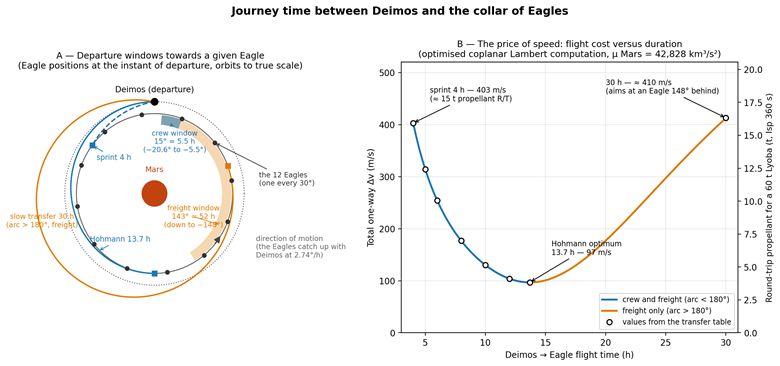
Figure — Journey time between Deimos and an Eagle: left, the departure windows towards a given Eagle (crew window of 15° ≈ 5.5 h, freight window of 143° ≈ 52 h per 131 h cycle); right, the cost of the flight as a function of its duration (optimised coplanar Lambert computation, points from the table above).
Let us quantify the wait. If the need to depart arises at a random instant of the 131 h cycle, a traveller who accepted only the exact Hohmann would wait 65.5 h on average — and 131 h at worst. The 5.5 h crew window brings this average wait down to about 60 h (125.5 h at worst, immediate departure in 4% of cases): the statistical gain is modest, it must be said honestly — to reach a given Eagle, the synodic rhythm rules. The real benefit of the window for humans therefore lies elsewhere. First, the freedom to choose one’s hour within five and a half hours, rather than being hostage to a slot of a few minutes. Then the strategy it allows: for someone who has already waited, waiting 5.5 h more under shielding and leaving on a 4 h sprint at window closing always beats leaving at window opening by Hohmann — one arrives about 4 h earlier and takes only 0.2 mSv instead of 0.65 (doses under the sleeve, now systematic; unshielded, the figures would read 0.3 versus 1). The downside is that this choice is made at the cost of multiplying propellant mass by 4.6: for a 60 t Lyoba, the round trip goes from about 3.5 t to some fifteen tonnes of methane-oxygen. As for boarding time itself, it will never be the constraint: the travellers of a given departure will number in units or tens, not in hundreds as in the wide-body jets of our airports — a few minutes will suffice to board a Lyoba. The departure window is a celestial constraint, not a human one.
Freight: distances and journey times
The cargo Lyobas, for their part, will fly bare: freight has no radiation issue. They will also fly with no one aboard, fully automated — neither radiation issue nor crew (the development on the full automation of plateau freight comes in one ot the two following articles).
Freight will above all be able to widen the departure window on the other side, with transfers slower than Hohmann (arcs greater than 180°): up to 30 h of flight for about 410 m/s, which makes it possible to aim at an Eagle still 148° behind and raises departure availability to about 52 h out of 131, i.e. 40% of the time. For humans, on the other hand, better to wait at the dock, under shielding, than to “wait in flight” under radiation: crews will wait on Deimos and fly fast.
As for waiting, freight thus does much better than crews: with its 52 h window, the average wait falls to about 24 h (79 h at worst, immediate departure four times out of ten).
In sum, speed never shortens the 131 h synodic period, which depends only on the two orbital periods; it buys flexibility around that rhythm — the widened departure window — and, as a bonus, the shorter flight.
We have now reached our destination. But be warned! This demonstration is only valid for the Deimos-Eagle journey and (more or less) the Phobos-Eagle journey (we are on the same plateau). In the next article, we will see that travel in the same Eagle-Eagle orbit faces other constraints that do not make it less challenging. In another article, we will examine the different functions of the docking modules and the propellant stocks that must be maintained on board each Eagle. Arriving or departing is not simply a matter of docking or taking off.
Copyright Pierre Brisson.
Illustration: journey time between Deimos and the areostationary stations, created by claude.ai upon request of Pierre Brisson.
xxxx
To find another post in this blog which could be of interest for you, click on:
xxxx
And, if you enjoy this blog, subscribe (it’s free)!
On this 1st of August, I take this opportunity to wish a happy National Day to all my Swiss readers and friends. Cherish and celebrate your true democracy; it is as precious and rare as the world’s finest jewel!

