Choosing Deimos or Phobos?
1. The problem
Mars has two moons, and our architecture asks them to fulfil three distinct functions: serving as the interface with Earth (receiving interplanetary ships, their equipment and their passengers), serving as the interface with the surface of Mars (handling shuttle logistics and propellant resupply), and finally providing a meeting place for the residents of the necklace of twelve Eagles (stations in areostationary orbit). Nothing requires, a priori, that all three functions be performed by the same moon. The question therefore deserves to be asked for each function: Deimos or Phobos? The answer, as we shall see, is not the same depending on whether the dominant constraint is time or propellant — and it leads not to choosing one moon over the other, but to assigning them complementary roles, with a mutual redundancy that is in itself a decisive argument.
2. Time: the advantage of Phobos
For an Eagle resident, what matters is not the orbital period of the target moon, but the synodic period between their own areostationary orbit (24.62 h) and that of the moon: it is the synodic period that sets the frequency of Hohmann (minimum-energy) transfer windows.
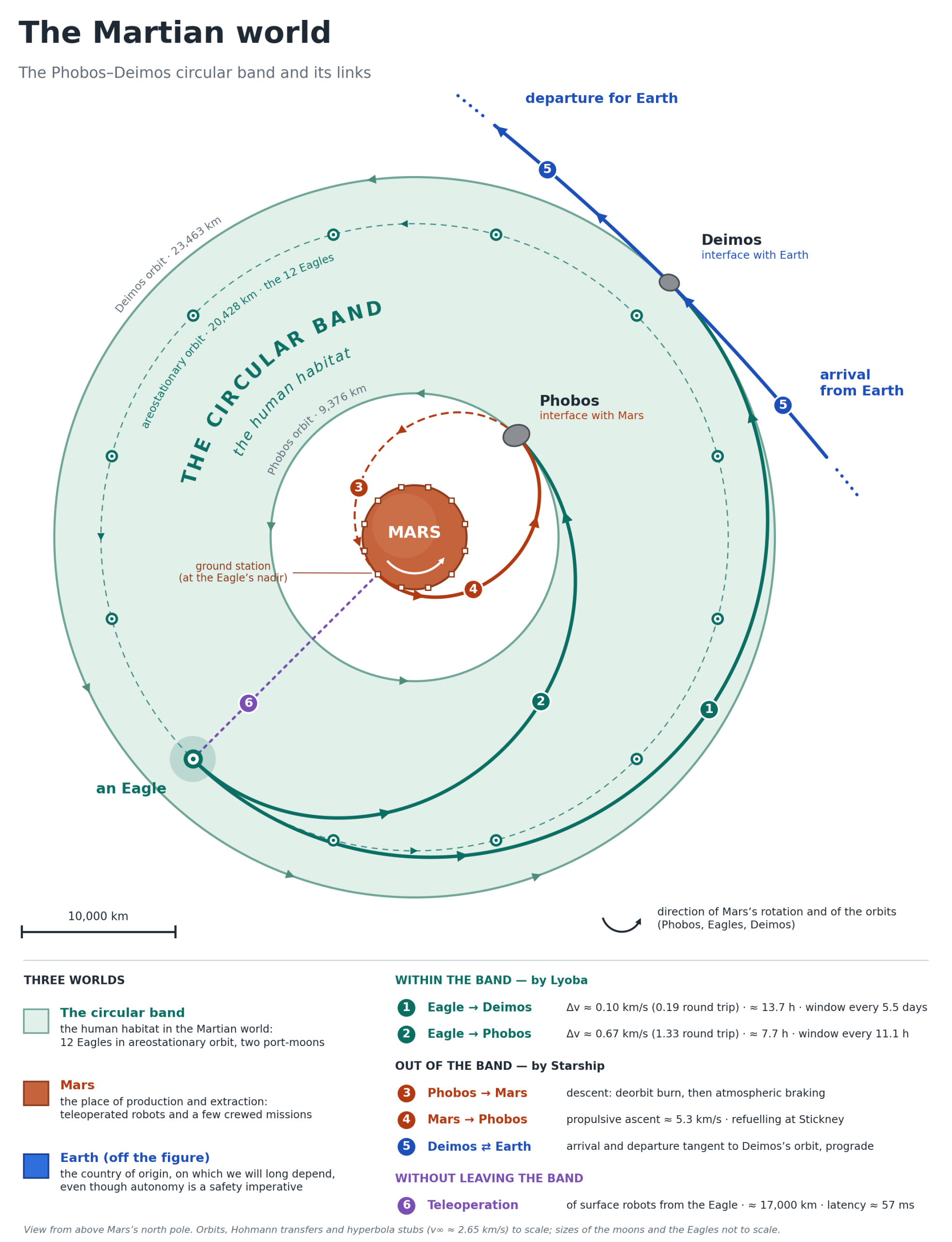
Phobos orbits in 7.65 h, well below the necklace of areostationary stations. The corresponding synodic period is about 11.1 h: each Eagle sees a window to Phobos open roughly twice per Martian day. Deimos, on the other hand, orbits in 30.31 h, only slightly more slowly than the necklace itself: the synodic period reaches about 131 h, or 5.5 days. Deimos drifts by only 2.7° per hour relative to the Eagles — it is almost a “thirteenth Eagle” sliding slowly along the necklace.
The practical consequence is clear. To bring together delegations from all twelve Eagles, Phobos allows everyone to depart within an 11-hour window and arrive in less than a day (the transfer itself takes about 7.7 h). Towards Deimos, the windows of the twelve Eagles are spread over the 5.5 days of the synodic cycle: a full assembly takes nearly a week to convene, unless one pays extra Δv to force the phasing. If time is the dominant constraint — and it is in any emergency — the advantage of Phobos is overwhelming.
3. Propellant: the advantage of Deimos
Seen from the surface of Mars, the propulsive cost of reaching either moon is comparable. Seen from areostationary orbit, it is not at all: Deimos is almost co-orbital with the necklace, whereas Phobos is at half the orbital radius. The table below summarises the comparison for a 60-tonne Lyoba (a high-altitude transfer vehicle developed by the Swiss startup Pave Space).
| Criterion | Eagle → Deimos | Eagle → Phobos |
| Δv one way (Hohmann) | ≈ 0.10 km/s | ≈ 0.67 km/s |
| Δv round trip | ≈ 0.19 km/s | ≈ 1.33 km/s |
| Transfer time (one way) | ≈ 13.7 h | ≈ 7.7 h |
| Departure window (per Eagle) | every 5.5 days | every 11.1 h |
| Propellant, 60 t Lyoba, round trip (Isp ≈ 380 s) | ≈ 3 t | ≈ 26 t |
| Gathering of all twelve Eagles (round trip) | ≈ 36 t | ≈ 310 t |
The factor is about seven in Δv, and it carries straight through to propellant: a gathering of all twelve Eagles consumes roughly 36 tonnes of methalox via Deimos against about 310 tonnes via Phobos. Two mitigating circumstances must nevertheless be credited to Phobos. First, the Eagle–Phobos round trip (1.33 km/s) remains cheaper than a round trip to the antipodal Eagle of the necklace (about 2 km/s according to our inter-Eagle phasing figures): Phobos therefore beats Deimos as the best location for a “rotating meeting” hosted by one of the twelve. Second, the Stickney depot (Phobos) allows a Lyoba to leave its Eagle with only the propellant for the outbound leg and to refuel on site for the return, which correspondingly avoid alighting for same amount the stock on the depots maintained (for about 60 tonnes) in each Eagle. It should be recalled that the propellant depot for travel within the Martian environment is located on Phobos, the closer of the two moons to the Martian surface where the methalox is produced (the depot maintained on Deimos is primarily intended for the resupply of Starships for their return to Earth).
4. Consequence: a differentiated doctrine
From these two findings naturally follows a division of roles rather than an exclusive choice.
Deimos retains three structural assets. It is the natural arrival point from Earth: equipment and passengers stop over there before joining their respective Eagles. It is, by far, the cheapest destination to reach from the areostationary necklace, co-orbitality oblige. And the Deimos-II station (a rotating station anchored in the moon’s surface) is already part of our roadmap. For the ordinary assemblies of the necklace’s institutional life — scheduled meetings whose date is known weeks in advance and to which each delegation departs in its own window — the 5.5-day convening time is not a real handicap, and the propellant cost is almost negligible. Deimos is therefore the ordinary meeting place.
Phobos, on the other hand, is the obvious choice for anything reactive or tied to the surface: emergency gatherings in less than a day, logistical transit between surface and orbit (already its role in our architecture, with the surface–Phobos shuttles and the Stickney depot), and meetings bringing together Eagle residents and teams that have come back up from the ground.
It is worth recalling here what surface operations are in our architecture: there is no permanent staff on the ground, but small groups — typically six people — who go down from each Eagle to the ground station at its nadir, for stays of one to three months at most, because of the negative effects of living in low gravity. The bulk of routine operations is carried out by robots, including Optimus units teleoperated from each Eagle: the areostationary geometry is ideal for this, since the ground station remains permanently at its Eagle’s zenith, about 17,000 km away, giving a one-way latency of only about 57 milliseconds — near-real-time teleoperation. The descents from the different Eagles have no reason to be synchronised, since needs vary from one ground station to another.
Finally, there is an asymmetry between descent and ascent. Descent is cheap: a vehicle fitted with a heat shield and landing legs deorbits and then brakes in the atmosphere; in theory, it could therefore be made directly from each Eagle, without going through Phobos. It is the ascent, propulsive from start to finish (about 5.3 km/s to Phobos), that makes the Stickney stopover indispensable for refuelling before returning to the necklace. In practice, however, nobody will descend directly from an Eagle to the surface. The vehicles capable of descending — the Starships, with their heat shields and landing legs — will not come to the Eagles, since they cannot dock there (see § 5). Conversely, the Lyobas serving the Eagles will not descend to Mars: as light vehicles without heat shields, they would not survive atmospheric braking; without legs, they could not land; and their thrust would in any case be insufficient to climb back up. The journey from an Eagle to the surface will therefore go through Phobos: by Lyoba to Stickney, then by Starship to the ground. Phobos is thus both the “departure lounge” for Mars and the “filling station for the return”.
Two rules follow. 1) For meeting in orbit, the deciding criterion is the dominant constraint: if it is time (days), Phobos; if it is propellant (tonnes), Deimos. 2) For leaving the great low-gravity plateau that stretches between Phobos and Deimos, the criterion is the destination: to Mars, go through Phobos; to Earth, leave from Deimos.
5. Redundancy: two moons are better than one
At our distance from Earth, no vital function may rely on a single site. Yet the two moons are exposed to symmetrical accidents: a ship arriving from Earth that botches its approach and crashes into Deimos; a ship climbing up from the surface of Mars that crashes into Phobos.
The physics of such impacts deserves clarification. A ship on approach arrives at a few tens or hundreds of metres per second — nothing comparable to the 6 km/s of the DART impactor on the asteroid Dimorphos. But microgravity works against us: the escape velocity is only about 11 m/s on Phobos and 5.6 m/s on Deimos. Even a “slow” impact therefore ejects most of the debris off the moon, where it does not fall back: it forms a cloud that accompanies the moon along its orbit for weeks, until it is re-accreted or dispersed. It is not so much the moon itself that becomes unusable as its orbital neighbourhood that becomes dangerous for rendezvous — which, from the standpoint of meetings and logistics, amounts to the same thing. An aggravating detail in the case of Deimos: this cloud would circulate relatively close to the orbital regime of the areostationary necklace, whereas a Phobos cloud would remain well below the Eagles.
The redundancy between the two moons is real, but asymmetric. If Deimos is put out of action, falling back on Phobos is immediate in time (windows every 11 h) but costly in propellant (1.33 km/s round trip instead of 0.19): a comfortable fallback as long as methalox production keeps up. If Phobos is put out of action, the reverse applies, but it is more serious: what is lost is not the “meeting” function, but the surface–orbit logistics link. A ship climbing from Mars with no stopover at Stickney must carry from lift-off all the propellant needed to reach Deimos — on the order of 5.7 to 6 km/s instead of 5.3, and above all with no intermediate refuelling — which severely cuts into its payload. The operational conclusion is clear: permanently maintain a minimum depot capacity on Deimos and a propellant reserve in the Eagles themselves, in keeping with the principle of “produce before leaving”, and plan the facilities that will allow the affected moon to be brought back into service as quickly as possible. This subject will be addressed in the next article, “Evolution of the Layout of Deimos and Phobos”.
One last point must be made: there is no third way. If one of the moons is put out of service, the Eagles themselves cannot be turned into substitute ports for interplanetary ships. Admittedly, an Eagle’s docking module, located on the axis, is counter-rotated and therefore stationary — only the interface sphere with the radial tubes rotates, along with the rings carrying the sling cables — so that a docking there would not transmit the station’s rotation. But the decoupling bearing and the axial structure are sized for 60-tonne Lyobas, not for a Starship ten to twenty times more massive; the station has neither the propellant depots nor the transhipment facilities of a port; and above all, bringing a vessel of that size close to an inhabited rotating structure strung with sling cables would import into the necklace the very collision risk that the redundancy of the two moons is meant to keep away. A crash on a moon disables a port; a crash on an Eagle would kill its residents. The Eagles are served only by Lyobas; the ports of the Martian system are the two moons, and they alone. That is precisely what makes their mutual redundancy indispensable.
6. Conclusion
The question “Deimos or Phobos?” therefore calls not for a winner, but for a division of labour based on two numbers: a synodic period of 11 hours on one side, a Δv seven times smaller on the other. Deimos, almost co-orbital with the necklace, is the interface with Earth and the venue for ordinary assemblies; Phobos, with its Stickney depot, is the interface with Mars — the obligatory passage for descent as well as ascent — the logistical hub and the venue for rapid or mixed gatherings. Each is the other’s plan B — an asymmetric plan B, which requires maintaining propellant depots on both sides and a reserve in the Eagles, and planning the layout of both moons for rapid return to service. Since the Eagles cannot be made into substitute ports for Starships, this two-moon redundancy is not a luxury: it is the only one there is. It thus extends the logic of the whole sequence — “Staying on Mars”, “Leaving Mars”, “Energy First”: in the Martian system, safety comes not from the robustness of a single site, but from the architecture that links them.
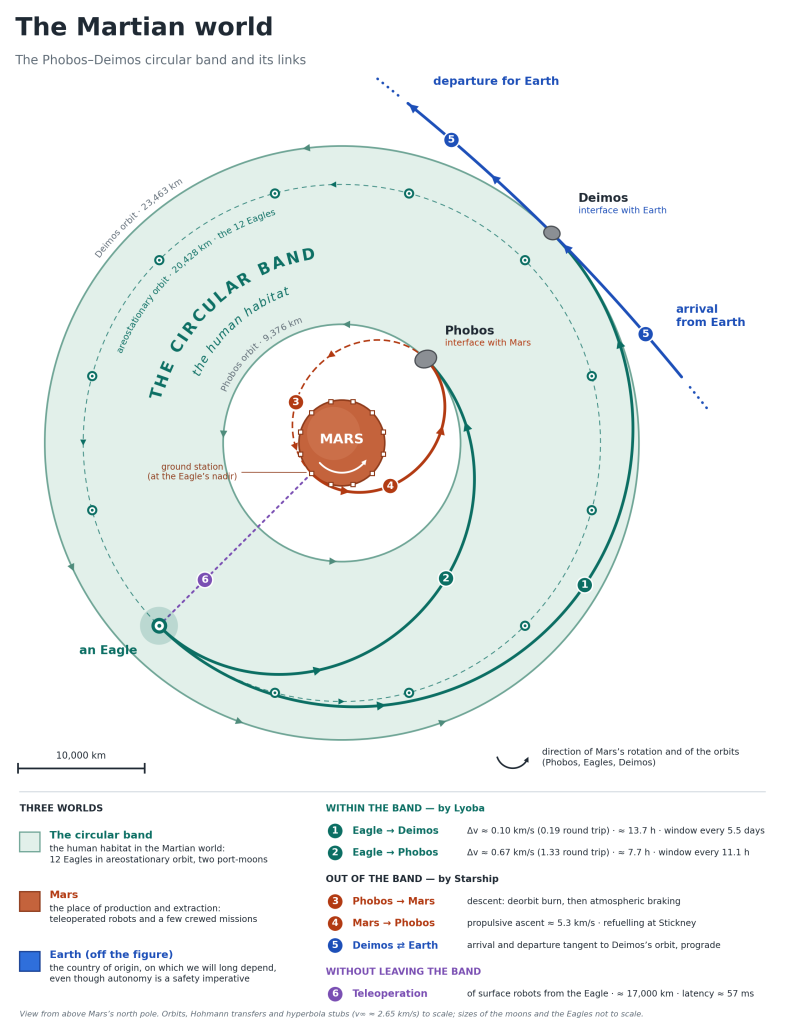
Title illustration (and above): the circular band between Phobos and Deimos as a habitat in the Martian world, with its internal connections and its connections with the surface of Mars and Earth (distances in km to the center of Mars). Diagram created by claude.ai based on instructions from Pierre Brisson.
Copyright Pierre Brisson
To find another post in this blog which could be of interest for you, click on:
xxxx
And, if you enjoy this blog, subscribe (it’s free)!

