Evolution of the Development of the Deimos and Phobos moons
Last week we saw the respective roles that Deimos and Phobos should play in the permanent human settlement that could develop in the Martian world, with a stable habitat in areostationary orbit. At Deimos, the service for arrivals from Earth; at Phobos, the link with the surface of Mars; at both, storage, meetings, consultations and gatherings. The development of these roles induces a need for evolution.
First Part
1. The need for evolution
We have seen that the large anchored rotating station, Deimos-II, built at the very beginning of the Martian adventure to allow the assembly of the first free rotating station, Eagle-One, and to serve as the point of arrival in the Martian world, will wear out fairly quickly (15 to 20 years). It will indeed be very massive (80-metre radius and radiation protection) in order to provide its occupants, for at least 18 months and then for one or more synodic periods of 26 months, with a minimum gravity (0.7 g) resulting of a 2.80 rpm rotation. This will allow to create a minimum gravity in the torus (0.7g) without suffering from too high a head-to-foot gradient (2.3%), too high a Coriolis coefficient (0.13), too high an absolute rotation rate (2.80 rpm), all these figures being below the recognized comfort thresholds. However, the size of the rotating mass will exacerbate the stresses and frictions that will inevitably occur despite the bearings, these frictions being further aggravated by the dusty environment.
Because of this wear, but also because of the evolution, and hence the change in context (introduction of the Eagles — free station(s) in areostationary orbit) and, consequently, the change in the role of Deimos, the first anchored rotating station will have to be replaced by a new one, Deimos III, better suited. At the same time Phobos will also play an important role with respect to the surface of Mars, and this role will justify additional facilities on Phobos, in particular an anchored rotative station, Phobos-II, similar to the Deimos-III station. This station will replace as soon as possible the rudimentary buried shelter located, from the start, near the installations in the Stickney crater (where stays will have been very short).
Also from the very beginning, Deimos will have had a tower and a crane for assembling the first station. Note that this tower will be smaller than the Mechazilla tower used by SpaceX for its Starship, only 40 m instead of 145 m, because the Deimos tower will only have to accommodate the lower part of the Eagle’s axis; the crane, on the other hand, will have to be as tall as the top of the upper part of the station’s axis and will therefore have to reach 90 m, with a 100 m boom (the torus is 80 m from the axis). But this equipment (tower and crane) will not be enough for the further development of activity on Deimos and the diversification of the moon’s functions (as well as Phobos’). Note: the dimensions may seem too large given the masses involved, but it must not be forgotten that this equipment will operate in near weightlessness.
For its part, Phobos will not be the place where the Eagles of the ring of stations are assembled, but it will have the role of a transit station to Mars. This will also require mooring towers for the Starships shuttling to and from the surface. These towers will serve both for mooring the vessels (Starships and Lyobas*), as was once done on Earth for airships, and for their loading and unloading, their overhaul and repair, and their release to depart in such a way that their propulsive flows are not directed toward the surface of the moon (they would cause clouds of dust to spread). These towers will multiply over time as traffic to Mars increases.
*the Lyobas are the high-altitude carriers of the Swiss startup Pave Space.
2. Deimos III
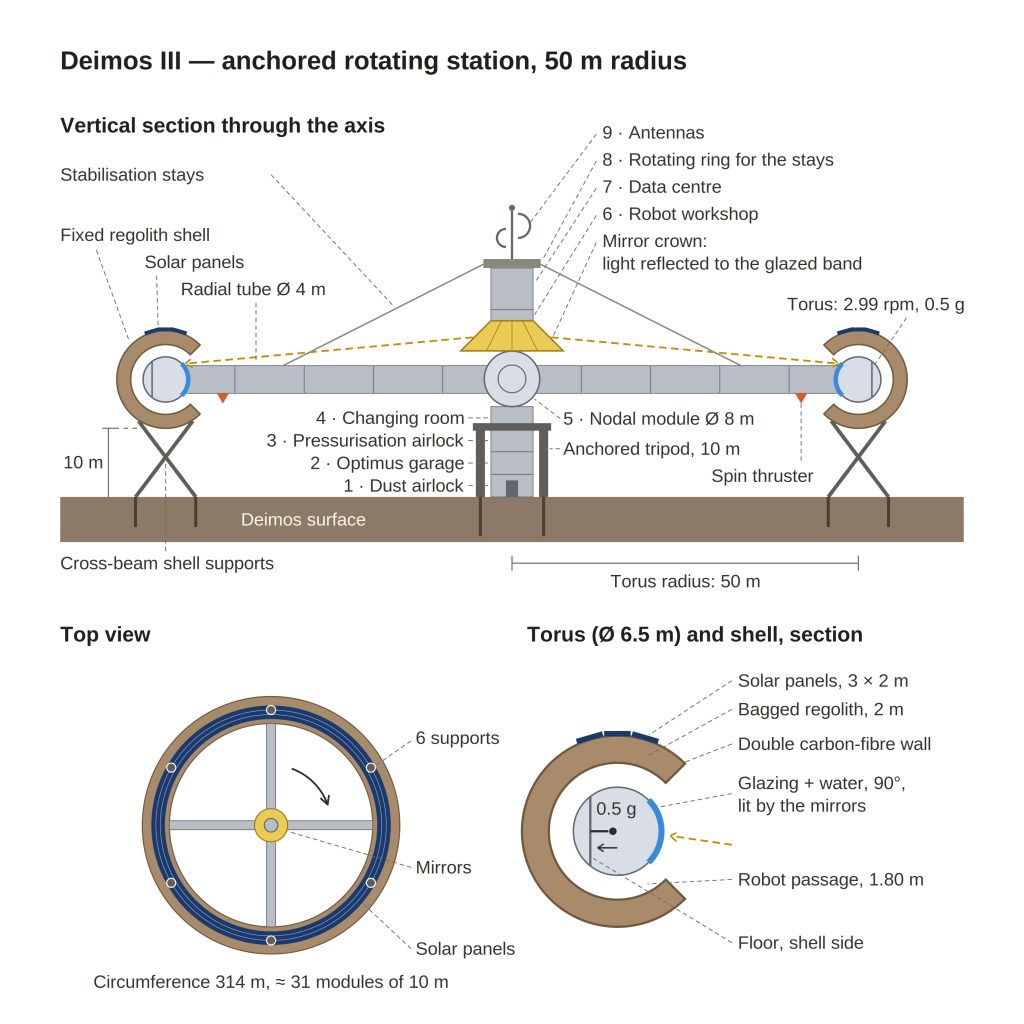
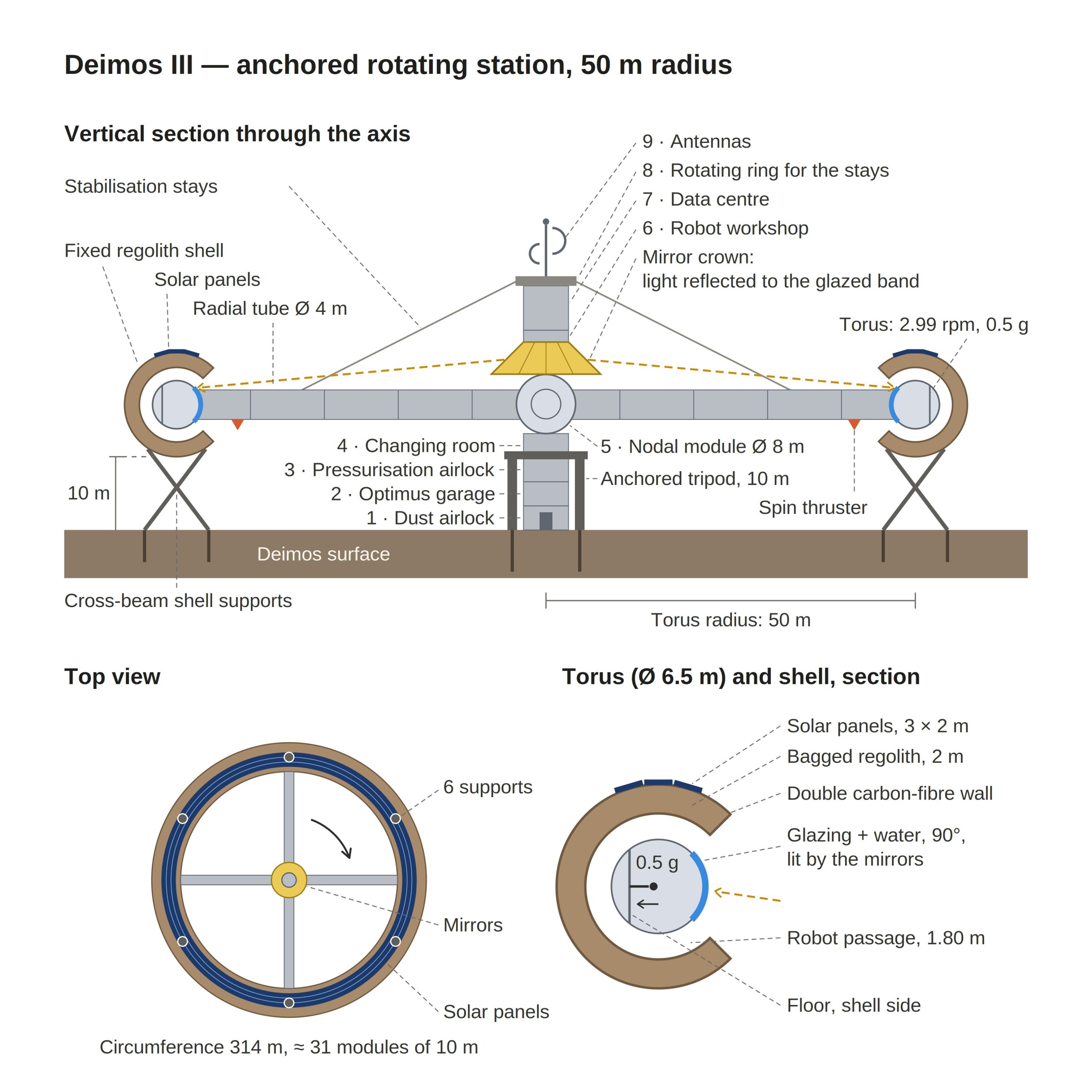
Deimos-III, the new anchored rotating station, may be adapted to shorter stays on Deimos than before the launch of the first free rotating stations where people will live. Indeed, these stays will not exceed 15 days or 3 weeks at most between arrival for the meetings and departure at the end of them, or only a few days for transits to and from Earth. The meetings will be the reason requiring the most time, since not only will the representatives of the various Eagles be unable to arrive at the same time because of astronautical constraints (see previous article), but also it will take a full week of continuous exchanges to justify a physical meeting, which requires a non-negligible expenditure of energy and time.
The construction of other Eagles or the repair of the old ones, as well as the reception of Lyobas coming from the Eagles or from Phobos, and of Starship vessels coming from Earth, will justify new towers and cranes. It will be necessary to plan “big”, both for the Lyobas (in the case of meetings organised for the representatives of all the Eagles together) and for the Starships coming from Earth and waiting for the return synodic window to open. This implies, “in the front line”, as many towers as there may be vessels or carriers on Deimos at the same time; in the second line, a large storage capacity for propellants* coming from Mars via Phobos, and several stations for refilling tanks; in the third line, a hospitality capacity for people staying or in transit. For this last reason, having at least two anchored rotating stations operational at the same time would seem reasonable (redundancy = safety).
*methane and oxygen for the Starships, argon used by Eagles to regulate their rotation, and other gases for the Lyobas.
3. Rotation
The consequence of the short duration of stays is that, a priori, the rotation of the station would not need to “give more” than Martian gravity, i.e. 0.38 g, rather than the 0.7 g provided in the Eagles. However, the a priori is misleading, and 0.50 g will on the whole be preferable. Here is why (for a rotating station of 50 m radius):
0.70 g => rotation 3.54 rpm, tangential speed 18.53 m/s, Coriolis number (Nc) 10.8%
0.50 g => rotation 2.99 rpm, tangential speed 15.66 m/s, Coriolis number (Nc) 12.8%
0.38 g => rotation 2.61 rpm, tangential speed 13.65 m/s, Coriolis number (Nc) 14.7%
For the three options above, the head-to-feet gradient of 3.6% is identical because it depends only on the radius. It is very comfortable: the threshold usually adopted in the literature is of the order of 10 to 15% maximum tolerable (ideally <10%). With a radius of 50 m, the gradient therefore remains well within the zone with no notable physiological consequence (no feeling of a “head lighter than the feet”).
As for the ratio of the Coriolis force to local gravity, the commonly cited thresholds are as follows: < 7–10%: negligible effect, almost imperceptible; 10–30%: perceptible effect, requiring a phase of vestibular adaptation (disorientation during rapid head movements, notably when standing up or abruptly changing radial direction); 30%: troublesome for a significant fraction of occupants, frequent space sickness even after adaptation.
The real disadvantage is a high absolute rotation rate. The Hall/Gilruth criteria* on vestibular adaptation relate to rpm, not to Nc — because the “cross-coupled Coriolis illusion”**, triggered by a head movement during rotation, depends directly on the angular velocity ω and not on the ratio to g. A head movement (bending over, turning around) generates a perceived moment proportional to this rate, whatever the level of artificial gravity produced. At 3.54 rpm, one remains below the 4 rpm threshold generally cited as “complete adaptation for the majority of occupants”, but one is approaching it: the acclimatisation period lengthens, and rapid head movements (bending over to pick up an object, turning around abruptly) become noticeably more perceptible than in the 0.38–0.5 g configurations. This is not prohibitive, but the comfort margin is shrinking. It therefore seems that, as a compromise, 0.5 g at 2.99 rpm would be preferable to the other solutions, all the more so as this 0.5 g would be an intermediate gravity between the 0.7 g of the resident Eagle station and the 0.38 g of the Martian surface.
* The Hall and Gilruth criteria refer to the physiological and geometric limits established for designing rotational artificial gravity environments. The primary objective of these criteria is to enable optimal vestibular adaptation. Robert T Gilruth was an aeronautic engineer at NACA; G Warren Hal was a scientist at NASA (Meeker and Hall data).
** A false, highly disorienting sensation of tumbling, pitching, or rolling that occurs when a person moves their head out of the plane of rotation while the body is already rotating.
I stop here to prevent this article being too long. In my next article I will deal with improving the torus layout, traffic on moons, the Phobos layout, and redundancy in general.
Title illustration (and above): Deimos-III anchored station. Concept Pierre Brisson, realisation claude.ai
Copyright Pierre Brisson
To find another post in this blog which could be of interest for you, click on:
xxxx
And, if you enjoy this blog, subscribe (it’s free)!

