Evolution of the Development of the Deimos and Phobos moons. Part-2
1. Second-generation anchored stations on Deimos or Phobos
We are referring here to the anchored rotating stations Deimos III and Phobos II. The cylindrical modules composing them could no longer be round as those of Deimos II but « oblong » (with a larger diameter perpendicular to the rotating arm). The result would be a larger floor area in width.
With a radius of 50 m, the Deimos-III station would be less massive than the 80 m radius Deimos-II (but il will generate a gravity of 0,5g only). Even with a regolith shell of the same thickness as that of Deimos-II, with a tube of equal diameter, the 270° shell would go from ~52,700 t to ~33,000 t simply through the reduction in circumference (it is above all the difference in the mass of the regolith shell that will make the difference). It would therefore be less fragile and longer-lasting.
The shell will also carry a continuous band of solar panels: three rows of 2 m by 2 m plates, one parallel to the ground at the top of the shell, the other two in contact with it, on either side, inclined at about 16° to follow the curvature of the shell. Over the 314 m circumference, this represents a collection area of about 1,900 m². With the solar flux received at the distance of Mars (586 W/m² on average, from 493 to 717 W/m² depending on the position in the orbit), space-grade cells with 30% efficiency and 15% system losses, one would obtain about 275 kW at peak (Sun directly overhead) and 85 to 90 kW on average over a Deimos day (30.3 h), night and grazing incidence included, i.e. some 2,600 kWh per Deimos day for a site close to the moon’s equator. There will of course be nuclear reactors (SNR), but it would be a pity not to take advantage of solar lighting, even if there will be intermittencies: it will be a supplementary and backup source, independent of the reactors (redundancy always!).
Given the increasing number of exhibitions, meetings, and discussions, and the need for security (redundancy again!), in addition to the transit to and from Earth, another anchored rotating station, « Deimos-IV, » should be set up fairly quickly. The stations following Deimos-II, Deimos IV, as well as Deimos III, Phobos II, and Phobos III (see below), will have the same structural characteristics with different layouts depending on their specialization.
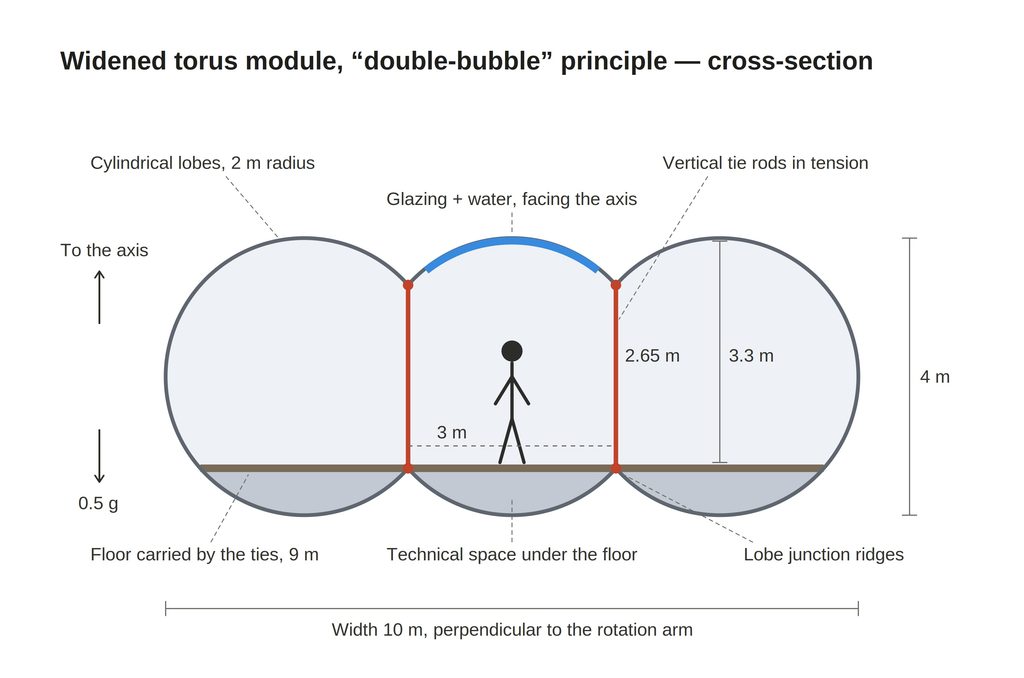
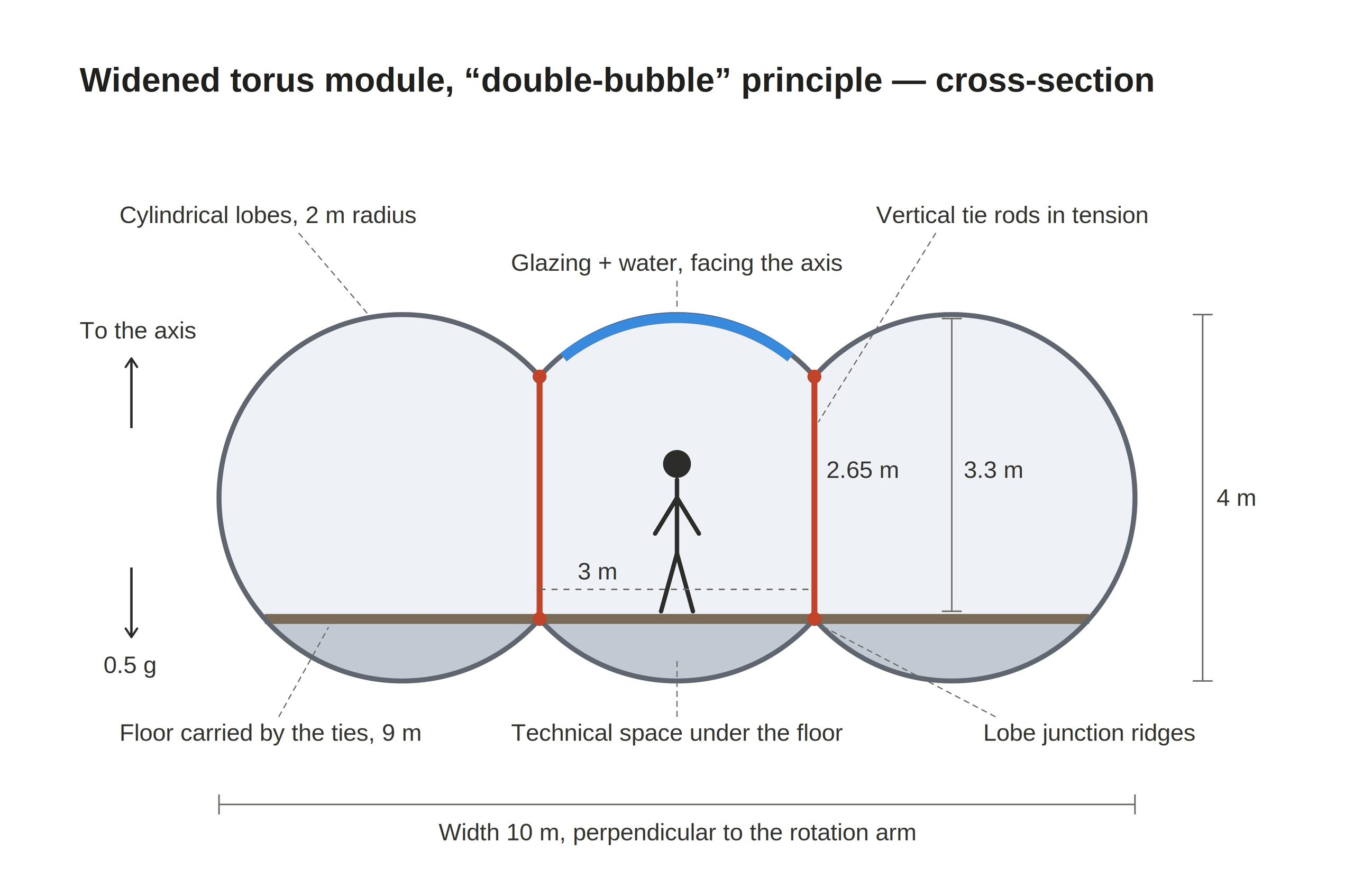
Since the main goal will be to have a large number of people interacting together, the structure of the torus of these new stations should consist of cylindrical modules rather than round ones, but « oblong » ones (with a large diameter perpendicular to the rotation arm). The result would be a floor area that is wider, for example modules of 10 m for the large diameter and 4 m for the small one. However, resistance to pressure will have to be considered. The cylinder is indeed the optimal shape for containing internal pressure, because its wall works solely in circumferential tension. As soon as the section flattens, the less curved zones can no longer convert pressure into pure tension and work in bending, which requires a much greater wall thickness for the same safety — a solution that is costly in mass. The remedy, already validated in aeronautics for studies of so-called “double-bubble” fuselages (two joined cylindrical lobes, intended to widen a cabin without losing the structural efficiency of a cylinder), consists in keeping two zones of high curvature connected by internal tie rods working in pure tension. Applied to the oblong module, this would amount to designing two cylindrical half-shells (floor side and ceiling side) connected by a network of vertical tie rods, which could also serve as the load-bearing framework of the floor itself. The mass penalty would remain moderate (of the order of 10 to 20% compared with an equivalent cylinder, according to comparable aeronautical studies), to be compared with the 50% or more which a simple reinforcement of the flat walls against bending would require. An additional advantage would be easier transport from Earth (smaller volume). Nevertheless, it will still be necessary to increase the diameter of the Starship cargo ship, which today is only 9 m (such increase is already considered).
More concretely, with a height of 4 m, the lobes will have a radius of 2 m, and two adjoining lobes could not exceed 8 m in width. To reach 10 m, the module will therefore have three lobes whose centres will be spaced 3 m apart, and two rows of tie rods (each half-shell, on the floor side as well as the ceiling side, thus being made of three arcs). Each row of tie rods will take up the pressure over a width of 3 m, i.e. about 15 tonnes-force per metre of module length at 0,5 atmosphere (42% of oxygen). Note that this pressure is the one chosen in “my” stations to limit the pressure against the walls (it would be 30 tonnes-force for one atmosphere), while allowing an acceptable proportion of inert gas (to counter fire hazard). The floor, placed at the level of the lower ridges and carried by the tie rods, will be 9 m wide, compared with about 4.7 m in the round tube of 6.5 m diameter (floor 1 m from the bottom), with a clear height of 2.65 m at the tie rods and 3.3 m at the centre of the lobes. Over the 314 m circumference of the torus, the usable area will thus go from about 1,500 m² to about 2,800 m², i.e. nearly double.
2. Getting around Deimos or Phobos
Since there will be several towers (one for each of the twelve Eagles plus perhaps six for the Starships arriving from Earth every 26 months), perhaps two rotating stations, not to mention the propellant tanks and various goods stored awaiting shipment to the Eagles or down to Phobos and the Martian surface, this will cover a large surface area of the moon (the vessels must be able not to touch each other!). A system for getting around between the various places likely to be visited will therefore have to be provided, especially as walking on the ground could stir it up (dust would then be spread and, because of the low gravity, would settle back only extremely slowly). Moreover, there would be a risk of losing one’s footing and leaving the moon by moving too fast. A network of cable cars carried by poles anchored in the ground could therefore be used.
3. Phobos II and Phobos III
On Phobos, the new Phobos II and Phobos III stations will be identical to Deimos III and Deimos IV, since their functions as transit station and meeting place will be very similar. Phobos II & III will be able to generate the same gravity of 0.5 g and will offer the same meeting and hospitality spaces. The difference will be that, in principle, stays there will be shorter since, because of the speed of Phobos’s orbital motion, the departure window from each Eagle (or the return window from the ground) comes round every 11 hours (against 131 h for Deimos). There will be a little waiting before going down to Mars, since one has to be well positioned to arrive right at the base belonging to one’s Eagle. But this wait will never exceed one day, and the advantage of having a whole necklace of bases on the ground around the Equator means that a navigation error or a technical problem preventing a landing at the right place would not be hopeless. However, a minimum of comfort must be provided in case the Deimos III and Deimos IV stations were unusable.
4. Redundancy
In an environment this hostile, uninhabitable without a complete and coherent technical infrastructure, one must always think of accidents and their consequences, and thus of redundancy. Phobos II and Phobos III will therefore be the main redundancy for Deimos III and Deimos IV (vulnerability due to their being on the same moon). But it is also necessary that, as far as possible, either moon can continue to fulfil its role in the event of an accident in the other. The worst cases are a natural impact or one resulting from the loss of control of a vessel (the most serious being that caused by the largest, the Starship). The impact would cause a blast, grazing ballistic ejecta and local fallout that could prevent the anchored rotating stations from working properly or even make them totally unusable. There will therefore be on each moon a basic facility able to serve as a viable shelter and also to protect people from radiation. It will be a buried shelter (emergency post) on Deimos and on Phobos, as there was one on Phobos at the beginning of the Martian adventure.
The location of the shelter will be less difficult on Phobos, which is nearly twice the volume of Deimos. With its dimensions (27 × 22 × 18 km), Phobos will make it possible to set up an emergency post that is geographically better separated from the main installation. But one must be honest about the limits of this shelter: even at the antipodes on Phobos, the surface above the shelter will not be completely protected. The debris cloud will envelop the entire moon, and the approach to the emergency post will cross the same degraded environment. The remedy will then be temporal and ballistic: wait a few days for the cloud to disperse, then approach on an inclined trajectory out of the plane of the debris. The emergency post is therefore mainly of value for the people and equipment already on site at the time of the accident, and as a recovery point once the approach has become safe again.
Reading this text may be frightening, since it highlights the dangers. The worst course would be to ignore them.
xxxx
Title illustration (and above): Cross section of Deimos-III anchored station. Concept Pierre Brisson, realisation claude.ai
Copyright Pierre Brisson
To find another post in this blog which could be of interest for you, click on:
xxxx
And, if you enjoy this blog, subscribe (it’s free)!

