Propellants (2): ground production and storage
In « Propellants (1): the needs for traffic, » we sized the storage facilities—first for an Eagle station, then, using the « surface-tonne » unit, for the consumption of the entire system. We still have to descend to the ground, where propellants are manufactured, and then to organize their stockpiles: this is the subject of this second article, which concludes the study.
I. Production on the ground
The marginal-cost rule and the initial phase
The marginal-cost rule
Each of the twelve ground settlements will have to produce the propellants for its own rotations to the moons. To size this production, a simple rule suffices, derived from the Tsiolkovsky equation applied to our shuttle Starship (dry mass ~120 t, six vacuum engines, specific impulse of 375 s): the climb to Phobos (Δv ≈ 5.4 km/s) imposes a mass ratio of about 4.3: at lift-off, the fully fuelled ship weighs 4.3 times what it will weigh on arrival. Every tonne that reaches Phobos, ship or cargo, has therefore required 4.3 t at departure from the ground: itself, plus 3.3 t of propellant burned on the way. The descent, almost entirely braked by the atmosphere, requires only ~1.2 km/s of propulsion (mass ratio ~1.4, i.e. 0.4 t of propellant per tonne landed). Hence the formula, easy to remember:
Propellants for one rotation ≈ 450 t (the ship alone, round trip) + 3.3 t per tonne carried up + 0.4 t per tonne carried down.
| Item | Propellants consumed | Remark |
| Ship alone, round trip (descent + climb back empty) | ~450 t | ~400 t on the climb, ~50 t on the descent |
| Per tonne carried up (surface → moon) | +3.3 t | mass ratio ~4.3 (Δv ≈ 5.4 km/s): 4.3 t at departure for 1 t on arrival |
| Per tonne carried down (moon → surface) | +0.4 t | loaded at the depot, i.e. ~4.2 t in surface equivalent (ratio ~10.5:1) |
| Crew of 6 (life support included, ~1.5 t) | +5 t up / +0.6 t down | negligible: humans are propulsively free |
| Trip lifting 150 t (full hold: propellant, freight, ores) | ~950 t | typical case: 450 t + 150 × 3.3 t; a Starship almost always flies up full |
| Trip bringing 150 t down (arrivals from Earth, every 26 months) | ~510 t | 450 t + 150 × 0.4 t; the extra 60 t, loaded at Stickney, are worth ~630 surface-tonnes. Ship full both ways: ~1,000 t (450 + 150 × 3.3 + 150 × 0.4) |
Check against our reference figures: a rotation carrying up 100 t costs ~780 t of propellants, a rotation carrying up 150 t costs ~950 t — and a rotation full both ways ~1,000 t: hence the bracket of 700 to 1,000 t. One subtlety deserves mention. The 3.3 t per tonne carried up are propellants loaded on the ground: they cost only their production. The 0.4 t per tonne carried down are loaded at the Stickney depot, where every tonne of propellant first had to be lifted: it cost about 10.5 t produced on the ground if a tanker made the trip just for it (the propellant it burned, plus the delivered tonne itself), 4.3 t if it rode on a rotation that was flying anyway (the 3.3 t burned plus the tonne itself: the mass ratio again). A tonne carried down therefore comes to ~4.2 t of surface propellant (0.4 × 10.5), slightly more than a tonne carried up (3.3 t). Going down is no freer than going up — it is the same plant that spends.
It is the mass of the ship itself ant that of its propellant that dominates everything. The most striking consequence concerns the crews. Six people with their suits and the life-support consumables for a journey of a few hours represent ~1.5 t: that is 5 t of extra propellant on the climb and 0.6 t on the descent — “background noise” against the ship’s own 450 t. Humans are propulsively free. A crew-rotation flight on a Martian mission, without freight, costs practically the price of an empty flight.
Energy, power and machines
Electrical power turns into propellant only over time. The net balance of the chain (CO₂ capture, water electrolysis, Sabatier reaction, liquefaction) is about 6.7 kWh per kilogram of methalox (liquid methane and oxygen), of which electrolysis alone accounts for some 85%. Adding the auxiliary spendings (thermal control, pumps, losses), we will prudently use 8 to 10 kWh/kg. A ~800 t trip therefore requires 6.5 to 8 GWh. The hydrogen itself does not need to be liquefied: it is consumed in the Sabatier reactor as it leaves the electrolyser. Only the methane and the oxygen are liquefied, and the Martian cold helps, especially with buried tanks. Electrolysis even supplies slightly more oxygen than the engine burns, and the surplus goes to life support.
But a quantity of energy is not the whole story. Power also matters, that is, the size of the machines that consume the energy: electrolysers, CO₂ collectors, compressors, liquefiers. For a given amount of energy, the production time sets the power to be installed, and hence the size of the plant. The flow rates make this clear. Producing 100 kg of methalox per hour requires ~11 kg/h of hydrogen, drawn from about 50 kg/h of water (net, since the water formed by the Sabatier reaction is recycled), and ~60 kg/h of CO₂. The CO₂ is the bulkiest item (as Christophe de Reyff very aptly noted in a previous article). The Martian atmosphere holds only about 0.02 kg of CO₂ per cubic metre, so at least 3,000 m³ of gas must be drawn in and processed every hour, and more depending on capture efficiency. The size and reliability of the installation are decided in the pumps, filters and condensers, far more than in the energy source.
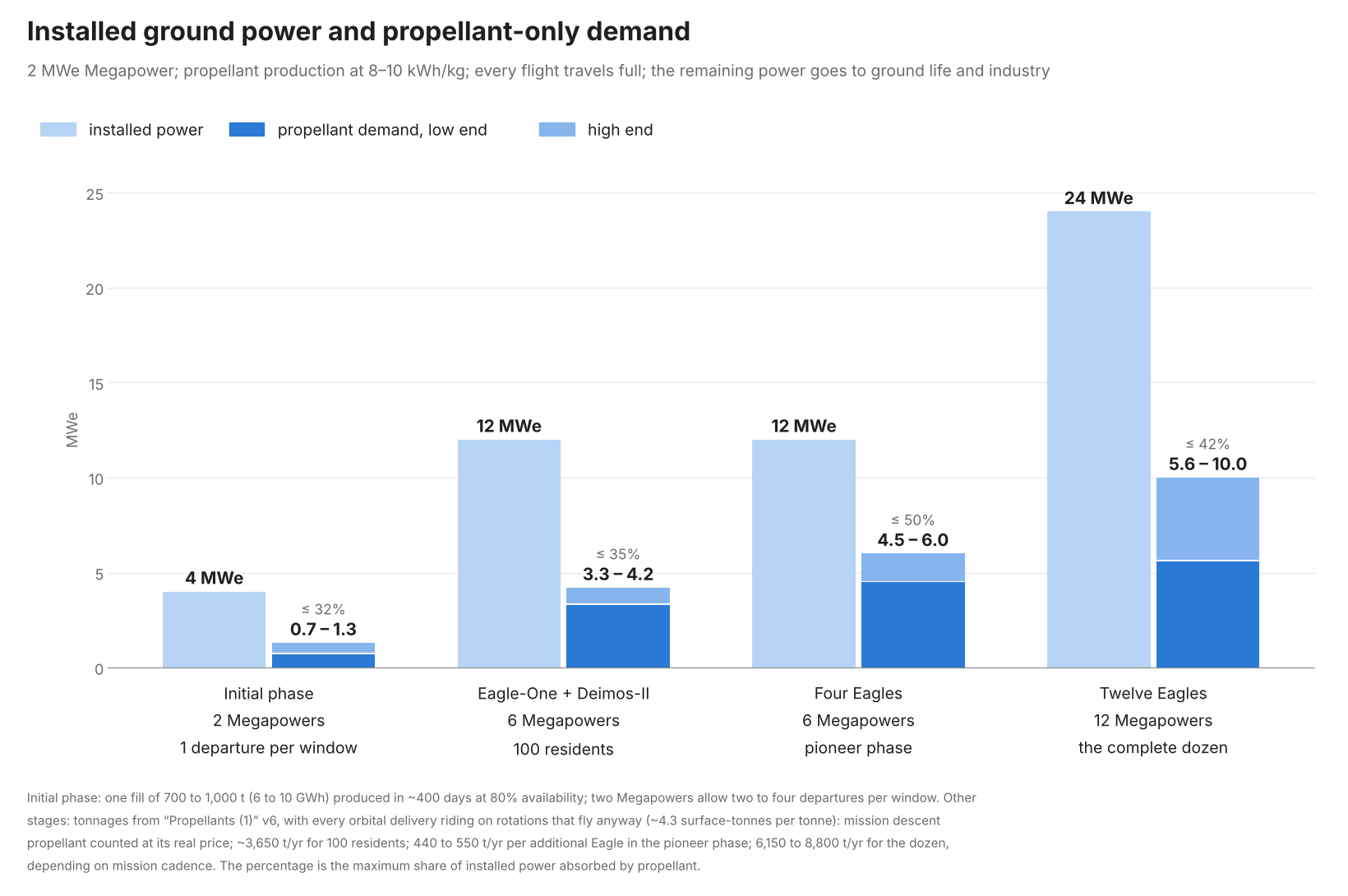
With the nominal fleet of six Megapower units (12 MWe, of which ~10 MWe are available for ISRU once the habitat, robots and industry are served), a plant sized to match the reactors produces an 800 t load in five to six weeks, downtime included. It is then, however, a plant of some ten megawatts, processing more than 30,000 m³ of atmosphere per hour (NB: « minor » problem in case of a dust storm lasting several weeks). The flight rate is proportional to installed power: that of the reactors, but also that of the machines that turn their electricity into propellant. This is the structural link between the reactors, the plant and the platform.
The initial phase: two Megapowers suffice
This arithmetic might seem to doom the beginnings, when only two reactors can be shipped (~80 t between them — they in fact fit together in a single cargo Starship), the rest of the flotilla being taken up by the ISRU plant, the robots and the construction equipment intended for Deimos and the ground. Not at all — precisely because in the initial phase only one ship must depart for Earth: the crewed ship, at each synodic window.
Now the detour via the Stickney depot, with its ratio of ~10.5 t produced per net tonne delivered, pays off only once the depot exists and a shuttle run feeds it. As long as there is only one ship, two simpler options are available. Either the direct return from the surface: climbing from the ground and injecting directly toward Earth costs ~6.2 to 6.5 km/s in all, i.e. 700 to 900 t of propellant loaded on the ground, with no orbital logistics whatsoever. Or, if the ship must call at a moon (to pick up the Deimos-II crew, for example), the climb carrying its own injection propellants as payload: ~130 t of return propellant cost, by the formula above, ~880 t in total — the same order. In both cases, the requirement stays within the bracket of one rotation, 700 to 1,000 t, i.e. 6 to 10 GWh. With two Megapower units, energy is no problem at all. Over the 500 or so days (12,000 hours) of production that a synodic cycle offers, after deducting the outbound voyage, they deliver ~48 GWh, of which a load of 700 to 1,000 t takes only 12 to 21%.
Sizing therefore concerns the machines, not the reactors. If production were spread continuously over those 500 days, an average power of 0.5 to 0.8 MWe would suffice. But several things must be allowed for:
- setting up the reactors and bringing them to full output after landing;
- maintenance shutdowns;
- having the tanks full before the departure window, not on the day itself.
Assuming ~400 days of production at 80% availability, i.e. ~7,700 useful hours, 0.7 to 1.3 MWe of production equipment must be installed. Some 0.6 to 0.75 MWe of this goes to electrolysis, for a flow of 90 to 130 kg of methalox per hour. PEM electrolysers (proton exchange membrane) of this size are already on the market, so this is no technological leap. The reactors keep a comfortable margin: 17 to 33% of their power is enough for the load, and the rest goes to the base and to redundancy. This calculation applies to one ship. Several departures in the same window would multiply the machines accordingly, and with ~2.5 to 3 MWe available for ISRU (ISPP), two Megapower units could supply two to four, depending on each ship’s load. The limiting factor in the initial phase is therefore not the energy source but the reliability of pumps, filters and condensers, so failures, spare parts and repairs must be planned for.
Produce before departing
An operational discipline makes the whole robust, in the direct line of the principle laid down by Robert Zubrin for Mars Direct: the return propellants must be produced and stored before the crew even leaves Earth. Our precursor architecture lends itself exactly to it: at window N, the robotic cargo ships deposit the two Megapowers and the ISRU plant, whose commissioning and production occupy the cycle; at window N+1, the crew leaves Earth knowing that its ~800 t for the return already await it, tanks full. No gamble, no race against the clock: robotic production precedes the first crewed flight.
The initial constraint, far from weakening the architecture, reveals its virtue: it starts small. Two reactors, one plant, one ship going home — then the system grows in steps, and each step (the Stickney depot, the shuttle run, the six Megapowers, then the dozen) is required only by the traffic it itself makes possible. The general rule still holds: the size of the nuclear fleet on the ground, and that of the plant, are set by the fleet that departs.
II. Storage
The geography of the needs draws that of the stocks: three levels, each with its function. At the lowest, the Stickney depot, on Phobos: it is there that the rotations unload their 150 t holds, there that the tanker Lyobas and the shuttles fill their tanks — the wholesale hub, at the system’s best price (~10.5 surface-tonnes per tonne). At the level above, the stocks of Deimos: the strategic reserve, dedicated to the returns to Earth. At the highest level (though not in altitude, since Deimos is higher than the areostationary orbit), the Eagles’ depots: 60 t each — one tanker load —, the local operational stock described in “Propellants (1): the needs for traffic”.
The allocation of the Deimos stocks deserves its written rule. The crewed ship will depart from Deimos: it is therefore at Deimos that it will fill its tanks, before boarding, and it will leave its berth with tanks complete — no refuelling operation on the critical path between the crew and Earth. This choice has a price: a tonne delivered to Deimos comes to ~13 surface-tonnes, a good quarter more than a Stickney tonne, the shuttle run adding its tithe — the tanker Starship lifts the propellants from the ground to Phobos, the tanker Lyobas take over the relay to Deimos. It has it for good reasons, and it extends into orbit the Zubrin principle laid down in the previous chapter: just as the return propellants are produced on the ground before the crew leaves Earth, they are delivered to Deimos before it boards for the return voyage. The target stock follows: one complete return campaign plus a margin — two ships, 260 t, rounded to 300 t —, i.e. five tanker deliveries spread over the cycle, and ~4,000 surface-tonnes produced on the ground (300 × 13): about four rotation fill-ups.
The technique, for its part, will be the same at every level, the one described in “Propellants (1)”: propellants liquefied at 2 or 3 bars (90 K, 111 K), capillary screens and thermodynamic vents for weightlessness, zero boil-off by cryocoolers — and, wherever residents live, an oxygen tank left to “breathe” toward the life support. Only the scale changes: a few dozen tonnes at an Eagle’s berth, a few hundred at Deimos and at Stickney. On all the plateaus of the system, nothing will go to waste.
This concludes our study of propellants: the reactors supply the energy, the machines set the production, production sets the flights, the flights fill the depots — and the depots, from the surface of Mars to the dock of the last Eagle, keep the system moving.
illustration title: Installed ground power and the needs of propellant alone. Graph Made by claude.ai, Pierre Brisson’s concept.
Copyright Pierre Brisson
xxxx
To find another post in this blog which could be of interest for you, click on:
xxxx
And, if you enjoy this blog, subscribe (it’s free)!

