Propellants (1): the needs for traffic
As a reminder, there are two consuming domains: a great circular plateau of low gravity around Mars, and the surface of the planet. The plateau is bounded by the orbit of Phobos (6,000 km above the surface) and that of Deimos (20,000 km above the surface). The latter lies just above the areostationary orbit, the Martian equivalent of Earth’s geostationary orbit (17,000 km above the surface), where the Eagles (rotating space stations) are located, each one overseeing, at its nadir, a sector of the ground where a base hosts visits of limited duration. In this first part, we deal with the energy needed for traffic between the Eagles, between the Eagles and the moons of Mars, between the moons themselves, between the moons and the surface of Mars, and between Deimos and Earth. The energy needed for life in the Eagles or on the moons of Mars is supplied mainly by solar panels.
Each Eagle has, at the end of its axis (at the bottom in our illustrations), a docking sphere with three ports for Lyobas (the shuttles that travel across the great plateau). Two ports are for the residents — the lifeboat and the mission Lyoba — and the third is for visitors. Immediately above the sphere are two cylinders dedicated to propellants, one for methane, one for oxygen.
We will first see (A) what the propellant depot of each Eagle must hold, then (B) what the Martian system as a whole will consume.
A. The quantities for each Eagle
Let us assess the quantities needed, in order to know what volumes we will require and therefore what dimensions and what mass the module storing them must have (bearing in mind that these propellants — methane and oxygen — will have to be kept liquid and very cold; we will come back to this).
Propellant reserves: how much, and how to keep them?
The sizing rule follows from the above: an Eagle must be able to launch each of its missions without waiting for a propellant delivery. Three items translate it into tonnes — counted, as throughout this first article, for a 60 t Lyoba and a specific impulse of 360 s (a measure of an engine’s efficiency: the higher it is, the less propellant is needed for a given change in velocity).
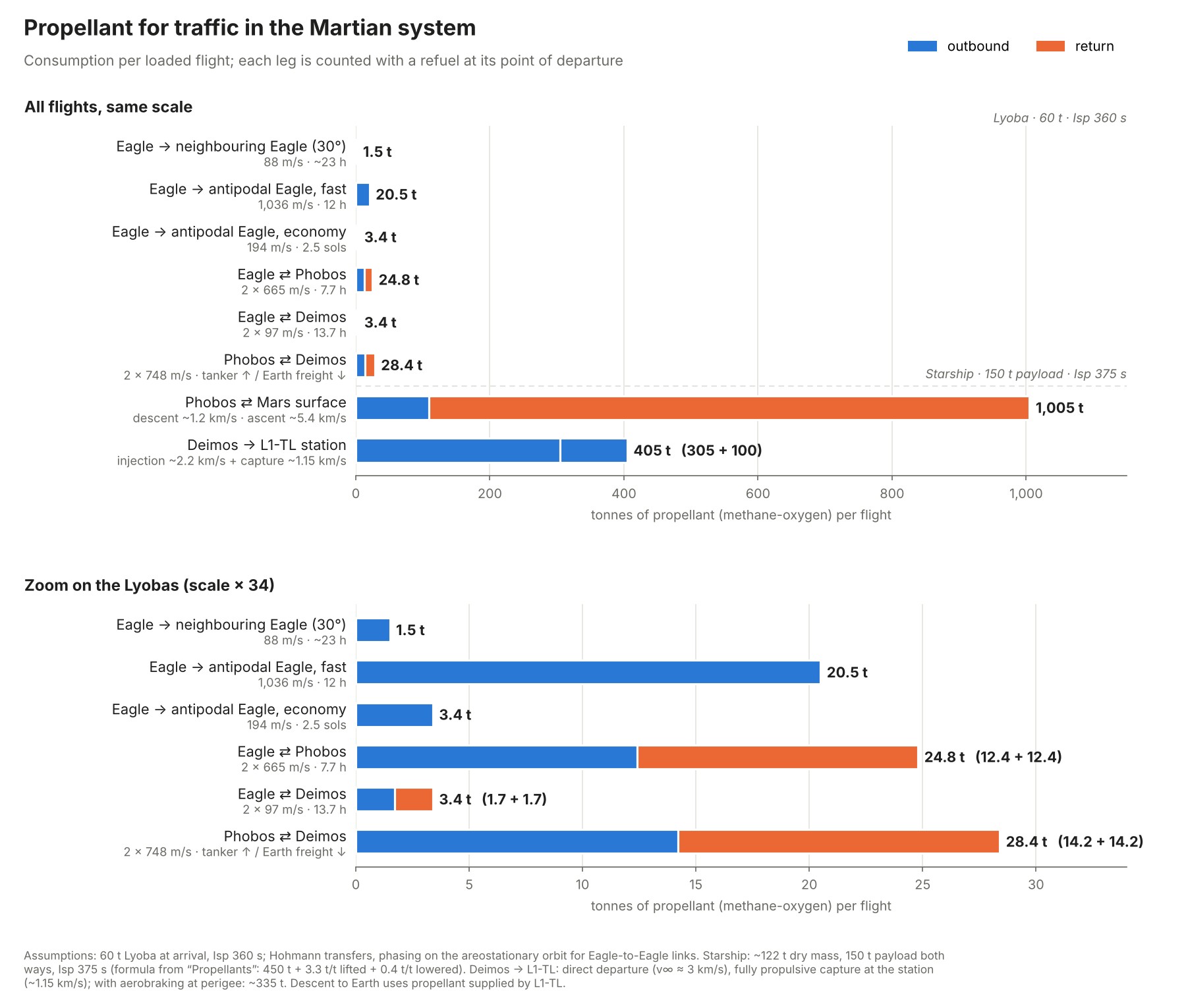
First, the lifeboat: its tanks will be kept full at all times, i.e. ~13 t of methane-oxygen for the one-way trip to Phobos (a change in velocity of 665 m/s).
Next, the mission Lyoba: its most demanding routine trip will be the round trip to Phobos (2 × 665 m/s, ~27 t), which comfortably covers the round trip to Deimos, even in the 4-hour fast mode (~15 t), and visits to neighboring Eagles (a few tonnes); only distant rendezvous along the necklace (up to ~48 t for the antipode) will require a top-up — but these rare trips are planned in advance, and the delivery can precede the departure.
Finally, one refill for the lifeboat (~13 t), to cover evacuation drills and top-ups.
The total falls neatly: ~53 t, which we will round up to 60 t — exactly the payload of a tanker Lyoba. An Eagle’s depot will therefore be counted in delivery units: one full load in stock, with resupply triggered as soon as the level drops below half (~30 t, the price of a round trip to Phobos). Deliveries will normally come from Phobos, since the propellants will be an ISRU product (In Situ Resource Utilization: the on-site use of local resources) coming from Mars. And with a window opening every ~11 h, less than a day will pass between the call and the docking. Note that this depot will serve only the two resident Lyobas: visitors, taxis and tankers will arrive with their return propellant on board.
At the methane-oxygen mixture ratio (~3.6 kg of oxygen per kg of methane), these 60 t break down into ~13 t of liquid methane and ~47 t of liquid oxygen, i.e. ~31 m³ and ~41 m³ — 72 m³ of liquids in all. They will fill the two propellant cylinders (described in the article “Getting to and leaving the Eagles”) built to the common gauge of the axis — 6 m in diameter — one per liquid to keep methane and oxygen apart, immediately above the docking sphere, as close as possible to the ports. Since these modules are not the last ones on the axis (the last ones being the washrooms, changing rooms and EVA airlocks), people and robots must be able to pass through them: each will therefore be pierced by a pressurized axial tunnel with 1.4 m of clear passage, sheathed in vacuum and multilayer insulation, around which the tank will take the shape of a ring — in cross-section, an annulus 5.5 m in outer diameter around a 2 m sleeve. At this gauge, 2.5 m of length is enough for the methane and 3 m for the oxygen, vapor space included: the two modules will take up only 5.5 m of the axis. With the structure, insulation, cryocoolers, radiators, piping, tunnel sleeve and micrometeoroid shield, the whole assembly will weigh some 9 t empty — about 15% of the stored propellant — and the vents will point away from the three docking ports.
Rigidly attached to the docking module, the depot will not rotate, and will therefore be in true weightlessness — and in weightlessness, liquid does not sit at the bottom of the tank: you cannot pump from “the bottom”, because there is no bottom. The solution will be the very one SpaceX is developing for the orbital refueling of its Starships, precisely with methane-oxygen, and it comes down to two passive devices with no moving parts:
First, “capillary” devices. Capillarity is the property by which a liquid, through its surface tension, clings to solid walls and moves by itself through narrow passages — it is what draws coffee up into a dipped sugar cube, water into a sponge, or sap up a tree. Finely perforated metal screens and vanes will therefore line the inside of the tanks: the liquid clings to them, gathers there and is guided to the outlet.
Second, the thermodynamic vent, which solves the other difficulty of weightlessness — venting vapor, not liquid, when pressure rises: a little liquid is drawn off and expanded (it cools down), circulated through a heat exchanger that cools the bulk of the tank, and only vapor is released. It is also through this circuit that the oxygen tank will “breathe” into the life-support system: the vent naturally delivers clean gas. Transfer from a docked tanker Lyoba will work the same way — capillary screens on the tanker side, slight overpressure to push the liquid — and the mass of this internal equipment, a few hundred kilograms, is already included in the module’s ~9 t.
That leaves storage, and first a clarification: the propellants will not be compressed but liquefied — stored at only 2 or 3 bar, at 90 K for oxygen and 111 K for methane. Compressed gas would be ruinous in tank mass as well as in volume; and if methane and oxygen were chosen (by SpaceX as by us), it is precisely because they are “mild” cryogens, not to be compared with hydrogen and its 20 K. The environment helps: at Mars’s distance, the solar constant falls to ~590 W/m² (43% of the terrestrial value) and, at 17,000 km altitude, the planet’s infrared radiation is negligible (~3 W/m²). Under a sunshade and a few dozen layers of multilayer insulation, the residual heat leak — including the passage tunnel, a warm wall at the heart of a cryogenic bath, which will add its fifteen or so watts — will be on the order of a hundred watts per tank. Left untreated, it would boil off ~35 kg of oxygen and ~13 kg of methane per day — 1 to 2% of the stock per month: tolerable between two deliveries, ruinous over a year.
The rule will therefore be “zero boil-off”, demonstrated on the ground by NASA in the 2000s: cryocoolers put back into the tanks the cold that the insulation lets escape. The cost will remain modest — 2 to 3 kW of electricity and a few square meters of radiators, a “crumb” for a station that will have hundreds of kilowatts. We can even do better than lose nothing: the passive boil-off of the oxygen tank (~35 kg per day) far exceeds the make-up that the life-support system of a hundred residents will require (leak compensation, airlock cycling, recycling-loop margins). Nothing will prevent us, then, from letting this tank “breathe” into the station’s circuit and reserving the cryocooler for the methane, which is smaller and easier to cool. The propellant depot will thus double as the Eagle’s oxygen reserve: on the great plateau, nothing will be lost.
The value of patience, and a look at other propulsion modes
First, a word about distant rendezvous. To reach a faraway Eagle on the necklace, one might be tempted to go via Phobos, which passes beneath each Eagle every ~11 h: descend to it, refuel there, then set off again when the moon is in a good position relative to the destination Eagle. That would be a false good idea. Descending from the Eagles’ orbit (17,000 km altitude) to that of Phobos (6,000 km), then climbing back, costs twice 665 m/s, i.e. 1,330 m/s, and takes 16 to 27 h depending on the wait. Staying on the plateau costs much less: one simply leaves the areostationary orbit for an orbit of slightly different period, lets the destination Eagle come to us (or goes to it), then re-inserts. For the antipode, an orbit of half the period arrives in 12 h 20 min for ~1,040 m/s per leg — this is the fast mode costed by the ~48 t round trip mentioned above: faster than the detour via Phobos, and no more expensive, even counting the refueling at Stickney (the storage site on Phobos) at 9 surface-tonnes instead of 13 (~270 surface-tonnes either way). But those willing to make two revolutions on a slightly lower orbit arrive in 37 h for 325 m/s (~6 t); with three revolutions, in 2.5 sols for 195 m/s (~3.4 t) — six times fewer surface-tonnes than the fast mode, without ever leaving the band between the orbit of Phobos and that of the Eagles. The doctrine thus fits in one line: for the antipode, take your time, not Phobos. The detour via the moon is justified only if one has business at Stickney anyway.
Next, the nature of the propellants themselves. On a plateau of such low gravity, could we not do without methane-oxygen — for instance by expelling carbon dioxide, which is inert, non-flammable and storable as a liquid without cryogenics (at ~20 bar around −20 °C)? Surface-tonne accounting settles the question: in the Martian system, a tonne costs first of all by its transport, not by its production. Yet cold-expanded CO₂ offers a specific impulse of only ~65 s (~130 s if heated), against 360 s: the Eagle–Deimos round trip of a 60 t Lyoba, which burns 3.4 t of methane-oxygen, would require ~21 t of it (~10 t heated), and the one-way trip to Phobos more than 100 t. Lifted from the ground, this “free” gas would become the most expensive propellant in the system. It nevertheless has a ready-made use: attitude control and final approach of the Lyobas. The quantities involved are small, the plume is clean and flameless a few meters from the hull and the ports, and the source is on board: each resident exhales ~1 kg of CO₂ per day, which the life-support system removes from the air in any case; the share not recycled into crops or oxygen will feed the cold-gas thrusters of the resident Lyobas. Finally, should the Japanese MMX mission reveal exploitable volatiles on Phobos (carbon, water), the question would have to be reopened: a propellant that does not have to be lifted from the ground changes the whole arithmetic.
For non-urgent freight, the real savings will come from electricity rather than chemistry. The Martian atmosphere contains ~2% argon, which the ISRU plants recover at little cost: when CO₂ is condensed, nitrogen and argon remain in the residual gas, from which they are easily separated. Expelled by a Hall-effect thruster at a specific impulse on the order of 2,000 s, this argon — even when lifted from the ground at the surface-tonne price — reduces the Eagle–Deimos round trip of a 60 t cargo Lyoba to ~0.6 t, and the one-way trip to Phobos to ~2 t. The trade-off is slowness: with a hundred or so kilowatts of solar power, thrust hardly exceeds a few newtons, and each trip takes two to three weeks. It will never be the mode for passengers; it can be the mode for spare parts, consumables and modules moving between Deimos and the Eagles — a slow conveyor, almost free in propellant, which will relieve the methane-oxygen depots accordingly.
B. The quantities for the system as a whole
We have just seen what each Eagle’s depot must hold — a few dozen tonnes, maintained by successive deliveries. But this depot is only one terminus among others: before going down to the ground where propellants are made, we must take the measure of everything the Martian system will consume — and answer the question that sets the pace of colonization: how many Eagles do propellants allow, four or the full dozen?
From one Eagle’s depot to the whole system: the surface-tonne
Every tonne of propellant burned anywhere in the Martian system will have been produced on the ground, by one of the ISRU plants, with electricity from the Megapowers (nuclear reactors installed on the ground, ~1.7 MWe each). To add up consumption occurring at different levels — on the ground, at Stickney (Phobos), at Deimos, at an Eagle’s dock — we need a common unit of account: the surface-tonne, i.e. the tonne produced by the plant on the ground, with everything its delivery will have cost along the way. The exchange rates follow from our reference figures: a tonne delivered to the Stickney depot has cost about 9 t produced on the ground; a tonne delivered to Deimos, about 11 to 12 t, the shuttle chain of tanker Lyobas adding its own Tsiolkovsky stage (the law that makes propellant mass grow much faster than the target velocity); a tonne delivered to an Eagle’s depot, about 13 t, the tanker’s round trip (2 × 665 m/s) burning ~27 t for 60 t delivered. The rule is easy to remember: the farther out in the system one consumes, the more expensive the tonne — by a factor of 9 to 13.
Let us apply this accounting to the scenario that will follow the completion of Eagle-One: a Martian population of 100 people — 50 in Deimos-II (a rotating station anchored to Deimos), 44 in Eagle-One (the first Eagle), 6 on a surface mission. Per synodic cycle (~26 months, the interval between two Earth–Mars launch windows), there will be four items:
First, returns to Earth, the dominant item: 60 people go home — 20 remain in each station, if only to ensure continuity between the departure of some and the arrival of others — i.e. two ships of 30 passengers (capacity being 40) and ~130 t of injection propellant each: 260 t loaded at Deimos, i.e. ~3,000 surface-tonnes.
Next, Eagle-One’s shuttles: one every two months, thirteen per cycle, almost all of them Hohmann transfers to Deimos (the most economical trajectory between two orbits) (~4 t per round trip) — barely more than 50 t at the depot, i.e. ~700 surface-tonnes.
Deimos-II’s own links (freight receptions, meetings, rotations to Phobos): on the order of 900 surface-tonnes.
Finally, surface missions, four per year, eight to nine Starship rotations per cycle: 4,000 to 4,500 surface-tonnes, ships and payloads included.
The total envelope approaches 9,000 surface-tonnes per cycle. But this counts the same flights twice: the first three items implicitly include dedicated tanker rotations, whereas a simple discipline — no Starship climbs back empty — entrusts these lifts to the mission rotations, which fly anyway: four or five of them, each carrying 150 t of propellant in its hold, cover the entire orbital demand, and a tonne lifted this way costs only ~4.3 surface-tonnes instead of 9. The envelope falls back to ~6,500 surface-tonnes per cycle, i.e. ~3,000 t per year, i.e. ~45 GWh per year: at 15 kWh per kilogram, about 5 MWe dedicated to ISRU. The nominal fleet of six Megapowers, with its ~10 MWe available, covers the minimal scenario with a margin of one to two.
Development after Eagle-One
What, then, does each additional Eagle cost? Two regimes will follow one another. In the pioneer phase, most residents will want to go home at the end of their stay — this is the case above, 60 returns for 100 residents — and the dominant item grows with the number of stations: about 2,000 to 2,500 surface-tonnes per cycle and per Eagle, i.e. ~15 GWh per year — one Megapower per Eagle, in round figures. NB: the Megapowers are on the surface of Mars.
Then, station after station, a threshold of confidence will be crossed (effects of the environment on people, reliability of equipment, and… company): in the mature regime, about ten residents per Eagle and per cycle will return to Earth — the 120 people of the complete dozen will fit in three 40-seat Starships — and the marginal cost will fall back to routine deliveries plus a share of a ship: ~1,000 surface-tonnes per cycle, ~7 GWh per year — half a Megapower per Eagle.
The question raised at the outset is thus answered. Four Eagles spaced 90° apart live on the fleet of six Megapowers. The complete dozen — returns, deliveries to twelve depots, Deimos-II’s links and a surface activity that will have grown in proportion — will require on the order of 100 to 130 GWh per year depending on mission cadence, i.e. 12 to 16 MWe of ISRU: the dozen Megapowers will suffice. As for cadence, some thirty rotations per cycle, which two or three shuttle Starships can easily handle — it is production that paces the flights, never the fleet. There is therefore no propellant ceiling that rules out twelve Eagles: the constraint is an indexation — one Megapower per station as long as the pioneers go home, half a Megapower afterwards. What is unreasonable is not a mass but a regime: systematic sprints where Hohmann transfers suffice, improvised round trips to the antipode, refueling at the most expensive level — every such habit pays its factor of 9 to 13.
These exchange rates rest on arithmetic that must now be established: let us go down to the ground, where propellants are made — this is the subject of the second article: “Propellants (2): ground production and storage”.
illustration title: Propellant needs for various types of journey around Mars. Made by claude.ai, concept Pierre Brisson.
Copyright Pierre Brisson
xxxx
To find another post in this blog which could be of interest for you, click on:
xxxx
And, if you enjoy this blog, subscribe (it’s free)!

