Deimos, the ideal construction site for a space station in the Martian world
Context
Building a rotating space station in the Martian world is the only viable solution for providing an environment where gravity could be compatible with long-term human health. Choosing Deimos as the construction site is the best option available. Its gravity is sufficiently low (0.00029g) to make the handling of the enormous masses involved (62,250 tons including radiation shielding) physically manageable, and to allow the station to be released into nearby space without prohibitive energy expenditure.
Logically, the first step should be a rotating space station near Earth — to test not only the concept of this type of habitat, but also the reliability of its design. This first station (generating 0.5g at a radius of 60 m) would also serve as a replacement for the ISS as it approaches end of life. If positioned at the Earth-Moon L1 Lagrange point, outside Earth’s gravity well, it would additionally serve as a stopover for crewed ships returning from deep space. I will call it « L1EML » (Earth-Moon L1).
The second step would be a station in the Martian system, built on the same principles as L1EML. A surface location on Mars is out of the question: the planet’s gravity (0.38g) is too low for permanent human health, yet too high to spin up a rotating station large enough — and therefore massive enough — to compensate for that very deficiency. It is also worth noting that radiation exposure on the Martian surface would not be fundamentally different from that on the moons Phobos and Deimos, given the thinness of the atmosphere even at the lowest surface levels and the absence of a planetary magnetic field. The second station must therefore be on one of the two moons. Which one? Phobos has nearly twice the gravity of Deimos (0.0005g), is already deep inside Mars’s gravity well (6,000 km altitude versus 20,000 km), and rotates very rapidly (7h30), producing short day/night cycles that induce significant mechanical fatigue. Deimos, by contrast, is nearly synchronous with Mars (30h00). The second station will therefore be on Deimos, and I will call it « Deimos-II. » It would be slightly larger than L1EML (80 m radius) to generate a somewhat higher gravity (0.7g), reducing the health risk of long-term exposure to sub-optimal gravity. For the same reason, it would require more effective shielding than L1EML — and the simplest solution is to make extensive use of the moon’s regolith.
The difficulty with Deimos (as with Phobos and, to a lesser extent, Mars) is dust and residual gravity, combined with the need for anchorage and the moon’s day/night cycles. These factors cause friction and mechanical stress on the structure. Deimos-II should therefore not be expected to operate for more than 15 to 20 years without major restoration.
It is therefore necessary to « go further. » The solution is to build a second station on Deimos and then release it into space, positioning it on the nearby areostationary orbit — the Martian equivalent of Earth’s geostationary orbit — at 17,000 km from the surface, reachable with a Δv of 85 m/s following a departure of only 5.6 m/s, plus up to roughly 7 m/s depending on the chosen point on the orbit. I will call this vehicle « Eagle One, » and I will now give you the details of its construction and release.
The structural elements of Eagle One will for the most part be identical modules to those already used for Deimos-II. They will come from Earth, since no Martian industry will yet be capable of producing them. Water will be needed for part of the radiation shielding and for life on board; it is largely recyclable, and will come from Martian ice since there is no water on the moons — but Mars is not far. The regolith that makes up 84.7% of the total mass will come from the surface of Deimos itself.
It is important to clarify at this point that while the weight of the assembled station on Deimos will be very low — only about 19 tonnes in total, due to the gravity — its inertia will remain unchanged at 62,250 tonnes. The low weight will make it easier to lift large masses, but inertia will require that all movements be made very slowly during the assembly and construction phase. Later, the low weight and low escape velocity (5.6 m/s from Deimos, compared with 5.3 km/s from Mars) will greatly ease the process of releasing the station from the moon’s gravitational sphere.
Assembling the torus and the axis
The horizontal portion of the station — torus, torus shell, and radial tubes — can be built lying flat on the surface, since it can be lifted afterward. The axial modules, by contrast, must be assembled vertically, as re-erecting a structure from an inclined position is always more complex. This axis will have an upper section and a lower section, each 40 m tall. The two sections will meet through a fixed 1.5 m-diameter tube passing through a central sphere, which serves as the junction between the vertical axis and the horizontal radial tubes leading to the torus. NB: The entire working surface of the site will be covered with modular geotextile membranes to contain the dust. Assembly will proceed symmetrically, both for the radial tube elements and for the torus arcs, to maintain mass balance on a surface that behaves more like a fluid than solid ground.
After considering a pit in which to stack the lower axis modules — thereby avoiding the need to lift the horizontal assembly over them — I abandoned this approach due to the nature and density of Deimos’s surface. The low gravity and extreme dryness give the regolith very low cohesion, making solid pit walls impossible: once excavated, the walls would collapse like a low-viscosity fluid. Working at the bottom of such a pit would also be extremely difficult. The only viable solution is therefore a tower.
In fact, two towers will be needed: one hollow — a tube — in which the lower-axis modules can be assembled and held perpendicular to the moon’s surface; and the other one, a crane, to lift the horizontal assembly once completed on the ground, position it above the lower axis, then finish the vertical axis by stacking and welding the upper modules one by one, and finally attach the stay cables that ensure stability of the horizontal assembly.
The tube will be a metal lattice structure reinforced by periodic rings and vertical posts. The posts will be doubled on the inside by rails, along which each module slides via a « spider » bracket — rigid radial arms fixed to the module’s shell, each ending in a shoe sized to the rails’ constant radius. That radius is set by the widest module in this section of the axis (the docking sphere, 8 m); for the standard-diameter levels (6 m), the spider arms make up the approximately 1 m gap on each side.
At the base of the tube, after digging a shallow cavity (and before stacking the modules of the lower axis), the departure thrust device will be installed. Its purpose is to impart the necessary departure velocity over the height of the tube, without rocket propulsion, so as not to disturb the ground beneath. The device consists of the following components:
An « anvil »: a fixed anchor with a wide bearing paddle at the bottom of the cavity, remaining on Deimos after departure. A compressed-gas bladder: a flexible, hermetic envelope, pre-charged and locked throughout the construction period, released at the end — preferred over a conventional piston/cylinder because it has no sliding seal continuously exposed to dust over several months. A distribution plate: placed on top of the bladder, it spreads the pressure evenly across the cross-section of the lower module rather than concentrating the force at a single point. A protective crown: encircling the lower rim of the last module during static compression and then during dynamic thrust, it is jettisoned once the departure velocity is reached — the same principle as Starship’s hot-staging ring.
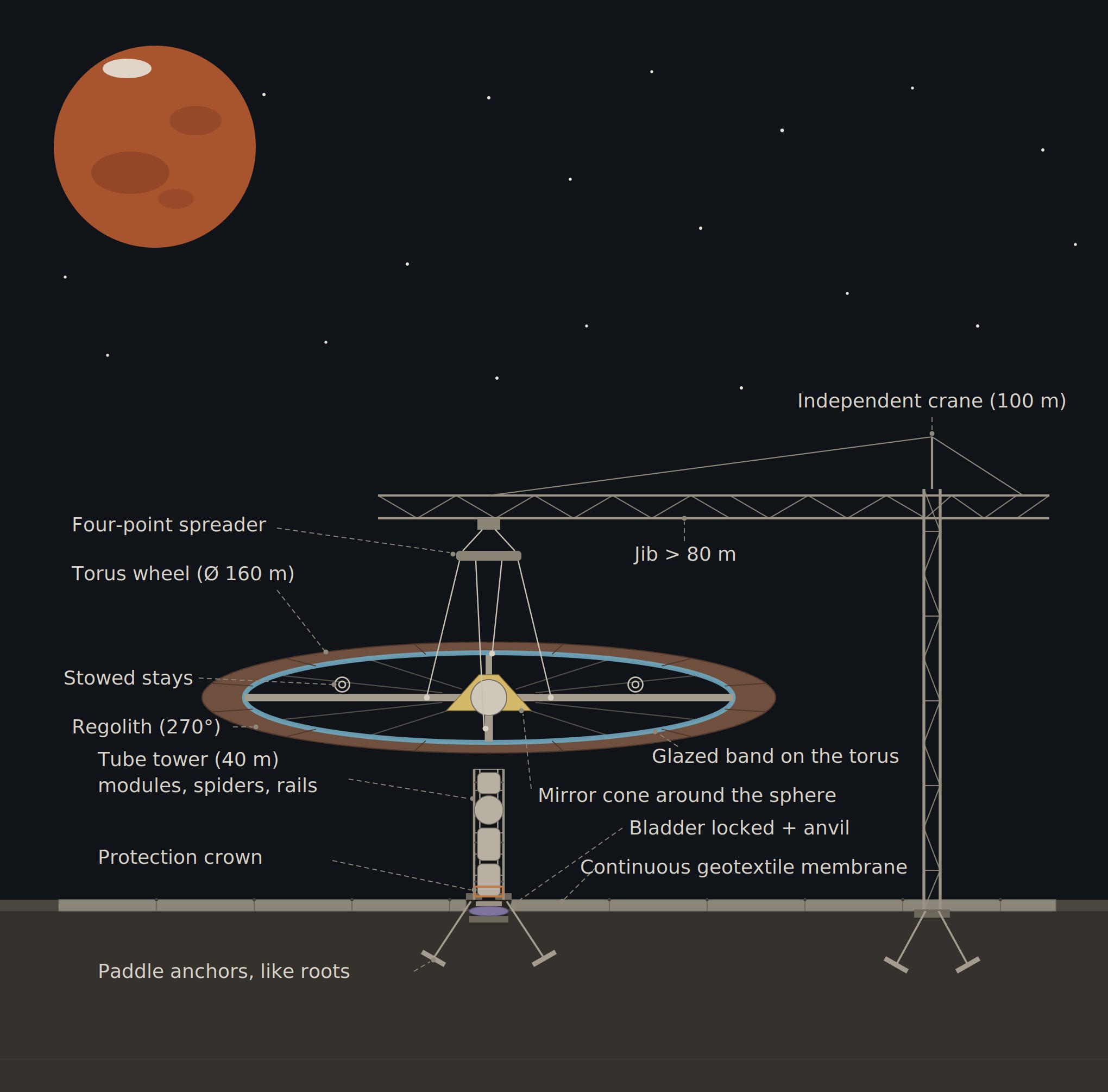
The crane will be positioned alongside the tube and the assembly area where the horizontal part of the station was built. It is of the « Mechazilla » type in its tower section — a robust metal lattice structure. It carries a jib to grasp the torus wheel at its center and lower it onto the upper end of the lower axis. The grip is provided by a four-point spreader bar fitted with hooks that each grab one of the four radial tubes through the reinforcement lattice, just beyond the mirror cone positioned around the axis. After translating the wheel into position, the crane will complete the axis by stacking the upper modules above the central sphere. Welding them together will be done primarily from the inside, since all modules communicate with one another.
The dimensions will be: 40 m in height and 8.3 m in diameter for the tube; 100 m in height for the crane tower (for reference, the Starship Mechazilla tower stands at 146 m); and the crane’s jib must exceed 80 m. This length explains why the critical risk is not the transported weight, but tipping.
The main challenges posed by these structures will be transportation from Earth and anchoring to Deimos’s ground.
Transporting these two structures from Earth carries a real logistical cost: until a Martian foundry is operational, the lattice bars and nodes must come by Starship, in standardized segments of approximately 9 m, requiring several dedicated flights. This cost is reduced by nesting segments inside one another in the cargo bay — the narrower jib elements can slide inside the open lattice volume of the tower segments. Fortunately, this cost will not recur: both structures will remain on Deimos and will subsequently serve the entire collar of stations around Mars. It will also decrease as a Martian foundry eventually comes online, making it possible to produce these bars locally rather than importing them from Earth.
Ground anchoring will not be straightforward. Both the crane (at risk of tipping) and the tube require tensioned cables, inserted only a few meters deep but multiplied per structural foot, and critically, terminating in wide deployable paddles that lock at an angle when pulled — the « duckbill Earth anchor » principle.
This type of anchoring is counter-intuitive but makes perfect sense when understood: on Earth, an anchor’s holding capacity depends almost entirely on the confining pressure exerted by the weight of the surrounding ground. On Deimos, this mechanism is nearly absent, since there is almost no weight to compress the regolith at any depth. The correct approach is therefore the inverse: favor bearing area over depth, and multiply anchor points per structural foot to spread the load — a load that, in any case, consists almost entirely of tipping moments and dynamic construction forces, since the structures’ own weight is itself negligible at this gravity. The drilling required to place them can reuse the same sealed auger mechanism already planned for regolith extraction without dust dispersion.
Departure
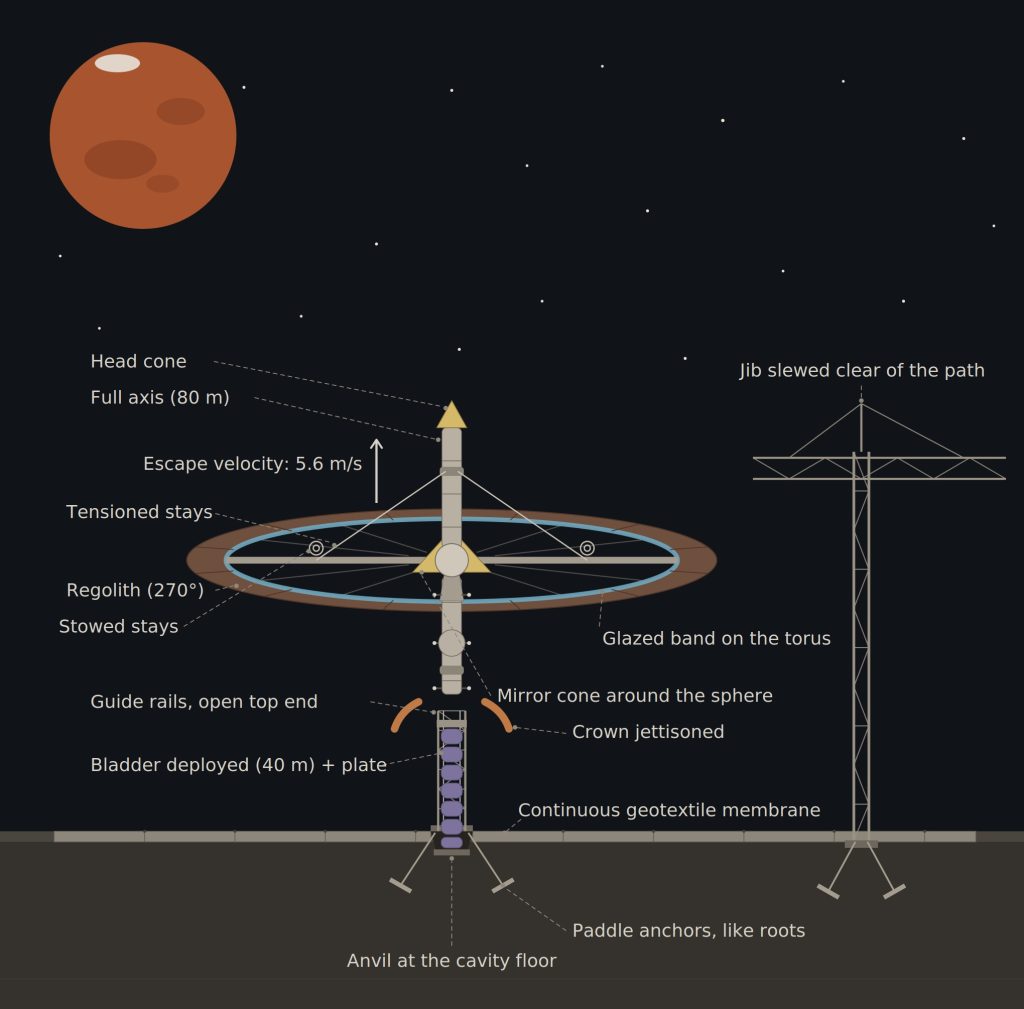
At the end of construction, it will « simply » be a matter of releasing the compressed gas stored in the bladder beneath the axis. The bladder will expand inside the assembly tube over a height of 40 m. The departure velocity (5.6 m/s) should be reached by the time the stroke is complete. The protective crown is then jettisoned — just as hot-staging worked before it was integrated into the SuperHeavy booster.
The station will then slowly make its way to areostationary orbit under electric propulsion powered by a nuclear reactor expelling argon — a gas that constitutes approximately 2% of the Martian atmosphere.
The same site can then be used to assemble the next Eagle, drawing on modules shipped from Earth and stored on Deimos or Phobos. As the number of stations grows, the cost per unit will steadily fall through economies of scale — and the collar of stations around Mars will gradually take shape, each one permanently positioned above its own territory on the surface below.
xxxx
Title illustration: Assembling Eagle One. The crane is putting the torus above the lower part of the axis. Concept Pierre Brisson, realization claude.ai
Illustration hereunder: Launching Eagle One to Space. Concept Pierre Brisson, realization claude.ai
xxxx
Copyright Pierre Brisson
xxxx
To find another post in this blog which could be of interest for you, click on:
xxxx
And, if you enjoy this blog, subscribe (it’s free)!

