Between Deimos, Mars and Earth, it’s gravity that makes the difference
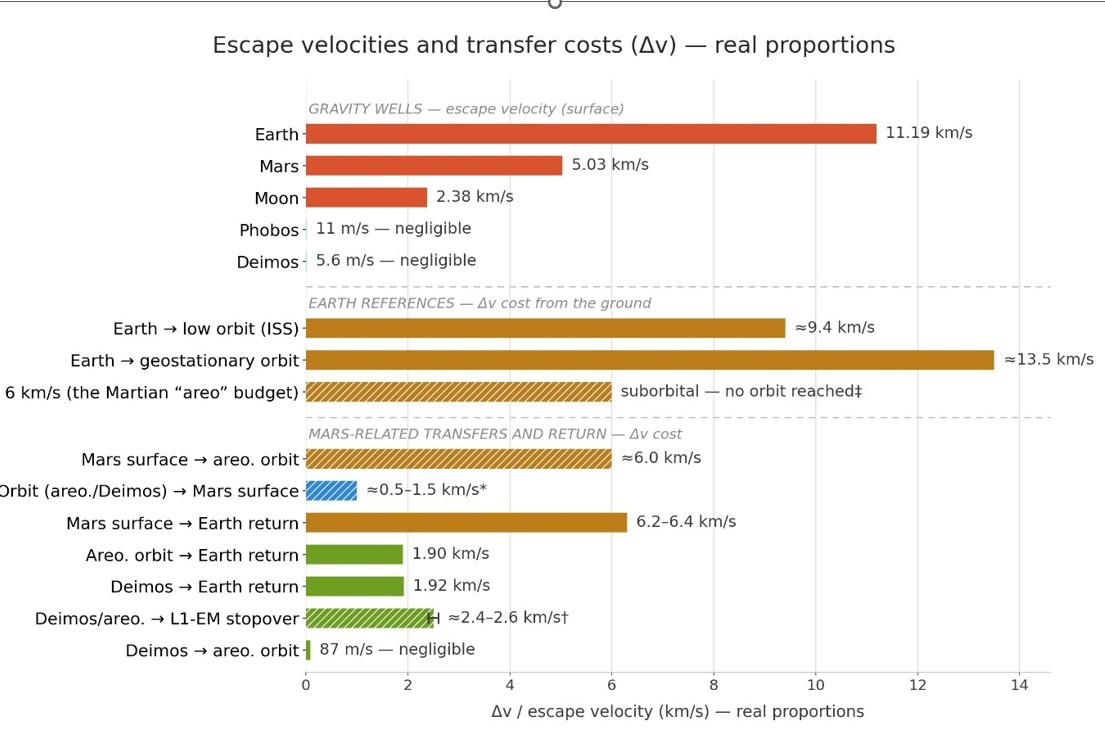
The Earth-Mars distance ranges from 56 million to over 400 million kilometers, depending on where the two planets sit on their orbits — a sevenfold swing. One might assume that this distance is what determines the cost of a trip. That is false, or nearly so: what costs energy is not crossing interplanetary space, but tearing free from the bottom of a gravity well, or plunging back into one. This distinction — gravity rather than distance — runs through the entire Deimos-II / Eagle-One architecture. It deserves to be stated once and for all, with the numbers to back it up. Let us start at the bottom of the scale: escape velocity, the speed needed to break free of a body’s pull once and for all, starting from its surface. On Earth, it is 11.19 km/s. On Mars, 5.03 km/s — less than half, which already explains why a return trip to Earth costs more than the outbound leg (on the Moon, 2.38 km/s). And then, on Phobos and Deimos, Mars’s two moons: 11 and 5.6 meters per second. Not kilometers per second — meters per second. The ratio between Earth and Deimos is roughly 2,000. That difference, by itself, is what makes the entire Deimos-II architecture possible: you do not build a rotating station of several tens of thousands of tonnes, like Eagle-One, on a body you would later need to escape at 11.19 km/s or even at 5.03 km/s; you build it where escaping costs almost nothing (to go somewhere where the trip cost almost nothing more).
* Deimos-II is a station anchored in Deimos’s ground; Eagle-One is an identical station, released from its anchor and positioned in areostationary orbit (the Martian equivalent of Earth’s geostationary orbit).
Shown in real proportions (rather than on a logarithmic scale), comparison hits very hard: Phobos and Deimos simply vanish, flattened against the axis — visually negligible next to Earth’s 11.19 km/s.
Terrestrial yardstick: what does 6 km/s buy at home?
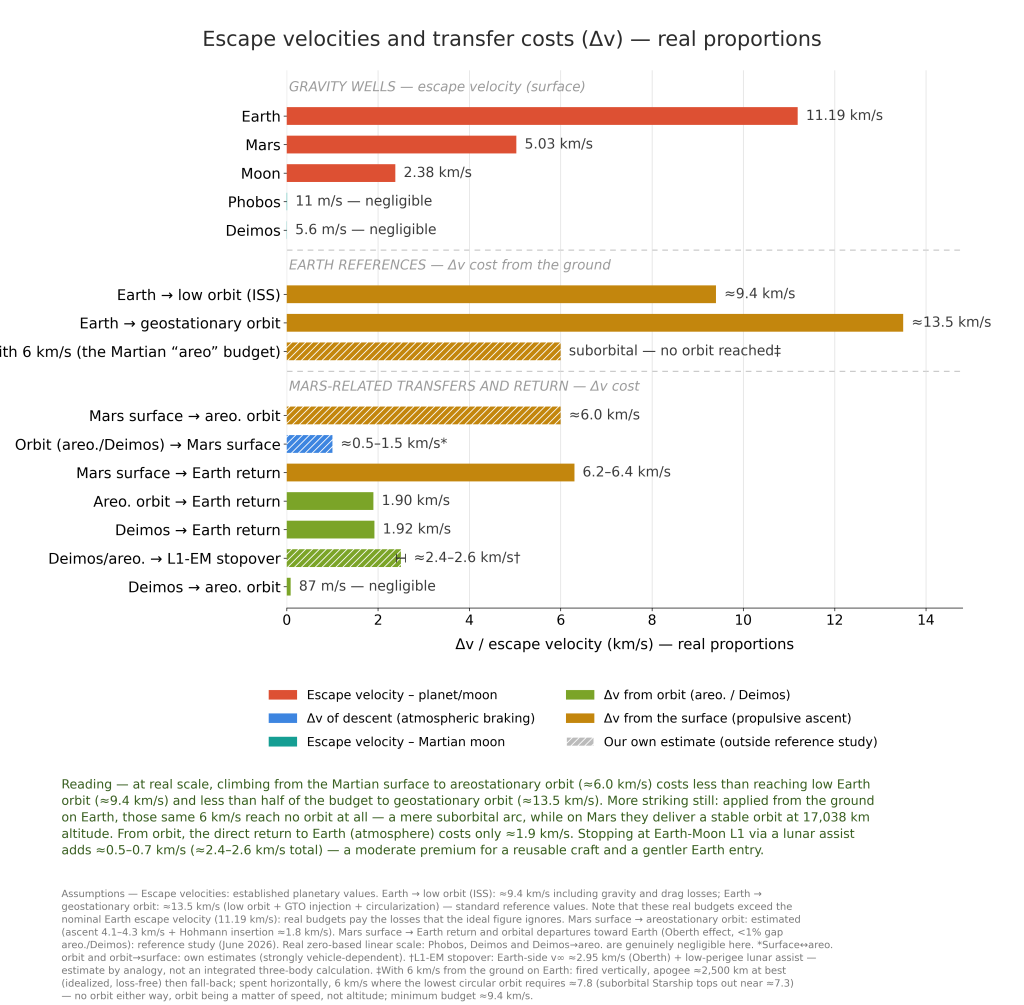
These Martian figures come into sharp relief when set against the references everyone carries in mind: those of the rockets that leave Earth. Reaching mere low orbit — that of the International Space Station — costs about 9.4 km/s, gravity and drag losses included. Reaching geostationary orbit costs about 13.5 — more, one will note, than Earth’s escape velocity itself (11.19 km/s): the latter is an idealized figure that ignores the losses every real launcher must pay.
Against these references, the Martian budget changes face:
The 6.0 km/s that suffice, on Mars, to lift a vehicle from the surface to areostationary orbit — 17,038 km up, a stable and permanent orbit — would reach, applied from the ground on Earth, no orbit at all. Two figures make it plain: the minimum orbital velocity around Earth is about 7.8 km/s, and Starship, on its suborbital test flights, tops out near 7.3 km/s — half a kilometer per second short of orbit, while barely exceeding 250 km of altitude. Orbit is not a matter of altitude; it is a matter of speed. Our 6 km/s fall well short: spent horizontally, they leave the ellipse intersecting Earth, and you fall back well before having reached orbit. The lowest stable Earth orbit demands its 9.4 km/s of budget, with no room for negotiation: the 7.8 km/s of final velocity, plus the toll of the climb — gravity and drag losses no launcher can evade, barely softened by Earth’s rotation bonus (7.8 is the speed to destination and 9.4 the cost of the trip). In other words: the complete Martian ascent, all the way to the orbit of stationary satellites, costs less than the very first leg of spaceflight as Earth has taught it to us.
The most striking comparison may be this one: returning from Deimos all the way to Earth costs 1.90 km/s (1.92 to come back from the areostationary orbit) — five times less than climbing from home to the ISS. Coming back from the suburbs of Mars costs less than leaving our own floor.
The orbital advantage, and its indifference to distance
It is in orbit, and only there, that the picture flips. Once clear of Mars’s direct grip — whether at Deimos or in areostationary orbit — heading back to Earth costs only 1.90 to 1.92 km/s. The calculation uses the Oberth effect, which exploits the speed already gained in orbit to minimize the cost of departure: Δv = √(v∞² + 2μ/r) − √(μ/r) — a calculation that assumes an impulsive, high-thrust burn: it is chemical propulsion, not electric (as it will be to travel from Deimos to Eagle One or reverse), that is at work here (more on this below). A notable, counterintuitive fact: whether you depart from Deimos (20,000 km above the Martian surface) or from areostationary orbit (17,032 km above that same surface), the result barely changes — under a 1 % difference, despite a real gap of nearly 3,000 km between the two. Beyond a certain threshold, the exact distance from Mars stops mattering. What matters is having climbed out of the well — not knowing exactly how many kilometers away you are.
The ascent/descent asymmetry, and where the propellant stockpiles belong
The return trip, from orbit down to the Martian surface, is not the mirror image of the outbound one. Climbing up costs about 6.0 km/s of pure propulsion; coming down costs only 0.5 to 1.5 km/s (an indicative estimate, strongly vehicle-dependent), because the Martian atmosphere absorbs most of the kinetic energy — heat shield, atmospheric braking, a modest final propulsive correction. Real missions give a sense of scale: Curiosity and Perseverance needed only a few hundred meters per second of propulsive delta-v for their very last maneuver.
This asymmetry has a direct operational consequence. A vehicle climbing from the surface to Deimos or areostationary orbit can carry, in its own tanks, the small propellant reserve it will need to come back down: the Tsiolkovsky equation calls for about 20 to 65% more propellant to produce on the ground for this.
The figure may raise questions, because 0.5 to 1.5 km/s seem small next to the 6 km/s of the climb; but two effects compound: the descent reserve already weighs 15 to 50% of the vehicle’s dry mass (Tsiolkovsky’s exponential, ve ≈ 3.6 km/s), and every kilogram of that reserve must itself be hauled up those 6 km/s, at a cost of about 4.3 kg of ascent propellant. Even so, the total remains far cheaper than building a propellant depot in orbit (I will develop the point further in another article). In practice, one will aim for the low end anyway: the more atmospheric braking takes its share of the work (propulsive Δv close to 0.5 km/s), the more the bill falls back toward ~20%. The true limit of that saving is not propulsive but physiological — the criterion is the deceleration an ordinary, reasonably fit human can withstand, a few sustained g and no more. And coming from Deimos or areostationary orbit, entry into the Martian atmosphere occurs at only ≈4.6 km/s, far below Earth-return speeds: the braking profile naturally stays within that envelope. The only real stockpiles that need to be built up at Deimos or aboard Eagle-One are therefore the long-haul ones, and they come in two distinct kinds. On one side, electric-propulsion argon, produced locally through ISRU, but reserved for uncrewed cargo — freight and structural elements, like the Deimos→Eagle-One transfer already mentioned — since its weaker thrust, even sustained longer, noticeably stretches travel time*. On the other, the chemical propellant needed for crews returning to Earth or L1-EM — for transit time only penalizes passengers, and for them it must be counted in months; freight cares only about throughput: a pipeline of slow electric freighters departing on a regular cadence delivers on a regular cadence, just as Earth’s sea freight supplies whole continents daily with ships that spend weeks at sea. That return propellant will most plausibly be produced on the Martian ground, where ISRU chemistry will be mastered, then shipped up and accumulated on Deimos during the stay preceding each return window.
*SpaceX’s Starship, for instance, does not use electric propulsion but chemical (Raptor) engines; both propulsion families coexist in the Deimos-II / Eagle-One architecture, each suited to its own role.
The Earth-Moon L1 stopover (L1-EM)
One last question remains: where to land, once back near Earth? The most direct answer — immediate atmospheric entry — is also, on the face of it, the cheapest in propellant terms (≈1.9 km/s from Deimos or areostationary orbit). But a stopover at the Earth-Moon L1 point, reached via a lunar gravity assist, adds only 0.5 to 0.7 km/s to that total (roughly 2.4 to 2.6 km/s overall; an estimate by analogy with lunar transfer missions). As with the rest of this leg, this maneuver assumes high-thrust chemical propulsion, the only kind compatible with a few-month transit for a human crew — a modest propulsive premium for three substantial benefits: a gradual reacclimatization to gravity (a rotating station at L1 could restore 0.5 g, a stepping stone between transit weightlessness and full Earth gravity); a medical and planetary-protection check before any contact with Earth’s biosphere; and a full inspection of the vehicle before it commits, irreversibly, to Earth’s atmospheric entry. Half a kilometer per second, on the scale of this journey, is a reasonable price for that safety airlock.
Operational summary
Taken together, these figures sketch a simple rule for the whole Deimos-II / Eagle-One architecture: produce on the Martian ground what is expensive, chemical, and crewed — the ascent, and the crews’ return to Earth or L1-EM; reserve for Deimos what is slow, electric, and uncrewed — the transport of freight and structures within the Martian orbital environment (Deimos, Eagle-One, Phobos); and never pay twice for a gravity well that can be avoided. It is the same logic that drove the choice of Deimos for construction, of areostationary orbit for permanent habitation, and of L1-EM for the return airlock: stay up high, and only descend into a well when it is truly necessary.
In this regard, when considering the Δv required for a mission on Mars, it’s important to understand that it’s very low (approximately 7 km/s descent and coming back included), given the small requirement for landing on Mars (approximately 1 km/s). 7 km/s isn’t much, since, in terms of propellant, it’s not even enough to reach Earth orbit from the surface. This simply means that we won’t be landing on Mars for nothing and that we’ll do as much as possible remotely. This will be facilitated (1) by the areostationary position of the Eagles, which will allow for constant view of (and action on) the same area, and (2) by increasing the number of Eagles. We’ll quickly build two, then four. With two stations on opposite sides of Mars, considering the distance (the 17,032 km of the areostationary orbit compared to the 6,779 km diameter of Mars), we’ll cover the entire sphere of the planet (less effectively at the edges, the gray zone). With four stations, we will have access to the entire Martian sphere, without any blind spots, and they will be able to communicate with each other. With twelve stations, coverage will be perfect, each controlling 30° of longitude (from pole to pole). It should be noted that this coverage will be much better than if the same stations were on the ground, since the observer and operator will have an immediate view of this 30° area, especially as there will be no ionospheric reflection to propagate the waves around the planet.
Copyright Pierre Brisson
The graph and computations have been made by claude.ai upon my request.
xxxx
To find another post in this blog which could be of interest for you, click on:
xxxx
And, if you enjoy this blog, subscribe (it’s free)!

