Orpheus, a mission to explore the pits and caverns of Cerberus Fossae?
Pascal Lee, a researcher at the SETI Institute, has just published a report on the work carried out under his supervision by one of his students, Connor Bunn, on a project to explore the pits and caverns within the Cerberus Tholus 1 volcano massif (CT1), in the Cerberus Fossae area. This area is of interest because of its recent volcanic and tectonic activity. The mission would be called Orpheus, in reference to the last explorer of the underworld, whose dog Cerberus guarded the Gates.
As the report explains, these pits/caves: a) are the closest ones to the site of the most recent volcanic eruption on Mars (between 46,000 and 200,000 years ago); b) they are centered over the most seismically active region on Mars (as determined by NASA’s InSight mission), a fissure extends 150 km away; and c) they show themselves signs of recent volcanic activity.
This area clearly deserves our attention because of its geological youth and the fact that it recently generated heat (and therefore may have fostered biochemical reactions) amidst a very a cold environment. This interest is further heightened by the presence of cavities (underground shafts and galleries) that have protected the inner environment from radiation.
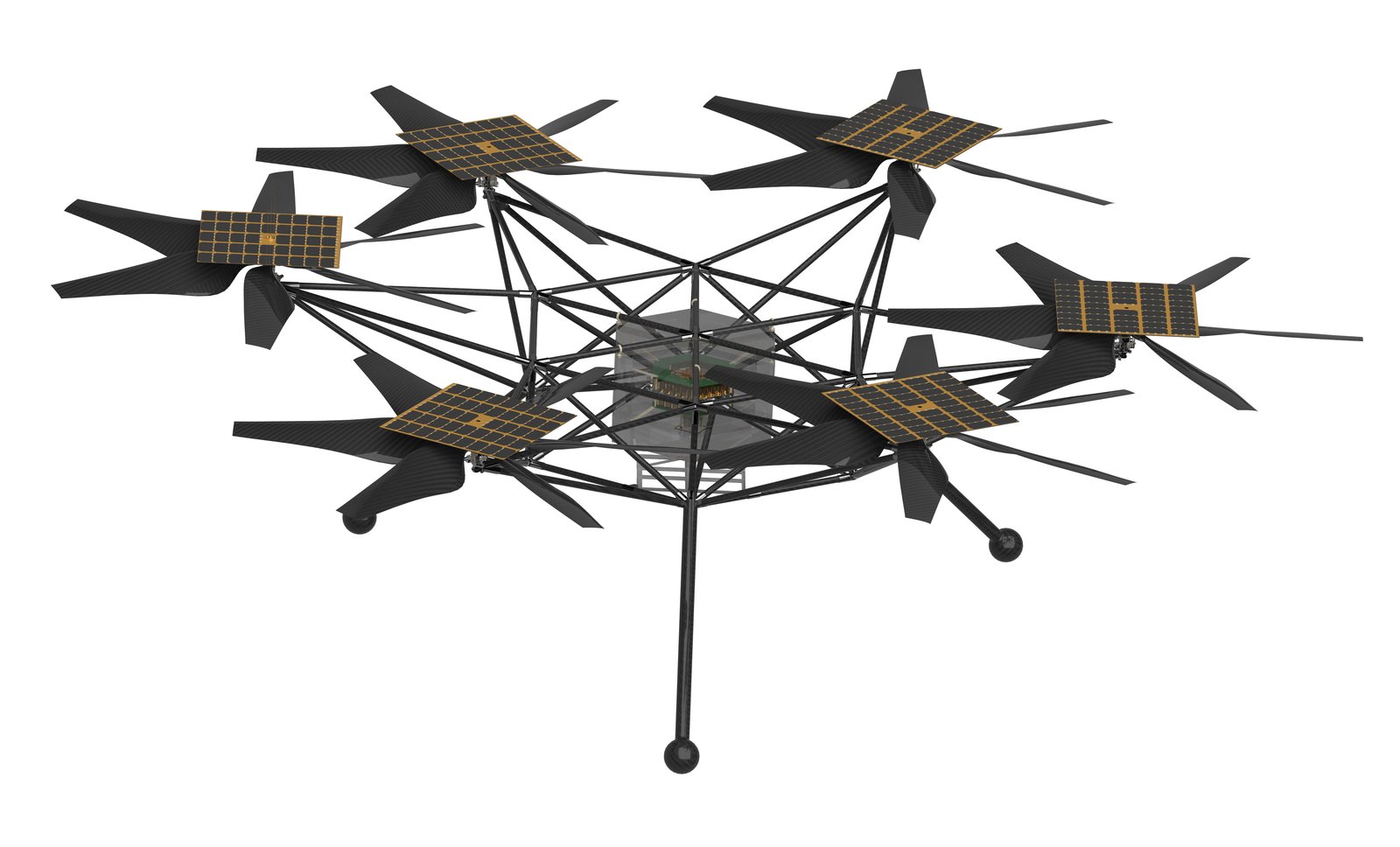
As an exploration tool, Pascal Lee proposes sending the possible successor to Ingenuity, a « Mars Chopper, » as NASA calls it (a concept presented by the agency on December 11, 2024). This would be a multirotor vehicle, each rotor powered by solar panels, named Orpheus, with a significantly greater payload capacity (5 kg) and a much longer flight time than the famous small helicopter. And the performance will likely be better than expected in 2024 because NASA is currently working on an even faster rotating rotor (see link below). Note: Ingenuity weighed only 1.8 kg and had a flight time of 90 seconds.
“Orpheus’ payload would comprise: a) omnidirectional color cameras, b) a near-infrared spectrometer; c) a ground-penetrating radar; d) a biosignature detector. Orpheus would explore each vent and probe shallow depressions for subsurface voids.”
The objective would be « to explore this region and enter these intriguing pits/caves to investigate their interior, study Mars volcanism, analyze volatile release – esp. H2O, and search for signs of life.”
I can only applaud this proposal and hope that it will be approved and implemented by NASA. The CT1 site (and its surroundings) is indeed the most suitable for understanding the latest phases of the planet’s evolution and its consequences, especially on organic molecules. This exploration is necessary to better understand the Martian environment, both for purely intellectual reasons and to prepare for the first human (« inhabited ») mission.
It would be desirable for the first astronauts to have a good protection against radiation during their stay, which will in any case last at least 18 months (in between two long journey during which possibilities to shield this radiation will be limited). There would be no better solution than using a natural cavity with a very thick ceiling and walls (at least 2 meters) made of Martian soil (with a slope or a small staircase for exiting!). However, in case life were present, we will obviously have to change our plans and, as I have already explained, live in a rotating space station nearby, making only occasional forays to the surface. This would be until we know more about this life and its possible interference with our own.
This robotic mission could be conducted as early as 2029. Later (2033?), during an inhabited mission, the Mars Chopper could be controlled from the ground or from Mars orbit without time latency, which would greatly facilitate its use.
If we had an inhabited space station in geostationary orbit (see my previous articles), supplemented by a series of relays also in geostationary orbit around Mars, we could conduct this type of observation anywhere on the planet (negligible time lag).
This is not the first time Pascal Lee has proposed using a Mars Chopper. Remember the Nighthawk mission project I reported on in my blog on April 5, 2025. In this mission he suggested exploring the rugged terrain around Noctis Volcano, deep within Valles Marineris, another geologically rich region.
After the numerous missions using satellites, probes, and rovers, it’s time to apply the lessons learned from Ingenuity and utilize this new tool for both Noctis volcano and Cerberus Fossae!
Links:
https://lnkd.in/g3sgUifY (Pascal Lee article)
https://gizmodo.com/nasas-proposed-mars-chopper-is-ingenuity-on-steroids-2000541828
https://www.jpl.nasa.gov/images/pia26375-nasas-mars-chopper-concept-rendering
https://www.explorationspatiale-leblog.com/nighthawk/
https://science.nasa.gov/mission/mars-2020-perseverance/ingenuity-mars-helicopter/
Pascal Lee is Planetary Scientist at SETI Institute, Director of NASA Haughton-Mars Project, Director at Mars Institute, Prof. at Kepler Space University, Chief Scientist at Ceres Robotics, VP for Planetary Development at NSS (National Space Society).
Copyright Pierre Brisson
title illustration: Mars Chopper NASA concept, credit NASA.

