Going Down to Mars from the areostationary orbit
Going down to Mars, staying there, leaving it: three moments of a single movement, which our study covers in three articles. This one deals with the first — the descent, from areostationary orbit down to the ground. The next two, “Staying on Mars” and “Leaving Mars,” will follow.
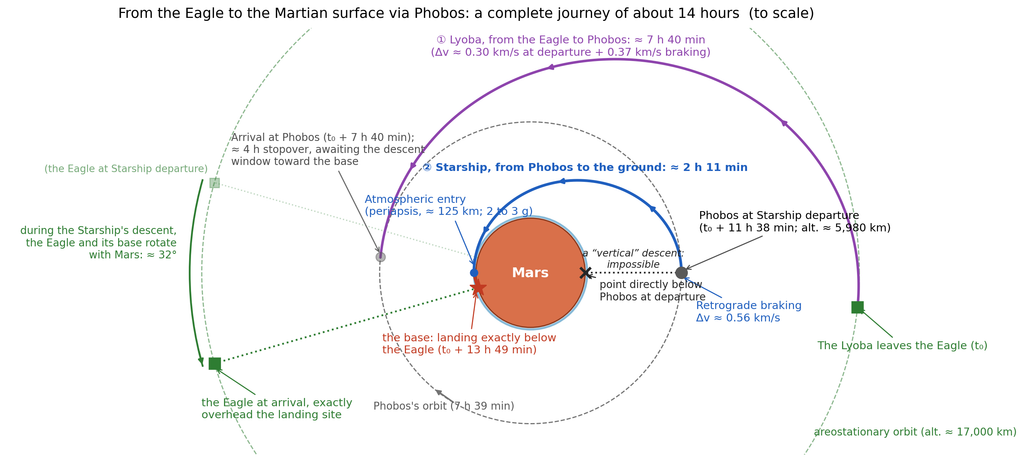
Illustration: From the Eagle to the Martian surface via Phobos (figure to scale). Three moments punctuate the journey: at t₀, the Lyoba leaves the Eagle (Δv ≈ 0.30 km/s) and descends in ≈ 7 h 40 min to Phobos, where it brakes (≈ 0.37 km/s); at t₀ + 11 h 38 min, after a stopover of about 4 hours (in this example), the Starship deorbits (≈ 0.56 km/s) and follows a half-ellipse for ≈ 2 h 11 min down to atmospheric entry, on the opposite side of the planet from its departure point; at t₀ + 13 h 49 min, it lands. During the descent, Mars, the Eagle and its base have rotated by about 32°: the moment of departure is chosen so that the landing takes place exactly below the Eagle. Complete journey: ≈ 14 hours — comparable to a Paris–Tokyo flight.
Today, we are leaving our rotative space station, one of the twelve “Eagles” in areostationary orbit, to go down to Mars because we have “business” there. We therefore take our Lyoba (high altitude ferry designed by the Swiss startup Pave Space) to Phobos (Mars’ biggest moon) and will then board a Starship that will descend to the surface of Mars. The destination will in principle be the base of the sector allotted to our Eagle, over which we operate constantly — thanks to our stable position in orbit — through our telecommunication network and the Optimus robots on site that we teleoperate. But we may also have been invited by the residents of another Eagle to come and see, or to do “something” together, at their place.
The advantage for operators in Mars orbit, compared with operators who stayed on planet Earth, is (1) that there is no perceptible time lag between areostationary orbit (17,000 km altitude) and the ground; (2) that the surface is constantly accessible by radio, since the manager and operator sits exactly above the sector assigned to him; (3) that one can go down to the ground more often than when on planet Earth (the “railway station” that the moon Phobos constitutes, is accessible twice per Martian day from any of the twelve Eagles in areostationary orbit, and from there one can then descend to Mars whenever one wants); (4) that the journey is much shorter; (5) that it requires less energy; and (6) that the people making this short trip receive a much lower dose of radiation.
One can therefore sustain a continuous activity: operate a mine (of water ice in particular), dig, build, run a factory (propellant production in particular, but also a foundry, a plastics plant, various chemicals, a glassworks, etc.), assemble, store, and even operate rockets (hoppers), perhaps ultralight aircraft fitted with “coflow jets,” and above all “ground” vehicles.
If we go to Mars from time to time, it is because we need to “see for ourselves” to understand better, to check something that does not work despite all our efforts, to supervise the loading of a Starship, or simply “to get some fresh air” (keeping our spacesuit on!), to walk on the ground, to explore a cave.
But we will not stay long, because the low gravity of 0.38 g remains a problem there for the human body (SANS syndrome), because one is often exposed to dust storms, and because contact with other human beings is less easy there than on Phobos or Deimos. One can travel on the surface, but distances are great, there are no roads, and airplanes or airships can hardly fly while carrying masses corresponding to human passengers with their gear and supplies, given the very low lift provided by the atmosphere.
Let us look at the different sequences of the descent:
Note first that the journey will take “a certain time” because, as we have said, we will not descend directly, in a single sequence and in a straight line from the Eagle to the surface of Mars. The Lyoba is light, which is a decisive advantage for moving about on the low-gravity “plateau.” But it cannot be flown down to the Martian surface: it would not withstand the mechanical and thermal stresses (the counterpart of natural atmospheric braking which, on the other hand, saves energy).
Before setting foot on Mars, we will therefore have to pass through the Phobos interchange, where we will board a waiting Starship. That ship, fitted with a heat shield, will be fully capable of facing the Martian atmosphere.
Let us give some figures. From Phobos’s orbit (at about 6,000 km altitude), a single braking impulse of about 560 m/s is enough to put the Starship on an ellipse whose periapsis dips into the Martian atmosphere. The ballistic descent then lasts about 2 hours 10 minutes, down to the atmospheric entry interface (around 125 km altitude), which the ship reaches at about 4.2 km/s. This is the whole point of departing from Phobos rather than arriving directly from Earth: a direct interplanetary arrival occurs at between 5.6 and 6 km/s depending on the launch window — markedly higher thermal and mechanical stresses (the kinetic energy to be dissipated grows as the square of the velocity; it is about half as much when starting from Phobos). Atmospheric braking proper lasts only six to seven minutes, with a moderate maximum deceleration (on the order of 2 to 3 g), before the final flip and the ignition of the engines for the propulsive landing, which costs about a further 600 m/s.
What do these 2 to 3 g mean for the passengers? On a motorway, the firm braking that takes you from 130 km/h to a stop at a toll plaza presses you against your seatbelt at about 0.3 g; an emergency stop, at the limit of tyre grip, barely reaches 1 g. For the few tens of seconds around the deceleration peak, our passengers will therefore endure the equivalent of two to three emergency stops stacked on top of one another — but lying in their couches, with the deceleration applied chest-to-back, the orientation best tolerated by the human body. An impressive, uncomfortable moment, yet harmless for a person in good health, and appreciably gentler than the Apollo astronauts’ return to Earth (6 to 7 g). It is also this constraint that will bar the descent to children, whose growing bodies tolerate such accelerations poorly, and to pregnant women: Mars, at least in the first decades, will be visited among adults, and expectant mothers will await their delivery in their Eagle, “at home.”
All in all, the descent from Phobos is economical. For our reference Starship shuttle (dry mass ~120 t, six vacuum engines, specific impulse of 375 s), the propulsive budget of about 1.2 km/s — deorbit burn and landing ignition included — represents ~50 t of methalox for a ship descending empty and ~105 t for a ship loaded with 150 t: even in the latter case, less than 10% of tank capacity. These propellants will have been loaded at the Stickney depot before the descent — propellants themselves brought up from Mars during previous rotations, as we shall see in “Leaving Mars.” The total mass of a loaded ship will thus be 375 tonnes at departure from Phobos and only 275 tonnes on arrival (i.e. a Martian weight of a little over 100 tonnes — depending on the propellants actually used for the landing).
As for choosing the moment: Phobos passes over any given equatorial site roughly every 11 hours (a combination of its orbital period of 7 h 39 min and Mars’s rotation in 24 h 37 min); one therefore has two descent opportunities per Martian day toward “one’s” sector, without any planetary-window constraint.
Then one must land, and to do so the rocket must be fitted with legs. In addition, the ground receiving the weight (and the 100 tonnes mentioned above are not quite negligible) must be of even density, firm and flat. The Starship must remain stable!
The hardest problem will arise during the first descents (above all the first one), because the ground will not have been prepared. Its flatness and composition can be known by camera and radar, but one will not see the large stones on the surface or the small irregularities of the terrain that can be destabilizing at touchdown.
In illustrations prepared for the Moon flight, SpaceX had contemplated a ring of thrusters below the ship’s airlock to stabilize it and brake it over the last few metres. It is to be hoped that the concept will be developed and applied for the first landing on Mars.
The engine plume will fiercely attack the ground, raising a great deal of dust and throwing up dust and stones…but there will be nothing to destroy!
Afterwards the risk will not be the same, since (1) a Mechazilla tower could have been assembled to catch the ship at the end of its flight and set it down on the ground, and (2) the ground could have been worked on — levelled, consolidated, fitted with a metal take-off plate, and then of course with a true launch platform of the anvil type, such as the Starship used on Earth for its IFT13 flight. The ground installations — platforms, service towers — are described in “Staying on Mars.” (next article)
As for lifting off again — the thrust to be delivered against gravity, the propellants to be produced on site, the “great gamble” of the first departure — that belongs to the final panel of the triptych: “Leaving Mars.” (following article)
copyright: Pierre Brisson
Illustration: Trajectories from the areostationnary orbit down to the surface of Mars. Graph by claude.ai upon directive request from Pierre Brisson.
xxxx
To find another post in this blog which could be of interest for you, click on:
xxxx
And, if you enjoy this blog, subscribe (it’s free)!

