The Eagles — getting there and leaving
Once close to an Eagle (rotative space station), arriving from another Eagle or from one of the two Martian moons, one will have to dock with it. The docking module will include three ports for this purpose (see the previous article describing the station), There will always be (1) a port occupied by the rescue conveyor, indispensable for safety and, to that end, equipped to carry people only (in bus-like conditions, but the journey will be short). Its destination will be Phobos, not Deimos (the reason is set out below); (2) a second port for setting out on a journey of the residents’ own initiative (while remaining within the great low gravity plateau); (3) a third port for visitors. Vehicles able to use these ports will only be Lyobas, because the Starships coming from Earth will all stop at Deimos to unload their payload and take on propellants.
Lyoba are high altitude conveyors, designed by Pave Space, A Swiss startup (Gruyere) created by young EPFL graduates. The rescue ones have dimensions out of the ordinary (see below). But all are much less voluminous and massive that Starship. With their 60-tonne carrying capacity, they will be able to bring everything the station needs. When they will be designed to carry human beings, the cabin will be wrapped within a 20 cm thick HDPE sleeve.
Lyoba port no. 1, for emergency situations.
The rescue Lyoba deserves that we pause on it, for an Eagle will house some one hundred residents: a lifeboat that could take only ten of them would be no lifeboat at all. Its cabin will therefore be of a special size: about 5 m in diameter by 8 m long, i.e. ~157 m³ — a little more than 1.5 m³ per person, rush-hour-metro conditions, bearable for a few hours in weightlessness. The squat shape is no accident: it shortens the interior distances and allows an emergency boarding — you get in fast, you strap in, you sort things out afterwards. For ~165 m² of envelope, it will weigh about 31 t. With the structure (~10 t), the hundred people and their effects (~10 t) and the consumables, we remain within the 60 t payload envelope: the lifeboat will be a standard Lyoba carrying a special cabin, not a new vehicle.
Its destination will not be Deimos but Phobos, and orbital mechanics dictates it: the Hohmann alignment toward Deimos comes round only every 131 h — unacceptable in an emergency — whereas Phobos, which completes its orbit in 7.65 h, catches up with an Eagle at ~32.4° per hour and thus offers a transfer window every ~11 h. An average wait of 5.5 h (11 h at worst), followed by a Hohmann flight of about 7.7 h for ~665 m/s (i.e. ~21 % of the final mass in propellants, Isp 360 s): the refuge is reached in ~13 h on average, ~19 h at worst — twelve times faster than by aiming for Deimos. And it is precisely at Phobos that one of the two copies of the 0.38 g way-station will be found, ready to receive the evacuees. The logic will be that of the maritime lifeboat: boarding is the rescue. As soon as the hundred residents are aboard — the cabin pressurized, shielded, autonomous, moored at its port — they will be safe; the wait for the window will take place under protection, with no clock ticking. In case of tearing or explosion of the torus, the sequence will therefore be simple: flee to the port, board — let us hope all one hundred —, cast off from the port, and only then fire the engines for Phobos.
The lifeboat will be permanently manned by two Optimus stationed on board — a crew that does not grow bored at the quay, that will keep the vehicle on alert and marshal the boarding of a hundred people through a single airlock in some ten minutes, provided the manoeuvre is regularly drilled. It will carry enough to hold out for 48 to 72 h: for a hundred people and per 48-hour period, about 170 kg of oxygen, 600 L of water, 120 kg of rations and the corresponding CO₂ scrubbing — barely more than a tonne in all, negligible in the mass budget — as well as three or four sanitary stations.
Lyoba port no. 2, for “ordinary” missions:
This Lyoba will be the one most used, since it will go everywhere according to the Eagle’s needs and decisions. It will of course be used to take part in meetings on Deimos, to inspect and possibly order equipment come from Earth. But it will also be used to pay visits to the neighbouring Eagles.
If a mission on Mars is required, this Lyoba will descend to Phobos, where the passengers will find a Starship to continue toward the surface. Complementary equipment drawn from the Deimos stock will be able to join them there, if necessary, conveyed by one of the Lyobas assigned to the Phobos–Deimos link.
Lyoba port no. 3, for visitors.
The third port may serve a visitor come by Lyoba from another Eagle (we saw in the previous article that they will be infrequent, for it is not so easy to move about on one and the same orbit). There will be no more than 3 ports, but the Lyobas come from other Eagles will unload or load and set off back to their Eagle of origin, like taxis. A rule of discipline will be required: this port will be a turnaround slot, not a parking space, failing which a lingering visitor would block the station’s only reception berth.
The fixed axis, from top to bottom
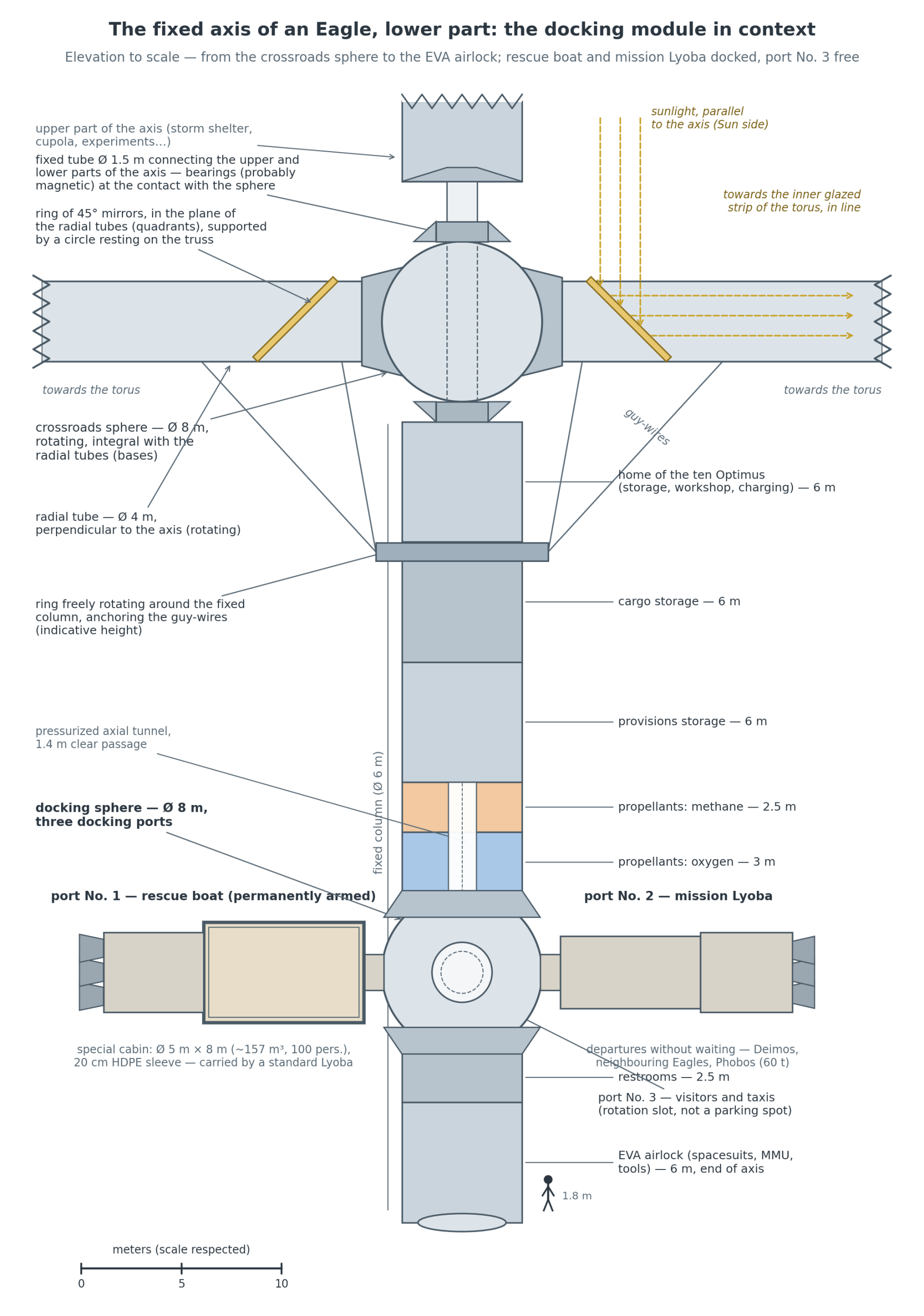
Before going further, let us recall the strategic points (for this article) of the architecture of this axis where one docks. Only the junction hub sphere rotates with the torus; the column that passes through it is fixed; contact between the column and the sphere is made by bearings (magnetic or other), and a rotating door set into the column allows passage from the fixed part to the rotating part.
All the cylinders of the axis are 6 m in diameter. Below the hub sphere are aligned: a 6 m cylinder, the main quarters — stores, workshop, charging points — of the ten Optimus humanoids assigned to the weightless part of the station and to outside work; two 6 m storage cylinders (freight, provisions); the two cylinders storing the Lyobas’ propellants — one for methane, one for oxygen —, but not the argon reserves, see below; the 8 m docking sphere and its three ports; a 2.5 m cylinder of sanitary facilities (men and women); at the end of the axis finally, a 6 m cylinder forming an airlock for the EVAs, with spacesuits, MMUs (Manned Maneuvering Units) and tools.
The illustration of this article shows the lower part of the fixed axis, « stripped bare, » so to speak. Indeed, like the rest of the space station, the axis will have to be be shielded from radiation. However, the shielding will be less thick than that of the torus that will serve as the habitat, because the duration of physical human presence will be shorter. Therefore, a 20 cm thick HDPE enclosure will suffice, avoiding the junction between the mobile sphere and the fixed axis, the rotating ring holding the guy-wires linked to the radial tubes, the docking ports, and the EVA exit.
The argon reserves of the four engines that maintain the rotation of the torus cannot be housed in the axis, since the axis is fixed (hub sphere excepted) and the torus rotates together with its radial tubes. They will therefore take their place in the radial tubes themselves, upstream of each of the four engines that will use them; delivered to the docking sphere, the argon will be conveyed to them through the rotating door of the hub sphere.
Regularly, Lyobas will come to take on propellants from Phobos (methane and dioxygen but also argon), since production will be by ISRU on the surface of Mars and Phobos is closer to it. The stocks built up on Deimos will be dedicated to the returns to Earth. Moreover, journeys from one Eagle to another, or journeys to Deimos for supplies of terrestrial goods, or descents to Phobos in order then to go down to Mars, or again meetings on Deimos or Phobos, must be possible without waiting. Stocks are therefore needed, and these stocks must be placed as close as possible to the place where they be used (hence just above the docking module for methane and dioxygen).
Three disciplined ports, a lifeboat always full, a mission Lyoba ready to leave without waiting, a depot placed at the shortest distance from the quays: everything, in this architecture of arrival and departure, converges on one and the same condition — having propellants and knowing how to keep them. How much will be needed, how to keep them liquid and very cold, and how they will be produced on the ground: this will be the subject of the article that closes this series, “Propellants: needs, ground production and storage”.
Now that we have described the Eagles and the possibilities for transport to and from the moons, we will return to the moons themselves. We shall draw the consequences about the advantages but also the difficulties that the situation of each moon presents relative to the Eagles, for their refitting after the first Eagles have been released into space.
Copyright Pierre Brisson.
Illustration: The lower part of the axis of an Eagle (rotating space station on the areostationary orbit) designed by claude.ai upon request of Pierre Brisson.
xxxx
To find another post in this blog which could be of interest for you, click on:
xxxx
And, if you enjoy this blog, subscribe (it’s free)!

