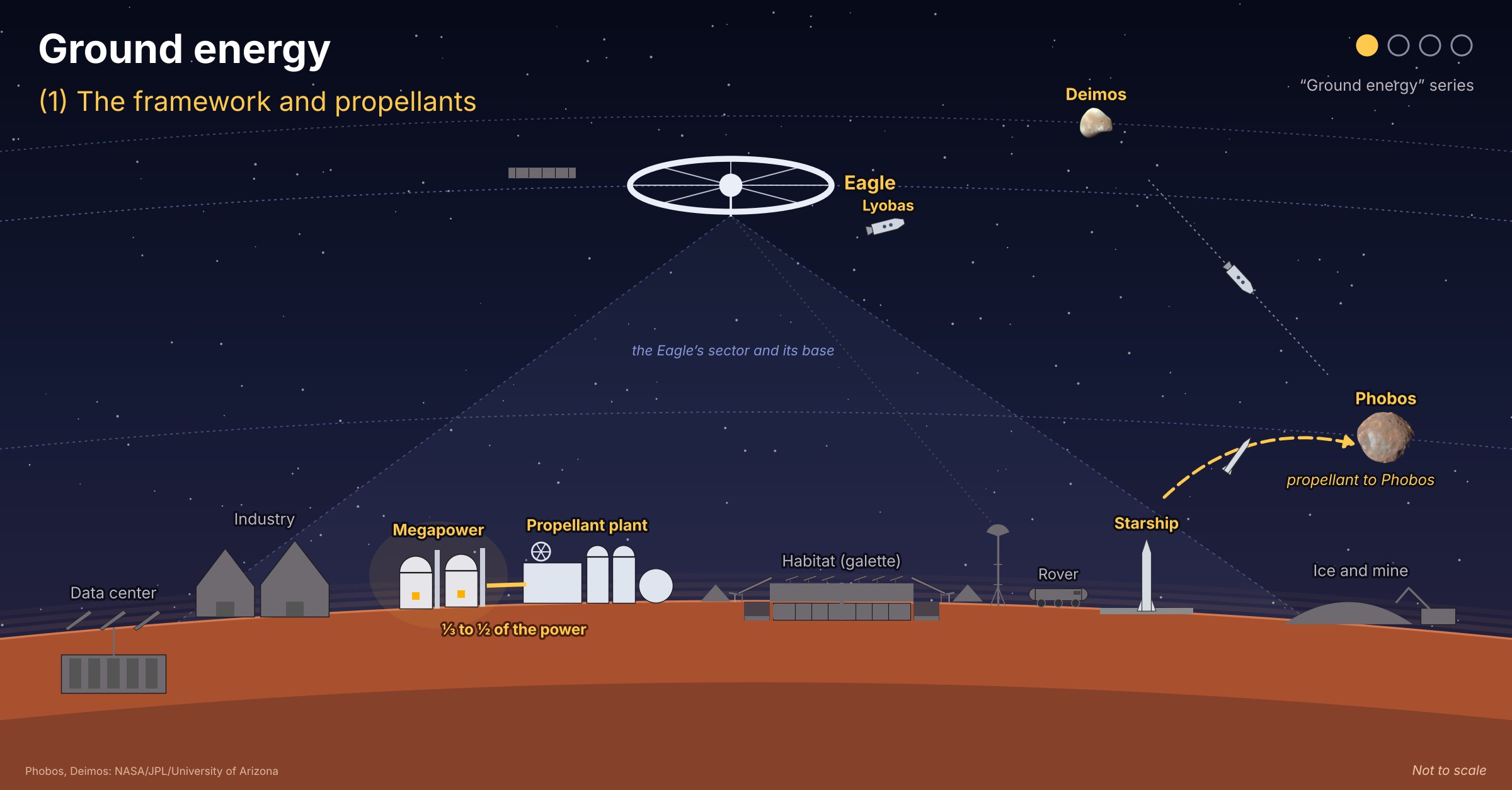
1. After circulation in space around Mars (1): life on the ground
In “Propellants (1)” and “Propellants (2),” we calculated the energy needed to move people and goods through the Martian system: producing methane and oxygen on the ground, lifting them to Phobos, Deimos and the Eagles, and filling the ships that head back to Earth. That is the energy of circulation. What remains is to calculate the energy needed for everything humans do on the ground: digging and maintaining their habitats, breathing, eating, heating, lighting, communicating, running their robots, computing, and finally producing on site what it would be absurd to bring from Earth and what is needed for their safety, given the distance between the two planets.
The energy of the Eagles themselves, our rotating space stations, lies outside our subject. It will be dealt with in a sidebar (§ 15), because the orientation of their rotation axis determines their solar output, and because a station next to each Eagle could one day beam solar energy down to the ground (§ 16).
The starting point is a result of the study carried out in the article “Propellants (2)”: at every stage of deployment, propellants absorb only one third to one half of the nuclear power installed on the ground. The rest, that is, at least half of the fleet, is available for life on the ground and for industry. This series of four articles, which begins here, shows how that remainder is distributed, and its conclusion fits just in a few words. A ground base is inhabited intermittently, but it is both a permanent factory and a permanent center for scientific and technological research: the life of the base itself is measured in tens or hundreds of kilowatts, not in megawatts. What will absorb most of the available power is industry, and it is the available energy that will set the industrial and scientific ambitions, not the other way around. I mention science and technology because we will not go to Mars only to produce, but also to do research: to expand our knowledge and our ability to act in the most difficult environments, which will also help us managing the Earth better.
Two units are worth keeping in mind for what follows: continuous power, in electrical kilowatts or megawatts (kWe, MWe), and the energy consumed over a year, in gigawatt-hours (GWh). A Megapower (the compact nuclear reactor selected in “Propellants”) delivers 2 MWe, or 17.5 GWh per year if it runs continuously. One electrical megawatt for one year (one MWe-year) represents 8.8 GWh. Unless otherwise stated, “year” means the Earth year; the Martian year lasts 687 days, or 1.88 Earth years.
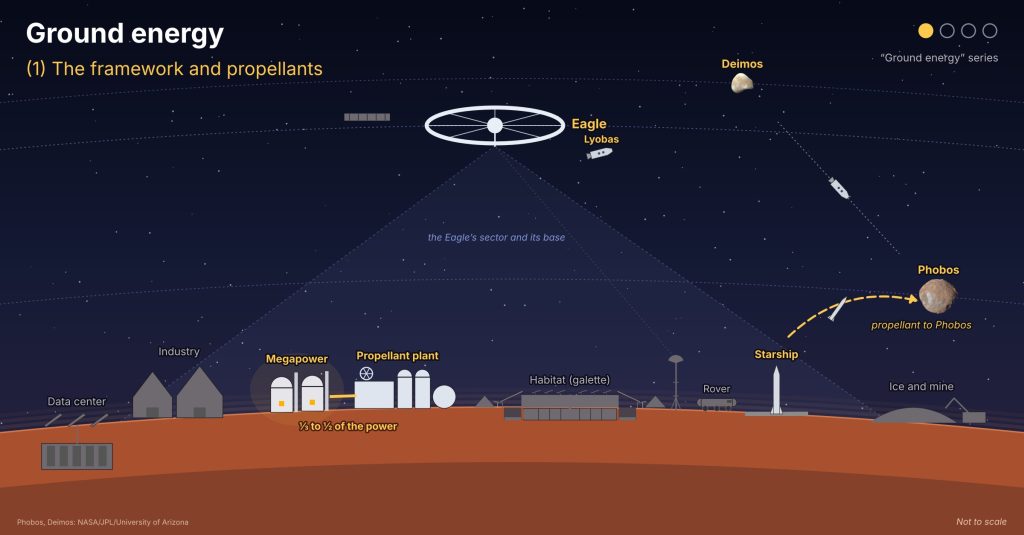
2. The framework: one ground base per Eagle
One base per Eagle
Deployment follows the sequence described in previous articles. A first Eagle, in areostationary orbit (an equatorial orbit at an altitude of 17,000 km, on which a satellite stays permanently above the same point on the surface), comes with a ground base in its sector. A second Eagle follows with its base, then two more, placed 90° from the first ones, so that each covers a quarter of the planet. We then go up to a dozen, each with its base, which produces the propellant for its own rotations. Each Eagle has about a hundred residents.
Short and infrequent missions
Stays on the ground are difficult, notably because of the low gravity. The Eagles’ torus offers 0.7 g; the surface of Mars, 0.38 g. We do not yet know whether 0.38 g is enough to prevent, over the long term, the disorders observed in astronauts in weightlessness, such as SANS (Spaceflight-Associated Neuro-ocular Syndrome, which deforms the eyeball and affects vision). The Eagles have other advantages: people live there far from the dust, with better sunlight, and they are closer to Earth in energy terms. So it is in the Eagles that people live, and on the ground that they stay for a while. There will be no long stays. Two types of stay are planned:
- the emergency stay, of about a week, for an intervention the robots cannot carry out on their own;
- the stay of about a month, to set up a new production process, rework part of the habitat or install new communications equipment. There are about six of these per Martian year and per base.
A regular mission has 6 to 8 people, assisted by humanoid robots (of the Optimus type) for upkeep and maintenance. The headcount rises to 13 at most: one representative from each of the twelve Eagles plus one for the host Eagle, if an exceptional discovery justifies everyone’s presence. The participants then meet at Phobos to descend together to the base concerned. As “Propellants (2)” showed, people are “propulsively free”: a crew-rotation flight costs practically the same as an empty flight. The scarcity of missions therefore stems from the effects of life on the ground on health, not from the cost of transport.
A base is occupied by people between a quarter and a third of the Martian year (687 days, nearly two Earth years). With six one-month stays and a few emergency stays, at 8 people, this amounts to roughly 1,800 person-days per Martian year, or about 950 per Earth year. The rest of the time, the base runs with its robots, teleoperated from the Eagle. The buried circular habitat described in “Staying on Mars” (the “galette,” or pancake), with its nine rooms that can be doubled up (up to 18 people), thus keeps a comfortable margin.
This intermittency governs the whole series. Items that depend on human presence (breathing, lighting, heating) weigh only part of the year. Those that do not (producing propellant, extracting ice, growing crops, computing, manufacturing) weigh all the time.
Site constraints
Three constraints guide the choice of a base site, in order of importance.
- Access to water ice, the raw material of propellant and of life. This is the decisive constraint, but it is bounded by another: each degree of latitude makes flights to the moons and the Eagles more expensive, since they orbit in the plane of the equator (§ 13). The base is therefore placed on the ice closest to the equator, and never beyond 20° latitude (§ 4).
- Visibility from the Eagle. Seen from the ground, the Eagle is fixed in the sky. Its height above the horizon decreases with latitude: the link is comfortable up to 60–70° latitude, and the Eagle disappears below the horizon beyond about 80°. Up to 20° latitude, the link is excellent. The poles, however, are invisible from areostationary orbit. Incidentally, the farther the base is from the equator, the farther it is from the Eagle: the transmission delay, which matters for precision robotic work, therefore increases slightly while remaining very short (a round trip of 0.114 s at the equator, 0.115 s at 20° latitude).
- Sunlight, if nuclear energy is to be supplemented by solar. It matters little, since the baseload is nuclear.
Available sources
The reference source is the Megapower: nuclear, indifferent to night and to dust storms. It provides the baseload.
Ground solar is a supplement. At the top of the atmosphere, Mars receives about 590 W/m² on average (from 490 to 715 W/m² depending on the distance to the Sun, since Mars’s orbit is fairly eccentric). On the ground, one must subtract absorption by dust, the night, and above all global dust storms, which can hide the Sun for several weeks: the Opportunity rover did not survive the 2018 storm.
A third source is conceivable in the long run: solar energy collected in space, near each Eagle, and beamed down to the ground. It will be discussed in § 16.
3. The dominant item: propellant production
Here we only restate the results of “Propellants (2),” to which the reader is referred for details.
The net balance of the production chain (CO₂ capture, water electrolysis, the Sabatier reaction, which combines CO₂ and hydrogen into methane and water, then liquefaction) is about 6.7 kWh per kilogram of methalox (liquid methane and oxygen). Electrolysis alone accounts for some 85% of it. With auxiliaries (thermal control, pumps, losses), we conservatively use 8 to 10 kWh/kg.
The figure below, taken from “Propellants (2),” compares, at each stage of deployment, the installed power with the needs of propellant production alone, with all flights traveling full.
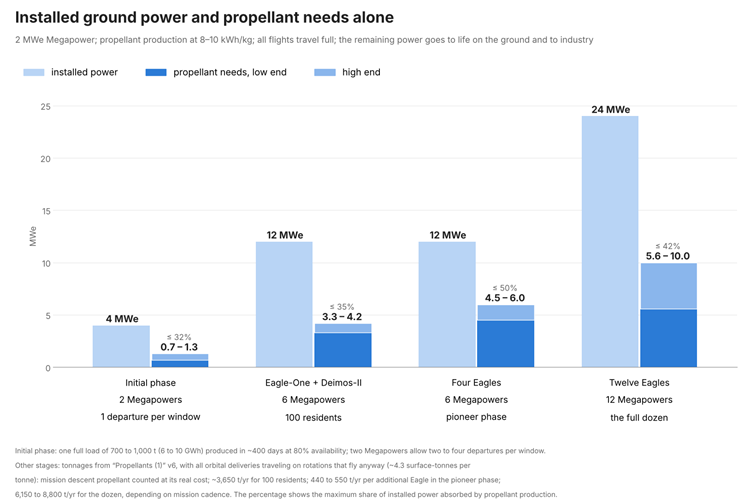
Installed ground power and propellant needs alone (figure from “Propellants (2)”)
Four stages emerge:
| Stage | Megapower | Installed power | Propellant needs | Maximum share |
| Initial phase (one departure per window) | 2 | 4 MWe | 0.7–1.3 MWe | 32% |
| Eagle-One and Deimos-II (100 residents) | 6 | 12 MWe | 3.3–4.2 MWe | 35% |
| Four Eagles (pioneer phase) | 6 | 12 MWe | 4.5–6.0 MWe | 50% |
| Twelve Eagles (the full dozen) | 12 | 24 MWe | 5.6–10.0 MWe | 42% |
Propellant production remains the largest consumption item on the ground, but it never absorbs more than half of the fleet. At each stage, therefore, 2.7 to 14 MWe remain available. It is this remainder that the next three articles will distribute.
One point deserves emphasis, because it sheds light on a question one may ask about the poles (§ 13). Capturing atmospheric CO₂ is the bulkiest part of the plant, as Christophe de Reyff pointed out: at least 3,000 m³ of atmosphere must be drawn in and processed per hour to produce 100 kg of propellant. But it weighs almost nothing in energy. One kilogram of propellant requires about 0.6 kg of CO₂; compressing it from Martian pressure (about 6 millibars) costs 0.06 kWh per kilogram of CO₂ in theory, rather 0.2 kWh in practice, or about 0.1 kWh per kilogram of propellant: barely more than 1% of the total. Fetching frozen CO₂ from the poles would reduce the size of the collectors, but the energy saving would be insignificant.
This topic of ground energy will continue in three further articles. Next week, we will look at the energy needs for living on the ground, producing and stoking propellant aside: water, digging the habitats, air, food, heating and lighting. We will then turn to the needs for being active on the ground: robots, telecommunications, data centers, mining and industry, transport on the ground and from the poles. Finally, we will draw up an overall balance, explain why we chose to keep the Eagles’ axis parallel to that of Mars rather than pointing it permanently at the Sun, and which energy sources we chose to meet these needs. Paragraph numbering continues from one article to the next: references to §§ 4 to 17 point to the following articles. The only purpose of this division is to make the whole easier to read.
illustration title: Ground energy 1: The framework and propellants. Graph Made by claude.ai, Pierre Brisson’s concept.
Copyright Pierre Brisson
xxxx
To find another post in this blog which could be of interest for you, click on:
xxxx
And, if you enjoy this blog, subscribe (it’s free)!

