1. In the Begining were only Desert and Solitude
When the first flight, a robotic one, reaches Mars, there will be no facilities of any kind to receive it — only resources in their raw state. And it will be necessary not only to land (see “Landing on Mars”) but also to leave again (this article). And leaving will only be possible after refuelling. We will not quite be in a “chicken and egg” situation, since we will have our rocket, with useful equipment on board. The return will nevertheless be a very delicate matter. Let us describe its various stages in this article and the following one (energy).
Preamble:
Ahead of the first crewed flight, a first precursor cargo ship, entirely robotic, will make a stopover at Phobos to drop onto the rim of the Stickney crater, the anchoring system —cables, base plates, drilled pitons*, duckbill anchoring — that will later be used to moor the cargo ships and to establish the propellant and equipment depot. The stopover will admittedly cost the circularisation and then the deorbit burn (cost to be budgeted in the tanks filled at departure from Earth). But that is not what will burn most of the propellants; that will have been the departure from Earth and the injection onto the interplanetary trajectory.
* A drilled piton (also called expansion bolt, anchor bolt, or spit — climbing) is a permanent metal anchor point. It is installed in a hole previously drilled in a rock or a wall to secure a load, provide protection in the mountains, or hang equipment.
In any case, the ship will then have to go down to the surface of Mars, since remaining propellants would be utterly insufficient to come back to Earth, and Phobos does not hold the resources needed to produce what is needed.
Unloading
After the landing (presented in the article “Landing on Mars”), all the equipment needed to prepare the return will have to be brought down from the ship’s cargo hold. It is a matter of masses to be handled, controlling their displacement inside the ship up to securing them on the descent platform, controlling their descent to the ground, then driving them off the platform to the operating / using site. It’s complex and delicate.
The elevator platform has been studied by SpaceX for the Moon (for the Starship HLS flights). It will be somewhat “borderline” for some large masses and volumes: the two Megapower reactors and the storage tanks. We will have to make do!
These movements will have to be accompanied by humanoid robots (mobility) checking that the plans are being followed (order of unloading) and stepping in to correct errors or adapt to unforeseen situations (depending on the objectives). The problem will be the time lag (see below).
Commissioning the propellant production and refuelling equipment
After positioning on site, the connections will have to be made, for electricity as well as for plumbing. And the equipment will be complex: the nuclear reactors already mentioned; the system for extracting water ice from the deposit located from orbit, and the device for protecting the extracted ice from sublimation (until storage); the equipment for extracting hydrogen and oxygen by electrolysis from this water ice and for storing these gases at the correct temperature and pressure*; the Sabatier unit for the production of methane, CH4, from atmospheric carbon dioxide and hydrogen from water; but also the capture and filtration of the atmosphere used and therefore the changing of the filters.
* hydrogen, whose long-term storage is very difficult — deep cryogenics at 20 K — will be consumed as it is produced by the Sabatier unit and kept only in small buffer quantities.
Preparing the ground for the next landing
In parallel with propellant production, other robots will look, next to the landing site just used (and which may have been damaged), for another spot that looks suitable for receiving the second robotic landing, so that it will be less risky than the first. This means probing the density of the ground, clearing the surface of stones, tamping it down and reinforcing it. For the latter, one can consider spreading water on the ultra-dry soil to turn it into duricrete (wet regolith turns as hard as cement). One can also plan to deploy a metal surface (a chequerboard of steel polygons, clipped together and then welded?), before an anvil platform over a flame trench, to carry the flames away, can be installed.
Other tasks
The same robots will be able to start looking for the butte, or simply the patch of ground, that can be excavated and fitted out as a habitat for the first crewed flight. The equipment needed to dig it will probably not yet be available, but the site can be scouted and the strength and cohesion of the rock can be tested.
Other robots (including a helicopter drone) will carry out a general inspection of the ship in order to repair any possible damages with the means at hand (and thus as far as possible). If repairing is not possible and the damage does not prevent taking off, it could be made later, before plunging in the Earth’s atmosphere, at the station orbiting around L1-EM (L1 of the Earth-Moon system) Lagrange point. If it could not, the return to the Earth’s surface will not take place and the technical assessment of the journey will be carried out in L1-TL by the observations and examinations that can be performed in L1-TL (in teleoperation or with technicians sent on site). Remember that on account of a quite lower gravity and a very weak atmospheric pressure, MaxQ is much lower when leaving Mars than when leaving Earth.
Finally, the Starship’s tanks will be filled in.
The assistance of humanoids
Most of these actions will require the intervention of Optimus-type humanoids. Without their agility and their adaptability to the most varied situations, the preparing for the return would be impossible. A major difficulty will come from the fact that they will have to be commanded from Earth, since the flight will be robotic, and that, like any robot control over such a distance, teleoperation will be constrained by a one-way time lag of 3 to 22 minutes. There is no answer to this time lag problem except for an AI development that would take us much further than today in terms of robotic autonomy. Indeed, the disadvantage of being unable to intervene on Mars with complete fluidity fully justifies the human journey to this planet (incidentally, the same reasoning fully invalidates the need for humans to be physically present on the Moon).
At departure, all the worker robots will be left on the ground, except one or two brought back for examination on Earth, to find out how they have been worn down by their work and by the dust. Those that remain will serve to keep the electric generators running, along with various probes and equipment for contact with Earth, and to maintain the continuity of propellant production and storage.
Second flight
The second departure from the surface of Mars can only be that of a second robotic vehicle. Indeed, given the synodic windows, the departure from Mars of the first ship (around month 22 or 23 after its departure from Earth, for a conjunction-class trajectory with a stay of about 500 days on Mars) will precede by only two to three months the departure window of the second ship from Earth (around month 26). We will thus have been able to verify the lift-off from Mars and the beginning of the return cruise, but neither the arrival in the Earth’s environment (around month 30) nor the state of the ship after a second interplanetary voyage (the flight back, down to Earth). Human life should therefore not yet be exposed to the risks of the journey.
The second flight will, like the first one, make a stopover at one of the moons of Mars, but this time it will be at Deimos, since this moon must also be fitted as soon as possible, with the anchorings that will be needed to land the elements allowing us to settle there.
This second flight could be used to work further on the landing-and-lift-off platform. By analogy with Earth, one might think a water deluge would be necessary. Fortunately it will not: the Super Heavy lifts off with ~74 MN of thrust, our Martian ship with ~8.5–10 MN at most (the case of a ship loaded with 150 t — which, as we shall see after, is well above what can actually be brought back directly from the surface of Mars), and only ~4 MN for an empty ship, as the first returning ships will be (among others, this flight we are speaking of) — that is, seven to nearly twenty times less, at most comparable to what a Falcon 9 needs (~7.6 MN). A steel anvil with a flame trench will remain very useful, if not indispensable, but the deluge, no. We will thus avoid having to use the enormous quantity of liquid water (2,450,000 litres per minute for Starship), which is unavoidable on Earth.
Above all, the excavation of the first habitat will be undertaken and, if possible, a start made on fitting it out (insulation of floors, ceilings and walls; laying of a pipe to bring water from the ice mine; laying of a power line to connect it to the generators).
The construction of a “Mechazilla”-type service tower will be postponed, given the mass of the elements needed to build it (and given the other payloads that will have had to be carried). One could nevertheless undertake the ground anchoring and the assembly of the base of this tower. Its dimensions and masses will differ from those of the terrestrial tower, since (1) the Martian tower will be much smaller (there will be no booster under the ship) and the lifting requirement will be lower (owing to a gravity reduced to 0.38 g). To replace the tower as far as possible at this stage, we will rely on the elevator platform integrated into the airlock of the starship and on inspection by helicopter drone for the parts the elevator cannot reach. In the event of a problem with the thermal protection, the robots, as said above, will inform Earth so that a repair can be planned at the space station at L1-EM.
After the first two robotic flights, the first crewed flight and a certain number of subsequent flights (until the completion of the first rotating station anchored in the ground at Deimos) will still go all the way down to the surface of Mars as the rotative station on Deimos or Phobos will not be completed yet (Note: we’ll still be in the situation of “the first return”). These flights, both crewed and cargo, will stop at one of Mars’ two moons to deliver the equipment needed to outfit the two moons and assemble them. But they will not stay there since the living conditions (in particular the very low gravity) would be worse than on the surface of Mars. This will be the opportunity to study more closely the effects of the reduced gravity of the surface of this planet (0.38 g) on the human body — the founding question of this whole reflection.
Copyright Pierre Brisson.
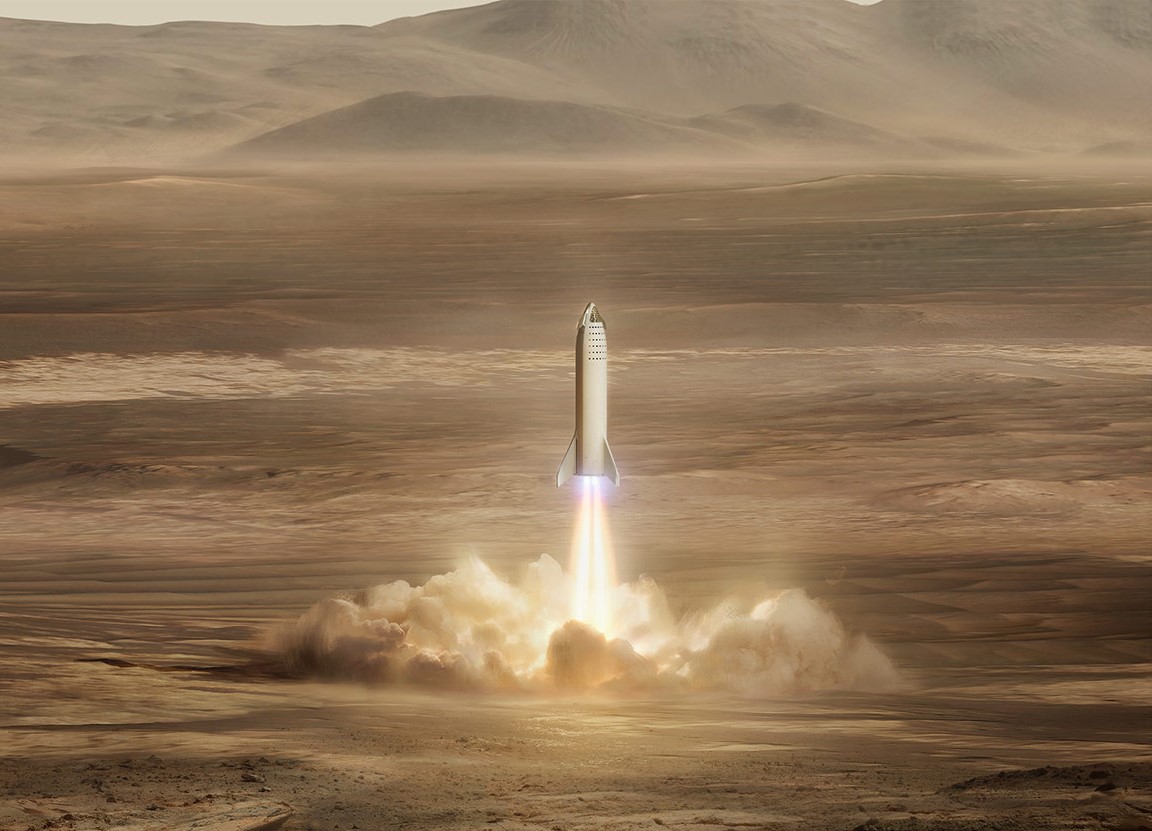
Title illustration: The first Starship flight landing or leaving Mars. Credit SpaceX.
Next week, I will write about Energy for this first flight.
xxxx
To find another post in this blog which could be of interest for you, click on:
xxxx
And, if you enjoy this blog, subscribe (it’s free)!

