Returns from Mars, 2. Mass, gravity and propellant needs
Once on the Martian surface, the first need will be to produce and load the quantity of propellant required for the return. Note that the first (robotic) ship will come back almost empty (its only payload being the one or two humanoid robots brought back for examination), as will the second (also robotic), probably with a few soil samples in addition. Indeed, the sole purpose of these two ships will have been to unload — first on Phobos and on Mars, then on Deimos and on Mars — the equipment needed for anchoring on the moons (to prepare for the establishment of relay stations) and for producing on Mars the propellant needed for the return. The whole point of these two returns lies in the reliability tests of the ship that they will give us.
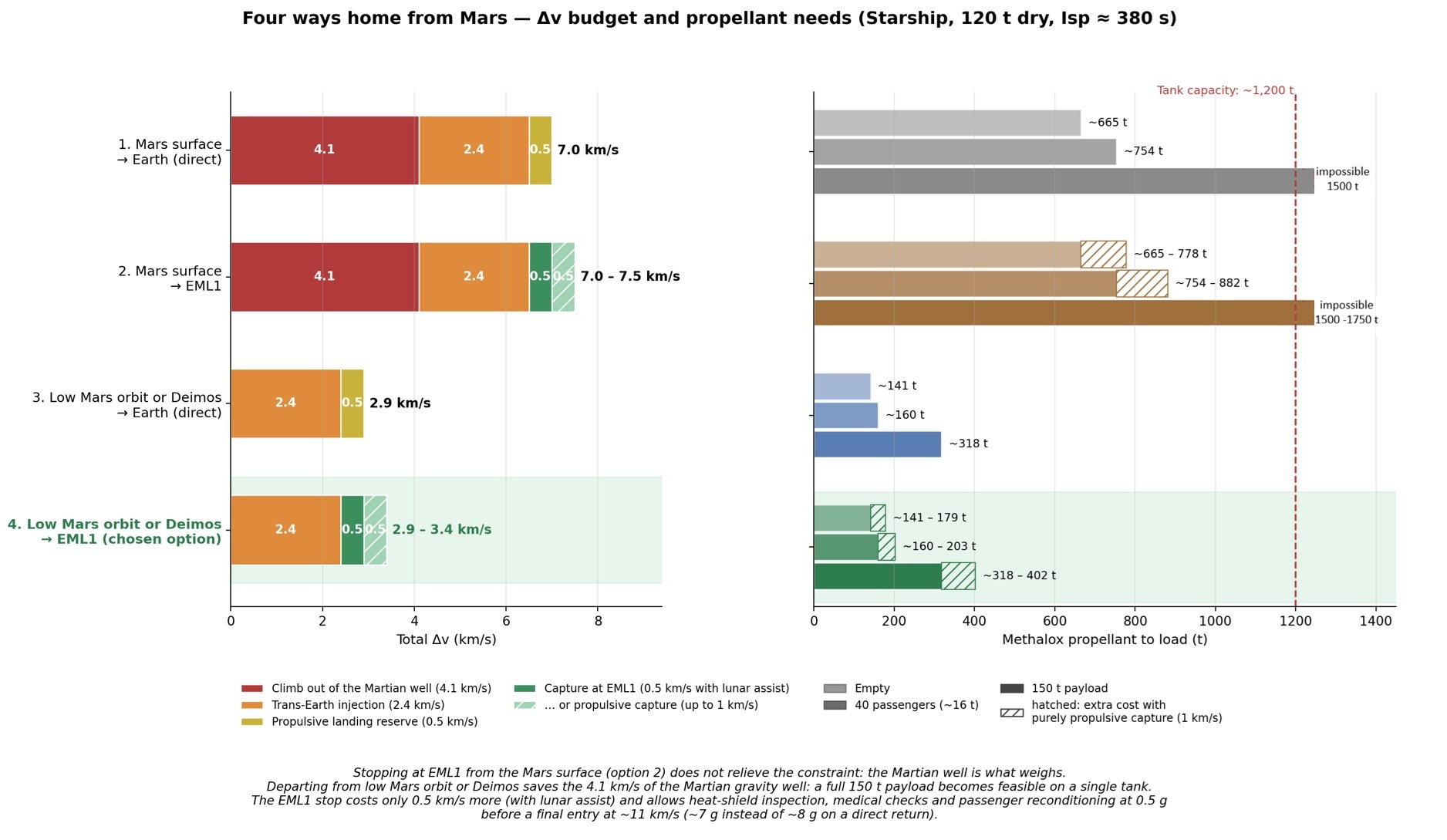
Over a longer period of time, several cases must be considered: (1) the direct return from the surface of Mars to the surface of the Earth; (2) the return from the surface of Mars to the station orbiting around EML1 (the L1 Lagrange point of the Earth–Moon system); (3) the return from Deimos to EML1. Routes 1 and 2 are those that will be flown on the very first voyages (as long as there are no propellant stocks available on Phobos and Deimos). Route 2 would be used only if no relay station is set up at EML1. Route 3 will be used if the architecture I propose is implemented.
For each of the three routes, one must consider a return flight empty, a return flight with passengers only (6 at the very beginning, 40 maximum once the system is established and the orbital stations are populated), and a return flight with a maximum of 150 tonnes (the current maximum carrying capacity of a Starship). We shall see that for a loaded return, the possible maximum is quickly reached unless one departs from Deimos and stops at EML1. The constraint comes from the quantities (mass and volume) of propellant required under the various assumptions. Let us look at them:
Common assumptions
All the estimates that follow rest on the same bases: a Starship spaceship of about 120 t empty (Isp ≈ 380 s), tanks with a capacity of about 1,200 t of methalox, and six Raptors delivering ~13–14 MN of thrust in total (a minimum assumption, since the new Raptor 3 already has a thrust of 3 MN). Propellant tonnages are obtained from the Tsiolkovsky equation. Note: nuclear propulsion is not yet in use between the orbits of the two planets. On the payload side, some forty passengers represent only about 16 t (i.e. ~0.4 t per person, personal effects included) and six passengers about 2.4 t: in terms of mass, a « passengers only » flight therefore remains very close to an empty flight.
The Δv building blocks used are the following: ascent to low Mars orbit, 4.1 km/s including losses; trans-Earth injection from that orbit, 2.4 km/s including margins; capture to stop at EML1, ~1 km/s with purely propulsive braking, or at best 0.5 km/s if a lunar gravity assist is arranged; a propulsive landing reserve of about 500 m/s after atmospheric entry, for those routes only that end on the surface of the Earth (and not at EML1). Note: Trans-Earth injection from Deimos is also taken at 2.4 km/s: Deimos orbits so high (~23,500 km, orbital velocity ~1.35 km/s) that the Oberth effect there is weak and this injection actually costs 1.8 to 2.2 km/s before margins. What is saved by departing from Deimos is therefore not the injection, but the 4.1 km/s needed to climb out of the Martian gravity well.
Route 1 – The direct return: from the surface of Mars to the surface of the Earth
A ship can come back from the Martian surface to the Earth’s environment with a total Δv of about 6.5 km/s (4.1 km/s of ascent to low Mars orbit, losses included, then 2.4 km/s of trans-Earth injection from that orbit, margins included).
For a Starship of about 120 t, empty (Isp ≈ 380 s), the Tsiolkovsky equation gives about 660 to 700 t of methalox, all included, for the direct return from the surface of Mars to the surface of the Earth. This total includes the propulsive landing reserve (~500 m/s after atmospheric entry): that reserve weighs only 15 to 20 t at the end of the flight but costs nearly 100 t at Martian lift-off, since it has to be carried all the way from the Martian surface, through every manoeuvre.
With passengers, the extra cost is modest: about 680 t for 6 passengers and about 755 t for 40 passengers — the 16 t of some forty people weigh little against the 120 t of the ship’s structure.
However, bringing back the maximum 150 tonnes of payload from the surface of Mars would be quite simply impossible on a single tank. The Tsiolkovsky equation would require about 1,495 t of propellant, for a lift-off mass of about 1,765 t (120 t of structure, 150 t of payload and those 1,495 t of propellant), whereas Starship’s tanks can hold only ~1,200 t; with the tanks filled to the brim, the available Δv would peak at ~6.3 km/s, insufficient even without the landing reserve. The maximum payload of a direct return to the surface of the Earth is therefore no more than about 100 t. As for thrust, Martian lift-off will in any case remain undemanding: ~4 MN suffice for an empty ship, and ~8.5 to 10 MN would be needed for the — theoretical — case of the ship loaded with 150 t, to be compared with the ~13–14 MN delivered by the six Raptors.
For safety reasons, it is advisable (1) to keep a margin of propellant available, and therefore to limit the payload to less than 100 tonnes; (2) always to go through EML1 for a check, for the reasons set out under Route 2.
Route 2 – From the surface of Mars to the EML1 station
Alternatively (to the direct return), count on about 780 t to come back with no payload to EML1 (the L1 Lagrange point of the Earth–Moon system, where I advocate placing a rotating space station to replace the ISS) from the surface of Mars. The rationale for this stopover has three aspects:
(1) Allowing an overhaul of the thermal protection before facing the descent through the atmosphere. It must not be forgotten that the heat shield will already have undergone a Martian entry and 500 days of exposure to dust (and its abrasion). To put the problem in perspective, recall that a direct entry from an interplanetary trajectory takes place at 11.5–12.5 km/s, entry from EML1 takes place at ~11.0 km/s, and braking to stop at EML1 costs ~1 km/s propulsively or, at best, 0.5 km/s if a lunar assist is arranged. A SpaceX engineer would no doubt propose a direct aerocapture into low Earth orbit. Final entry could thus be made at 7.8 km/s and 3–4 g only; but that would be just after an initial atmospheric pass at interplanetary speed (11.5–12.5 km/s), with deceleration peaks comparable to those of a direct reentry. This would be asking a worn-out heat shield to make yet another pass without prior inspection. It is precisely this option that the stopover in L1-TL eliminates.
(2) Allowing a medical check of the passengers. They will have travelled for 6 months in reduced gravity, and a stay in an intermediate gravity of 0.5 g (that of the EML1 station) will ease the return to 1 g. Moreover, doctors will be able to examine their condition in detail and in real time (there will no longer be any time lag). Various biological tests can also be carried out, in particular to comply with planetary protection rules.
(3) Staging the physiological ordeal of entry. Let us be clear: the stopover hardly softens the entry itself. EML1 lies ~320,000 km from the Earth, and a ship departing from it falls back into the Earth’s gravity well to arrive at ~11.0 km/s at the atmospheric interface, versus 11.5–12.5 km/s on a direct return. At peak deceleration for reentry from interplanetary speed or L1-TL, this gives about 7 g from EML1 against about 8 g on a direct return (by reference to the Apollo and Orion profiles, which enter at ~11 km/s with measured peaks of 6.7–6.8 g); the propulsive braking on approach to EML1, by contrast, is very gentle (~0.5 g with a single Raptor throttled down): it is the capture, not the re-entry, that is softened by going via EML1 softens. What changes is not the intensity of the peak, but the state of the passenger who endures it: after 500 days at 0.38 g followed by six months of microgravity, an organism should not be asked to take 8 g all at once; reconditioned after a few weeks at 0.5 g at EML1, it can take 7 g more easily.
It would therefore be reasonable to stop over at EML1, braking propulsively on approach (before the Earth’s gravitational acceleration becomes too strong): not for a mechanically gentler entry, but for the inspection of the ship and the reconditioning of the passengers before the final ordeal.
This braking accounts for the difference in propellant consumption indicated above (the 780 t for a return to EML1 instead of the 665 t for a direct return, always with no payload).
Note that these 780 t correspond to a purely propulsive capture (1 km/s) and that there is no payload on board. With a lunar assist (0.5 km/s), the requirement falls to about 665 t — i.e. the same total as the direct return, the 0.5 km/s capture simply replacing the landing reserve. With passengers we go up to about 795 t (6 passengers) or 880 t (40 passengers) with propulsive capture; about 680 t or 755 t with a lunar assist.
If the ship has to remain fully autonomous (going on to Earth after stopping at EML1 without refueling there), it would need to carry about 1,000 t at departure from Mars. This tonnage (still for an empty ship) remains well below the tank capacity of the Starship spaceships (~1,200 t). If the ship had a payload, this will be obviously less than the 100 t that the direct return or the return to EML1 with refilling can afford, i.e. only about 40 t with a purely propulsive capture (~1 km/s), or 65 t if a lunar gravity assist is available and allows the cost of the propulsive capture to go down to ~0.5 km/s.
Route 3 – The return from Deimos to EML1
The payload limitation will have no effect as far as the first flights are concerned: empty returns for the two robotic flights, then a crew alone (perhaps six people) for the first crewed flight. But it justifies all the more, for what follows, departures from Phobos or Deimos, where the ship can be refuelled (see « Leaving Mars again ») and from where it will no longer have to climb out of the Martian gravity well. With the 4.1 km/s of Δv no longer to be counted, the return could be made with the hold completely full, in mass (the 150-tonne maximum) as well as in volume, while remaining well within the 1,200 tonnes of propellant. In fact only 321 tonnes of propellant would be needed with a lunar assist, or 406 tonnes with propulsive capture, and this in either direction.
Empty, the route requires only about 143 t (lunar assist) to 180 t (propulsive capture); with 40 passengers (the maximum carrying capacity of a Starship), about 162 to 205 t.
Of course, the propellant produced on Mars and lifted to Deimos would have to be used for the departure. Otherwise, if no propellant can be obtained on Deimos, it would have to be brought from Earth. That implies a high cost. A round trip without refuelling would be possible if the lunar gravity assist is used (1,024 tonnes of propellant) but not if propulsive capture is used (1,484 tonnes).
Besides, this possibility of returning from Deimos to EML1 offers a major safety advantage. Suppose that we carried the max 1,200 t of propellant at departure from EML1, with propulsive capture in both directions. That corresponds to 317 t for the return from Deimos and 883 t for the outbound leg, given that one carries not only the empty ship (120 t) but also a payload of 150 tonnes and the 317 t mentioned above. Those 317 t would allow 91 tonnes to be carried in addition to the empty ship, whereas some forty passengers represent only about 16 t. Thus, a biological crisis (an epidemic) forcing people to give up living in the Martian environment would not prevent a rescue to EML1 — practically the Earth – with resources only from Earth.
For these shuttles between EML1 and Deimos, no thermal protection will be needed, nor landing gear. Nor will an aerodynamic shape be needed. There will therefore be no need for a Starship, as there will always be for climbing to orbit (from Mars to Deimos or from the Earth to EML1) and coming down from orbit (from Deimos to Mars or from EML1 to the Earth). One could thus begin to evolve towards a specific vehicle (derived from Pave Space’s Lyoba high-altitude conveyor), relieved of these useless elements but enriched with what will really be needed: (1) radiation protection for crewed ships (HDPE sleeves around the inhabited sections); (2) a larger cargo capacity, to carry more mass and more volume. Furthermore, travel off the Earth and Mars environment, would allow the use of nuclear propulsion engines (see the work of Alexandre Chapuis).
Propellant production on the surface
All these tonnages must be produced on site during the stay. Implication and consequence:
The initial fleet of two Megapower nuclear reactors produces this mass very easily during the stay of about 500 days — the complete chain (extraction of about 350 t of water ice, the net chemical balance being 2 H₂O + CO₂ → CH₄ + 2 O₂, with the water produced by the Sabatier reaction being recycled; electrolysis; liquefaction; CO₂ capture) requires about 6 to 8 GWh, i.e. 8 to 10 kWh per kg of methalox, whereas two 2 MWe Megapowers deliver ~48 GWh in 500 days. Propellant production will thus absorb only about 15% of their output, leaving most of it available for other operations. Note that the net balance supplies oxygen in an oxygen/methane mass ratio of 4.0, above the 3.6 required by the Raptors: the slight surplus of O₂ will be welcome for future life-support needs.
Summary table – propellant needs (methalox, tonnes)
| Route | Empty | 6 passengers (~2.4 t) | 40 passengers (~16 t) | 150 t (max) |
| 1. Direct Mars → Earth (landing reserve included) | ~665 | ~680 | ~755 | impossible (1,495 required); max ~100 t |
| 2. Mars → EML1, propulsive capture (1 km/s) | ~780 | ~795 | ~880 | impossible (1,750 required); max ~65 t |
| 2bis. Mars → EML1, lunar assist (0.5 km/s) | ~665 | ~680 | ~755 | impossible (1,495 required); max ~100 t |
| 3. Deimos → EML1, lunar assist | ~143 | ~146 | ~162 | ~321 |
| 3bis. Deimos → EML1, propulsive capture | ~180 | ~184 | ~205 | ~406 |
Assumptions: Starship 120 t empty, Isp ≈ 380 s, tanks 1,200 t. Routes 1 and 2 departing from the surface of Mars (4.1 + 2.4 km/s); Route 1 with a landing reserve of 0.5 km/s; Route 3 without climbing out of the Martian gravity well.
Gravity variations experienced according to various return options
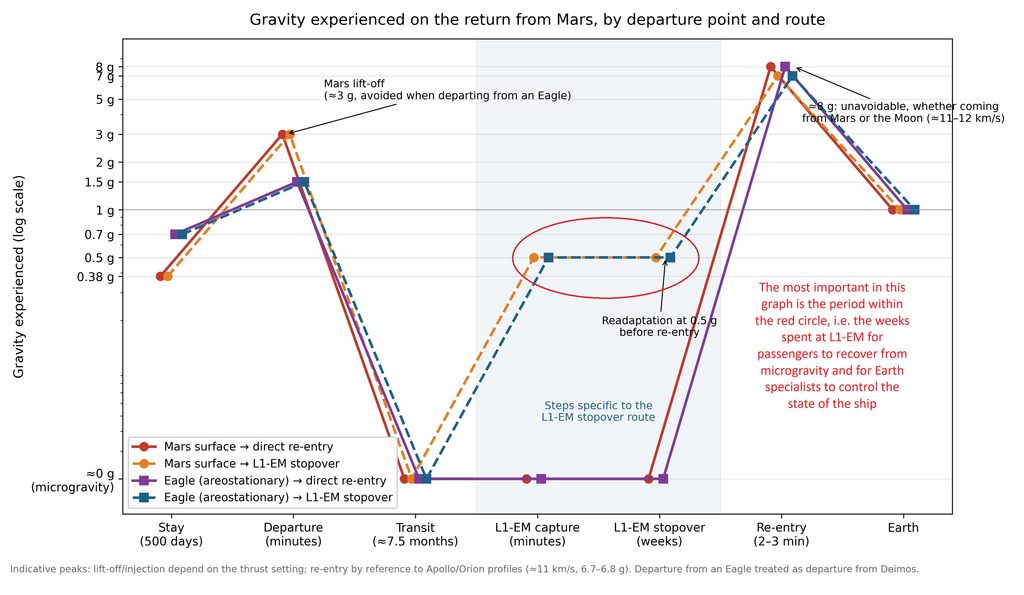
This demonstration clearly shows the enormous advantage that the establishment of a spaceport on Deimos, on the one hand, and of a space station around EML1, on the other, represents for the Mars–Earth voyage. There is no room for hesitation; we must build relay stations on Deimos/Phobos and around L1-TL!
Copyright Pierre Brisson.
Title illustration: The constraints of Mass, gravity and propellant needs upon a returning flight to Earth in the frame of four possible options. Graph made by claude.ai upon the request of Pierre Brisson
The gravity graph is also produced by claude.ai upon the request of Pierre Brisson.
xxxx
To find another post in this blog which could be of interest for you, click on:
xxxx
And, if you enjoy this blog, subscribe (it’s free)!

