SpaceX takes another step towards the Moon and Mars
This Saturday evening, with the successful accomplishment of its IFT15 flight, SpaceX took another step toward its conquest of Deep Space for Mankind.
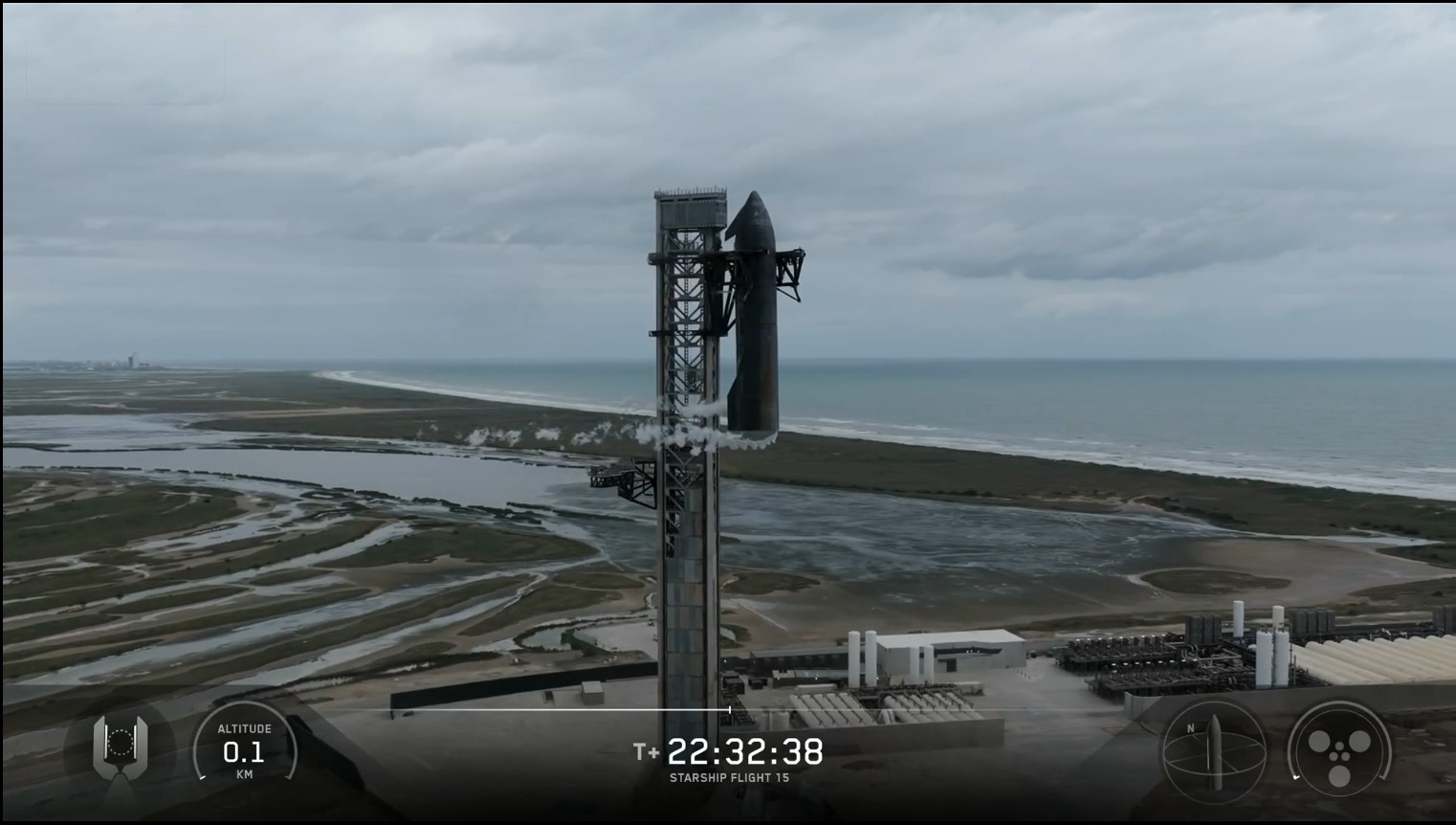
After completing 14 orbits around Earth, Starship S42 returned to its launch site at 22h32 (West European Time), 22 hours after liftoff, and was captured in the claws of the Mechazilla tower.
The B22 booster did not quite realize the same feat, as SpaceX opted to land it off Starbase in the Gulf of Mexico. It could have tried to also come back to Mechazilla (second tower) but did not dare and for good reasons as its guidance system gave indications that it was not perfectly operative (a low fuel mass alarm?). Nevertheless, it had accomplished its task: boosting the S42 sufficiently off Earth’s gravity to allow it to reach orbit (at a speed of 26,660 km/h and an altitude of approximately 260 km). During this phase, only one other minor issue arose: one of the B22’s 33 Raptor engines failed to reignite after being shut down to perform the S42 deployment maneuver.
Beyond the feat of recovering the S42, which demonstrates undeniable progress in mastering the spacecraft, the fact that this S42 returned to Earth in excellent condition will allow for a thorough examination of its state. This is particularly interesting, especially regarding thermal protection, with a view to reuse those ships.
Let us therefore congratulate the engineers and technicians at SpaceX for their work and acknowledge that they are head and shoulders above their competitors. Let us also congratulate Elon Musk for his perseverance and financial commitment. Without him, the dream of Mars, shared by all members of the Mars Society worldwide, and especially by myself, would not have progressed.
Before Mars, the next step on the road to the Moon will be to refuel the HLS (Human Landing System, name of the Starship that will perform the lunar landing and recovery) in Earth orbit. It’s a new challenge. The difficulty won’t come as a surprise. We know that weightlessness will greatly hinder the maneuver since, under these conditions, there’s neither water no up or down. The two pouches containing the two propellants (methane and oxygen) in their liquid, very cold state, will have to be slowly compressed. It will be necessary to prevent bubbles from forming in the tank that receives them, and of course, to avoid an explosion. And all of this will have to take place between two vehicles that will meet, dock, and travel at 28,000 km/h.
It’s not a done deal yet, but after the S42’s intact return to Earth, we can hope that the SpaceX teams will once again achieve the impossible.
Congrats to all of them and to Elon!

