Phobos, the hub of the Martian system
Why the orbital relay does not save a single metre per second — and why we should do it anyway.
In a previous article, we established that the journey between the surface of Mars and Deimos is not symmetrical: climbing costs nearly 5.8 km/s of pure propulsion, coming back down almost nothing, because the Martian atmosphere absorbs most of the kinetic energy. That asymmetry called for a sequel. For if the climb is the only real cost, then anything that lightens the climb — every kilogram we avoid hoisting out of the gravity well — is worth its weight in propellant. This is where Phobos enters the stage.
The guiding idea is that of rocket staging, transposed to the scale of the Martian system. A launcher drops its first stage as soon as it has done its job, precisely so as not to keep carrying a mass that has become useless. In the same way, the rocket that tears itself away from the surface of Mars has no reason to push on all the way to Deimos: it can hand over at Phobos, halfway up in energy terms, to a light shuttle designed for the upper leg alone. The first stage stays below, the second stage stays above, and neither carries the other.
The relay in figures
he orders of magnitude, computed as Hohmann transfers (µ Mars = 42,828 km³/s², reference low orbit at 300 km, Phobos at 9,376 km from the centre of Mars, Deimos at 23,463 km), are as follows:
| Leg | Propulsive Δv | Transfer time |
| Mars surface → low orbit (300 km) | ≈ 4.1 km/s (losses included) | a few minutes |
| Low orbit → Phobos (docking at Phobos included) | ≈ 1.2 km/s | ≈ 2 h |
| Surface → Phobos, total | ≈ 5.3 km/s | |
| Phobos → Deimos | ≈ 0.75 km/s (0.42 + 0.33) | ≈ 9 h |
| For comparison: surface → Deimos, direct | ≈ 5.8 km/s | ≈ 7 h from low orbit |
The table describes the ascending leg only; the descent, nearly free, is treated further on.
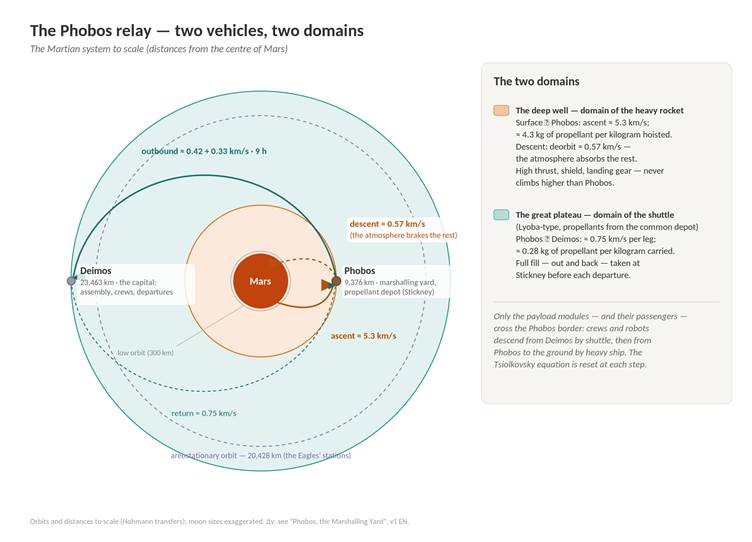
Figure — The Phobos relay: the system to scale, the two domains and their Δv (Hohmann transfers).
Two numbers deserve a pause. First, the Phobos–Deimos leg costs only 0.75 km/s outbound — and as much again on the way back, orbital mechanics being symmetrical — roughly one seventh of the cost of the climb from the surface alone. These 0.75 km/s split into two impulses, the minimum for a rendezvous: the first, given at Phobos (0.42 km/s), sends the shuttle onto the ellipse that rises to graze the orbit of Deimos; the second (0.33 km/s), given on arrival, equalises the velocities — without it, one would cross Deimos only to fall straight back towards Phobos. It is a remarkably benign flight regime, exactly the one in which a light, reusable tug makes full sense. Second, the synodic period of the Phobos–Deimos pair is about 10 hours: transfer windows open more than twice per Earth day. Add that Phobos passes over any given site on the Martian surface about three times per sol. The relay is therefore not a rare rendezvous to be watched for: it is a marshalling yard operating at a high tempo.
What the relay does not do
Let us say it plainly, for any reader armed with a calculator will check it: the relay through Phobos saves no Δv at all. The sum of the two legs (5.3 + 0.75 ≈ 6.05 km/s) is even slightly higher than the direct surface–Deimos trip (≈ 5.8 km/s). Splitting a Hohmann transfer in two at an intermediate point always costs a small penalty, here of the order of 0.2 to 0.3 km/s. If raw Δv were the yardstick, the stopover would be a mistake.
But raw Δv is precisely the wrong criterion. What costs is not the velocity to be acquired; it is the mass you carry while acquiring it. And that is where the stopover changes everything.
What the relay really does
The Tsiolkovsky equation is an exponential, and an exponential does not forgive additions in its exponent. A single vehicle flying surface → Deimos in one go exponentiates the full ≈ 5.8 km/s: every kilogram destined for the upper leg — the upper-leg propellant, but also the tanks sized to hold it, which stay aboard once empty — must be hoisted along the 5.3 km/s of the climb to the altitude of the relay, at a price of about 4.3 kg of propellant per kilogram carried. With the relay, the Tsiolkovsky equation is reset to zero at Phobos: each vehicle exponentiates only its own leg. The surface rocket lifts only the propellant of its own climb; the shuttle of the great plateau — let us so name the region stretching from Phobos to Deimos, where the Martian gravity well has flattened out so much that journeys are counted in hundreds of metres per second, no longer in kilometres — carries only the 0.75 km/s of its outbound run, renewed at every port call. The empty tank mass that would have had to be lifted all the way to Deimos in a single voyage simply no longer exists.
Let us give orders of magnitude, for it is in mass that the difference shows. Hoisting one tonne from the surface up to Phobos consumes about 4.3 tonnes of propellant: that is the toll of the deep well. Carrying that same tonne from Phobos to Deimos takes only about 280 kilograms. And even counting everything — the shuttle’s return and the descent reserve it carries with it — a complete rotation comes to roughly half a kilogram of propellant per kilogram delivered to Deimos: nearly ten times less than the surface–Phobos climb alone. This accounting is in fact conservative: it assumes the shuttle empty on the way back; in practice, it will often bring down crews bound for the surface, or equipment awaited at Phobos or on Mars, and the rotation will then deliver in both directions. That, in mass, is what the to-and-fro of the Lyoba (see hereunder) really has to carry up to Deimos: the payloads themselves, and almost nothing else.
The second gain is vehicle specialisation. The rocket that tears itself from the surface is sized for the deep gravity well: high thrust, a sturdy structure, a heat shield and landing gear for the way back down. The shuttle of the upper leg needs none of that: no shield, no gear; moderate thrust is enough. Making one vehicle do both jobs means parading a heat shield and landing gear to Deimos and back — dead mass that pays the upper-leg fare twice without ever serving. With the relay, the heat shield and the landing gear never climb higher than Phobos.
The third gain follows from the filling station. In our architecture, Phobos hosts a base buried in Stickney crater, equipped with a propellant depot fed by ISPP (In Situ Propellant Production): liquid methane and oxygen manufactured on the surface of Mars from the CO₂ of the atmosphere and the water ice of the subsurface, then ferried up to the depot. The surface rocket can therefore arrive at Phobos with nearly empty tanks and refill there for its descent. It no longer has to carry its descent reserve up from the ground — those extra 20 to 65% of propellant we computed in the previous article — which lightens the climb further. The refill for the way down happens at the top of the hill, not at the bottom. And we shall see that the shuttle of the great plateau likewise takes all its fills at this same depot — including, before it even climbs, the fill for its return from Deimos. Let us be honest to the end: this descent propellant does not escape the gravity well. It is lifted to Phobos from the surface by the heavy rocket itself, carrying a tanker module as its sole payload — uncrewed flights, at the pace of production — and it pays the same 5.3 km/s toll. The gain is therefore not energetic but structural and logistical: the rocket that carries payloads but no propellant in its hold flies with tanks cut for the climb alone — less dry mass to exponentiate — and the depot is replenished in bulk, on dedicated uncrewed flights, at the pace of production rather than that of missions.
Phobos: port of call, not parking orbit
A point of orbital mechanics needs stating. One would happily speak of leaving the rocket “in orbit around Phobos” while awaiting the next load. But Phobos allows practically no stable orbits about itself: its Hill sphere has a radius of only some 16 km, and the perturbations of Mars quickly dominate there. In practice, “waiting at Phobos” means either flying in co-orbital formation a few kilometres away, or — the solution we favour — being moored to the surface itself. The escape velocity of Phobos is about 11 m/s: you do not land on it, you come alongside, as at a quay. Mooring simplifies everything: transfer of the payload modules, propellant replenishment from the Stickney depot, maintenance by the robots of the base.
The operational scheme then becomes limpid. Upbound, the rocket from the surface berths at Phobos, sets down its payload module, refuels and waits — moored — for the next downbound load. The shuttle of the great plateau takes the module and carries it to Deimos in nine hours. Downbound, the same shuttle brings a module back from Deimos to Phobos, where the surface rocket picks it up and takes it down to the ground. Each vehicle plies its own leg, indefinitely, and only the payload modules cross the border.
A caveat on the downbound direction
Honesty requires noting that the downbound relay, for its part, has no energetic justification. From Deimos, direct deorbit into the Martian atmosphere costs only ≈ 0.67 km/s, with atmospheric entry at ≈ 4.6 km/s — a benign braking profile, as we have seen. That this figure is lower than the 0.75 km/s of the Deimos–Phobos leg alone is only an apparent paradox: descending to Mars is paid for with a single burn — the one that lowers the periapsis into the atmosphere, the arrival braking being provided free of charge by the atmosphere itself — whereas a rendezvous at Phobos, a body without an atmosphere, requires paying propulsively for both burns of the transfer. Going through Phobos on the way down adds the shuttle’s 0.75 km/s plus a deorbit burn of ≈ 0.57 km/s: the energy bill is nearly doubled. The downbound relay is justified by an altogether different argument: vehicle logistics. The craft capable of entering the atmosphere — with its shield, its gear, its re-entry structure — is based at Phobos and has no business climbing to Deimos. We therefore accept a modest energy premium on downbound freight so as not to duplicate the re-entry fleet, nor to parade its dead mass over the upper leg. It is a trade-off, and it must be presented as one.
Nota — the stopover itself is free: the docking burn at Phobos (0.42 km/s) and the later deorbit burn (0.57 km/s) are both applied at the same altitude and along the same tangential direction; their sum, 0.99 km/s, is exactly the single impulse a non-stop pass would require, switching in flight from the transfer ellipse to the atmospheric-entry ellipse. The downbound relay’s premium thus comes from choosing to pass at Phobos’s altitude, not from stopping there.
A shuttle for the great plateau
The upper-leg vehicle is no figment of the imagination: its category already exists in the nascent industry of terrestrial orbital mobility. The young Swiss company Pave Space (an offshoot of Fribourg’s Gruyère Space Program) is developing Lyoba, a chemical transfer stage running on storable propellants, designed to carry several tonnes from low Earth orbit to the high orbits in under 24 hours. Transposed to the Martian system, this template matches the need exactly: a light chemical stage with brisk thrust, allowing nine-hour transfers compatible with passengers. A word is needed on the propellants, however, for the transposition cannot be literal. Lyoba uses so-called storable propellants: liquid at room temperature, they keep for years without the slightest care. The liquid methane and oxygen of the Stickney depot belong to the other family, the cryogens: they must be held at around −162 °C for the one, −183 °C for the other. But these are “soft” cryogens — nothing like liquid hydrogen and its 20kelvin — which good insulation and a sunshade will keep for weeks in space. The plateau shuttle will therefore drink from the common depot: methane and oxygen, like the rest of the fleet. Its rotation lends itself to it: the full fill — the outbound run to Deimos and the return to Phobos — is taken at Stickney before each departure; the descent reserve travels in the shuttle’s own tanks; nothing needs to be stored at Deimos, and no tanker fleet is needed to supply it up there. Between two calls at the quay, only a few days elapse, which its insulated tanks cross with negligible losses; and during the long waits moored at Phobos, it is the cryogenic plant of the depot that keeps the cold. This chemical shuttle of the great plateau remains distinct from our argon-fuelled electric freighters: those provide the interplanetary noria — the slow, continuous to-and-fro of automated cargo ships between Earth and Mars, where only the cadence of the rotations matters, not the speed of any one of them. On the plateau, everything goes by the shuttle: crews, freight and tanker modules.
What Phobos changes for Deimos
One might think that giving Phobos this role weakens the case for Deimos as the main base. It is exactly the reverse. What weighs on the logistics of an orbital base is propellant: producing it, lifting it, storing it. With the relay, the mass of propellant that climbs above Phobos shrinks to almost nothing — the fill for one shuttle rotation, out and back, renewed each time at the Stickney depot. Deimos no longer has to serve as a filling station for surface traffic: it is relieved of that industrial servitude and can devote itself to what its high orbit marks it out for — the assembly of the large structures, the life of the crews, and the accumulation of the only stocks that truly must climb so high: the chemical propellant of the return to Earth, produced on the ground of Mars during the stay, lifted to Phobos in tanker modules and carried to Deimos by the shuttle before each window.
The hierarchy of the two moons thus settles naturally, dictated by their orbits: Phobos, low and fast, is the transhipment port — the marshalling yard where the draught horse of the gravity well hands over to the runner of the great plateau. Deimos, high and slow, almost at the threshold of Martian escape, is the capital — the place where one builds, where one lives, and from which one sets out for Earth. Each does the job that its gravity and its altitude assign it. Once again, it is not distance that governs, it is gravity; and the best way to defeat it is not to push harder, but never to carry anything that does not need to travel.
One last remark. Throughout this text, the destination was Deimos — the highest element of the great plateau, but not its only occupant. Nothing in the logic of the relay requires the terminus to be a moon: the day the Eagles have left the soil of Deimos to take up their stations in areostationary orbit — itself located on the plateau, between the two moons — each of them will become a possible terminus for the shuttle of the great plateau. Deimos, as a lunar body, will nonetheless retain a particular role in this architecture — that will be the subject of the next article.
xxxx
Complementary note on Lyoba
A stage’s “payload” is not a property of the vehicle: it is a property of the vehicle–mission pair. Lyoba’s public figures — a roughly 20-tonne vehicle delivering up to 5 tonnes from low Earth orbit to geostationary orbit in under 24 hours — are rated for the most demanding transfer on the terrestrial market, about 4 km/s. Let us calibrate an archetype on those figures: ~2 t of dry mass, ~18 t of propellant, storable-propellant specific impulse (~320 s) — a conservative assumption, as the Stickney depot’s methane–oxygen would do slightly better. Tsiolkovsky’s equation being an exponential, capacity climbs spectacularly as soon as the mission Δv drops:
| Mission | Propulsive Δv | Payload (full tanks) |
| Earth: low orbit → geostationary (reference) | ≈ 4 km/s | 5 t (public figure) |
| Phobos → Deimos, one way | 0.75 km/s | ≈ 65 t |
| Full rotation (loaded out, empty return) | 2 × 0.75 km/s | ≈ 60 t |
| Phasing between two points of areostationary orbit | a few tens of m/s | limited by structure and docking, not by propellant |
Without changing a line of the archetype, the stage that tops out at five tonnes around Earth would carry some sixty on the Martian upper leg — more than three times the mass of an Orion capsule. Orion (17.5 t) is in any case the wrong yardstick for a plateau cabin: its tonnes pay for an Earth re-entry shield, launch loads and three weeks of deep-space autonomy, none of which is needed between Phobos and Deimos. To fix ideas: Gemini weighed under 4 tonnes for two men and fourteen days of flight, heat shield included; the Soyuz orbital module, a simple crew compartment, about 1.3 tonnes. A 3-to-5-tonne cabin for four to six passengers — a nine-hour transfer, two days of margin — is therefore a reasonable order of magnitude, far below the stage’s capacity.
The freed capacity can also be traded for time. The nine hours of the journey are those of the Hohmann transfer — the most economical, not the fastest. By departing harder, on an ellipse whose apoapsis overshoots Deimos, one cuts across its path along the way: 1.1 km/s bring the trip under six hours, and the ~2 km/s per leg freed by a 5-tonne cabin close it in three and a half hours. Beyond that, returns collapse — it is the arrival braking that soars. Hence two regimes on the same plateau, served by the same vehicle: freight rides the Hohmann, passengers buy time with propellant. Departure windows, for their part, remain set by the two moons’ synodic period, about ten and a quarter hours. At full load, the engine’s 45 kN still deliver ≈ 0.5 m/s²: burns of some twenty minutes, negligible on the scale of a nine-hour transfer. And contingency is benign: an engine failure on the plateau precipitates neither re-entry nor fall — the shuttle drifts on a stable ellipse, a few hundred metres per second from home, awaiting rescue. One final honesty clause: Lyoba serves here as an archetype, not an off-the-shelf offer; the real adaptation work is not size but crew-rating — redundancy, backup systems, docking.
Title illustration: The two domains—exiting the Martian gravity pit up to Phobos and traveling across the "Grand Plateau" between Phobos and Deimos (created with the assistance of claude.ai).
Copyright Pierre Brisson
The illustration and computations have been made by claude.ai upon my request.
xxxx
To find another post in this blog which could be of interest for you, click on:
xxxx
And, if you enjoy this blog, subscribe (it’s free)!

