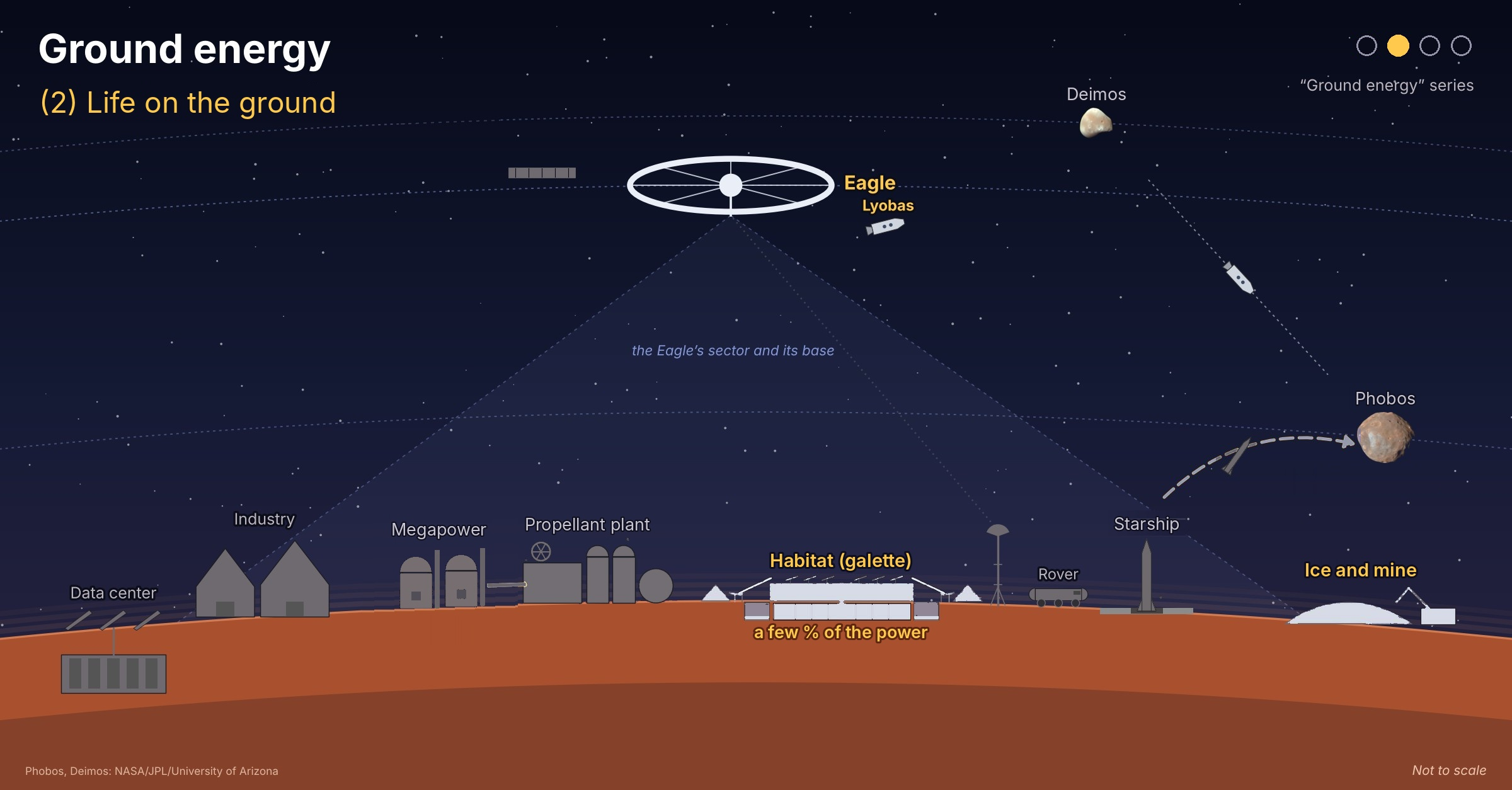
Ground Energy (2): Energy Needs for Life on the Surface of Mars, Excluding Propellant
Earlier in this study of “energy needs on the surface of Mars,” a first article dealt with the framework and with propellant (§§ 1 to 3 of the full study). Today we turn to the energy needed for human life on site, that is, for water, for digging the habitats, for air, for food, and for heating and lighting (§§ 4 to 8). Sections 9 to 16 of the full study will appear in the next two articles. Section numbering runs continuously from one article to the next.
§ 4 Energy needs for water: extracting the ice
What ice costs
Melting ice taken at −60 °C costs little: 0.03 kWh per kilogram to warm it to 0 °C, and 0.09 kWh to melt it, or about 0.13 kWh/kg. Adding excavation, transport to the plant and purification, we arrive at 0.3–0.5 kWh (easy access to ice hypothesis) per kilogram of water.
How much water is needed
Two uses share a base’s water.
- Propellant. About 0.5 kg of water is needed per kilogram of propellant (50 kg/h of water for 100 kg/h of propellant, the water formed by the Sabatier reaction being recycled). For the ~3,650 t of propellant per year at the 100-resident stage in the Martian environment (see “Propellants (1): the needs”), that is about 1,800 t of water per year.
- Life of the missions and crops. Since the recycling loops are almost closed, the need is small compared with that of propellant.
The Eagles’ water is not a charge on the bases. Their recycling loops are also almost closed (the International Space Station already recovers about 98% of its water): for 100 residents, routine make-up is only on the order of 10 to 20 t per year, plus one-off fills (shielding, water windows, crops). This water will come mainly from the poles, as will the raw material for the Eagles’ propellant reserves (§ 13).
At 0.4 kWh/kg, 1,800 t of water require about 0.7 GWh per year, or 80 kWe continuously. That is about 2% of the energy devoted to propellant (10 to 13 kWh/kg, § 3), a share amply covered by the margin taken for auxiliary loads. Water, as long as it comes as ice, is a problem of machines and logistics, not of energy.
Where is the ice?
Location, on the other hand, matters a great deal: the ice must be close at hand. The SHARAD and MARSIS radars, and images of recent impact craters that have exposed clean ice, show ice often less than one or two meters deep, from about 35–40° latitude. It is also found, above all, in large quantities in the polar caps, kilometers thick.
Near the equator, the situation is less favorable, but not hopeless. The MARSIS radar suggests that the Medusae Fossae deposits hold a large quantity of ice, but under 300 to 600 m of dry material, out of a base’s reach in the early days. Two sites are more promising. In the center of Valles Marineris, the FREND neutron detector on the European TGO orbiter has measured in Candor Chaos, over an area the size of the Netherlands, a hydrogen content equivalent to about 40% water in the top meter of soil; its authors lean toward ice rather than hydrated minerals. Farther west, in eastern Noctis Labyrinthus, Pascal Lee and Sourabh Shubham identified in 2024 a large eroded volcano (Noctis Mons) near whose base glacier ice may survive under a thin volcanic layer. These two clues, one instrumental, the other geomorphological, remain to be confirmed on site. Elsewhere in this zone, water is available only bound to minerals (clays, hydrated sulfates), at a few percent of the regolith’s mass. Extracting it means heating the regolith to several hundred degrees. In a rich ore, and with heat recovery, the cost then rises to 2 or 3 kWh per kilogram of water, 5 to 10 times more than ice, and would add about 10% to the propellant energy. In a poor regolith (2% water), a NASA study (Kleinhenz and Paz, 2017) points to about a dozen kWh per kilogram of water: the propellant energy would increase by half.
The depth of the deposit weighs mainly on access. Under two meters of dry regolith, stripping the surface is enough: a few thousand cubic meters, a few MWh. At 50 m, an open pit would have to move nearly half a million cubic meters, since its volume grows as the cube of the depth. Access will therefore go through a ramp or a shaft, followed by mining in galleries, or else the ice will be melted in place at the bottom of a borehole and the water pumped up, as the American South Pole station does. Where the terrain allows, a canyon wall, a cliff or a glacier front, a horizontal adit bored by the same machine that will dig the habitat (§ 5) will reach the ice at its own level: its length then depends on the distance to the slope, not on the depth, and loaded vehicles leave it going downhill. For ice a few tens of meters down, the access energy remains a few tens of MWh, paid once, and lifting the water 50 m costs almost nothing. The distance to the ice, vertical or horizontal, is first a matter of time, machines and wall stability. It is this distance, more than energy, that puts Medusae Fossae out of reach in the early days.
Yet we must stay close to the equator. Phobos, Deimos and the Eagles orbit in its plane: a ship leaving a base far from the equator has to change planes on the way up and on the way down, which makes each rotation 15% heavier in propellant at 20° latitude, and 44% heavier at 40° (§ 13).
Hence the site rule: each Eagle’s base is placed on the ice closest to the equator, going up to 20° latitude if none is found lower, and no farther. Prospecting for ice in the tropical regions (Candor Chaos, Noctis Labyrinthus and other sites yet to be found) is therefore the robots’ first task in each Eagle’s sector. If it fails, water from hydrated minerals, more expensive to extract, remains available everywhere.
The poles
The two polar caps are by far the largest ice reservoirs on the planet. Their water is not intended for the Eagles’ bases, which exploit the ice of their surroundings, but for space: for the Eagles and the two moons. It gets there in two stages, by a shuttle to a depot in low polar orbit, then by an electric tug. This question is dealt with in § 13.
§ 5. Energy needs for digging the habitats
The reference habitat is that of “Staying on Mars” (an earlier article): rooms dug into the ground from a circular trench 5 m wide and 3 m deep, which bounds a disk 30 m in diameter. The excavated regolith is compacted on the disk, forming a “galette”. From the trench, which will become a food garden, a tunnel boring machine drills five tunnels running diametrically through the disk, 3 m high, under 2.5 m of cover that will protect against radiation. Their intersection forms the central hall; widened, they become the bedrooms, the washrooms and the technical rooms. Besides the galette, the spoil will be used to build a protective berm against dust and radiation all around the garden.
The volumes
The trench, about 110 m long, represents some 1,650 m³, and the access ramp a little more. The five tunnels and their widenings into bedrooms and other rooms represent on the order of 2,000 to 3,000 m³. In all, the trench and the rooms dug under the disk require about 4,000 to 5,000 m³ of excavation. Raising the disk by 2.5 m takes some 1,800 m³; the rest is enough to build the berm around the garden.
This choice of a “light” galette over the habitat is deliberate. As shown in “Containing Pressure Inside a Buried Martian Habitat” (another earlier article), more than 8 m of backfill would be needed for its weight alone to balance an internal pressure of 0.5 bar. Digging that deep would take much longer, would require much thicker walls and would make the trench hard to hold. We prefer 2.5 m of cover, sufficient against radiation, and envelopes anchored in tension to contain the pressure. These take the form of pointed (ogival) vaults, held to the ground by tie rods.
Energy
The energy depends mainly on the ground.
- In loose regolith, an electric loader uses 1 to 5 kWh per cubic meter excavated and hauled a short distance.
- In ice-cemented ground, or in rock, a tunnel boring machine or a cutter is needed, and the figure rises to 20 to 50 kWh/m³.
This second case will be common, since the site rule of § 4 places the bases near ice deposits. Ice-rich permafrost at −60 °C is as hard as soft rock.
A galette therefore costs from a few MWh, in loose ground, to nearly 0.3 GWh, in frozen ground, once. Spread over a year of construction, this energy amounts to about thirty kilowatts on average at most. That is negligible compared with the available power (§ 3).
The real problem
Digging is thus a problem of machines, time and robots, not of the energy budget. Each machine has a power of a few tens to a few hundred kilowatts, and each works only part of the time: the tunnel boring machine alternates between cutting and installing ground support, the loaders wait for its spoil, and all of them stop to recharge their batteries and for maintenance. The power installed on the construction site thus reaches a few hundred kilowatts. It must be available, but not permanently.
A point of vigilance, specific to frozen ground: the heat released by drilling can locally melt the ground ice. It will have to be monitored, as is done on Earth in tunnels dug in permafrost.
§ 6. Energy needs for air: breathable air and pressurization
The reference atmosphere
All the habitats in the series share the same atmosphere: 0.5 bar, of which 42% is oxygen. The oxygen partial pressure, 0.21 bar, is that of Earth’s air at sea level; the rest is a buffer gas, nitrogen or argon.
For the rooms under the galette and for the pressurized trench, 4,000 to 5,000 m³ in all, this atmosphere weighs 2.5 to 3 tonnes, including 1.1 to 1.4 t of oxygen. It is contained by the individual envelopes described in “Containing Pressure Inside a Buried Martian Habitat”: pointed vaults, whose curvature allows them to hold the pressure in tension, held to the ground by tie rods.
Oxygen: a by-product of propellant
A person consumes about 0.84 kg of oxygen per day. A mission of 8 people therefore consumes less than 7 kg per day, and a mission of 13 people about 11 kg.
If it were produced specifically by water electrolysis (6 to 7 kWh per kg of oxygen), this would cost about 230 W per person: less than 2 kW for a mission of 8 people, 3 kW for 13.
Part of it will come from plants: according to “Staying on Mars”, the ~500 m² of the trench produce the oxygen for about ten people, more than a regular mission consumes. But plants are not a reliable source, and for the rest there is no need to produce oxygen specifically. As “Propellants (2)” (another earlier article) showed, electrolysis provides a little more oxygen than the engines burn, and this surplus goes to life support. A base’s propellant plant produces tens of tonnes of oxygen per month; the missions draw a few hundred kilograms. For a base backed by its plant, breathable oxygen is practically free.
Exhaled carbon dioxide must be removed from the air. The scrubbers (regenerable zeolites or amines) require a few hundred watts per person during missions. The recovered CO₂ can go to the plant, where it will feed the Sabatier reaction.
The buffer gas
The Martian atmosphere contains about 3% nitrogen and 2% argon. When the plant captures and condenses CO₂, these two gases remain: a free residue. For the roughly 2,200 t of CO₂ captured each year at the 100-resident stage, there are about a hundred tonnes of them. That is much more than needed to fill an habitat under galette (less than 2 t) and to make up for its leaks and for the losses at each airlock cycle.
Between two missions
Should the habitat be kept pressurized when no one lives there? From the energy standpoint, the question does not arise: a pressurized envelope consumes nothing except the gas of its leaks. The garden trench must in any case remain pressurized for the crops and the aquarium (§ 7).
The answer is therefore structural. Each cycle of pressurization and depressurization stresses the envelopes, their anchors and their joints; it is probably better to keep them at constant pressure, which also makes it possible to receive an emergency mission without delay. If the habitat had to be refilled with air, the base’s reserves (the plant’s liquid oxygen, the stored buffer gas) would do so within a few hours. It is a question of reserves and flow rate, not of energy.
The balance
Air costs a few kilowatts during missions, mainly for scrubbing and ventilation, and almost nothing between missions.
§ 7. Energy needs for food: the trench garden, the aquarium and spirulina
The principle
The core of the missions’ food is produced and stored on the ground, making maximum use of the garden laid out in the trench surrounding the habitat. The home Eagle brings only the products that are hardest to store or produce on the ground. The garden is tended by robots, and they work there all year round.
Sizing on the year, not on the headcount
People are present only between a quarter and a third of the time (§ 2). The garden can therefore be sized on annual consumption rather than on the number of people present. Its harvests are dried, stored, or partly sent up to the Eagle.
A base’s 1,800 person-days per Martian year are equivalent to about 3 people fed continuously. With a reserve for dust storms and unplanned missions, enough must be produced to feed 4 to 5 people.
What the trench yields
According to “Staying on Mars,” the heliostats and the reflective underside of the over-roof bring about 15 moles of useful photons per m² per sol to the bottom of the trench, half of what an Earth greenhouse receives. Light-emitting diode (LED) lighting provides the other half, for about twenty kilowatts on average over the whole trench. We can thus hope for fruit, and not just leafy greens.
At this light level, 60 to 80 m² of growing area are needed to feed one person completely (40 to 50 m² under more intense light). The ~500 m² of the trench therefore feed 6 to 8 people continuously: more than the 4 to 5 needed. The trench is sufficient for the missions, for about twenty kilowatts.
Biopods
“Staying on Mars” also provides for two biopods (Interstellar Lab’s insulated modular greenhouses) around the habitat, powered by a dedicated Kilopower reactor. They make it possible to adjust temperature, humidity and lighting to each crop and to avoid perchlorate contamination. Their particular strength is complete control of the environment: duration and intensity of lighting, temperature, humidity. Any season can be recreated artificially, so seasonal produce can be grown in any season. Since the trench covers the missions’ needs, the biopods operate only when needed: for diversity and seasonal produce, to rebuild a reserve, or to replace the trench if it is damaged. Their power, on the order of 10 to 20 kWe each when running under artificial lighting, is drawn only in these cases.
Dust storms
A global dust storm can deprive the garden of natural light for several weeks. Two countermeasures complement each other:
- artificial lighting able to take over, which means installing the power for the “all-artificial” case even if it is rarely used;
- stocks of dry food covering several months.
The nuclear baseload, indifferent to dust, makes the first countermeasure reliable.
What the Eagle provides
The home Eagle brings what the garden grows poorly or what keeps poorly on the ground. It can do so all the more easily as it is better lit, sheltered from dust, and closer to Earth in energy terms: it more easily receives what comes from Earth (spices, dietary supplements, certain animal products) and what its own crops produce.
The aquatic garden
The aquarium. Tilapia, or freshwater crustaceans (shrimp, crayfish), supplement the diet with animal protein. They are a priori not very sensitive to low gravity: fish have already been raised in weightlessness, aboard the International Space Station. Coupled with crops in aquaponics (fish waste fertilizes the plants, plant waste partly feeds the fish), the aquarium closes a loop. Its energy use is low: pumps, aeration and keeping the water at around 25 °C, on the order of a kilowatt.
Spirulina. This cyanobacterium (Arthrospira), grown in a tank, provides an excellent protein supplement, at 10 to 20 g of dry matter per person per day. It also produces oxygen, but that is a bonus, not a reason to grow it.
- Under the natural light of the heliostats, this oxygen is free.
- Under artificial lighting, it is expensive. Even with the best diodes, photosynthesis cannot produce a kilogram of oxygen for less than about 30 kWh. In practice, with crop losses, one must count on 60 to 150 kWh/kg. That is 10 to 20 times more than electrolysis, whose oxygen is already available as a surplus (§ 6).
Spirulina will therefore be grown in daylight, for its protein. The European Space Agency’s (ESA) MELiSSA program, which has been studying a closed-loop life-support system for thirty years, uses precisely Arthrospira.
§ 8. Energy needs for heating and lighting the habitats
Heating: a matter of ground conditions
A buried habitat is in principle well insulated. Dry, loose regolith conducts heat very poorly, all the more so as the Martian atmosphere is thin. For a habitat under a galette (hereafter simply “the galette”) with about 1,900 m² of walls, kept at 20 °C in ground at −60 °C, under 2.5 to 3 m of dry regolith, losses are on the order of 2 to 3 kW. They are amply covered by internal gains.
But the site rule of § 4 changes the picture. Ice-cemented ground conducts heat 20 to 40 times better than dry regolith. Losses can then rise to 25, or even 100 kW. Above all, this heat gradually thaws the permafrost under the foundations, at the risk of destabilizing them.
The countermeasure is architectural: placing an insulating layer between the habitat and the frozen ground, made of imported dry regolith or of insulation manufactured on site. It determines both the heating need and the stability of the structure. This point must be incorporated into the design of the galette (hence a 3 m dug height, to keep about 2.5 m of headroom once the insulating layer is laid).
Glazed surfaces lose more than buried walls. The quarter-vault roof of the trench alone represents some 600 m² of laminated glass. Exposed directly to the night sky, it would lose 50 to 150 kW. But it does not see the sky: it sees the reflective underside of the HDPE (high-density polyethylene) over-roof, which sends most of its radiation back. The vault’s losses then fall to a few tens of kilowatts at most, to be calculated precisely with the geometry. The eighteen water windows of the bedrooms, with their meter of water between two panes, lose little, and their roughly 30 t of water smooth out the difference between day and night.
Heat that is mostly internal
In practice, the galette will be heated mainly by its own electricity consumption, which always ends up as heat. The trench lighting (about twenty kilowatts, § 7) covers most of the losses and, in the bases that host one, the data center (§ 11) will add even more.
The problem will therefore more often be getting rid of heat than producing it, without dumping it into the frozen ground. Surface radiators and heat-rejection loops will be needed. Between missions, the lighting and the aquarium are enough to keep the garden above freezing.
Lighting the living spaces
By day, the heliostats and the light well light the habitat. At night and on dark days, light-emitting diodes take over, at 10 to 20 W per square meter. For the roughly 700 to 1,000 m² of usable floor area of a galette, that is 7 to 20 kW at most. This power is drawn only during missions, and only for part of the day.
Interim balance
| Item | During missions | Between missions |
| Digging (§ 5) | — | ≤ 30 kWe on average during construction, once |
| Air: scrubbing, ventilation (§ 6) | a few kWe | ~0 |
| Trench, aquarium, spirulina (§ 7) | ~20–25 kWe | ~20–25 kWe |
| Biopods (§ 7, when needed) | 0–40 kWe | 0–40 kWe |
| Heating (§ 8) | 0–20 kWe top-up, the rest covered by internal gains | same, if the galette is insulated from the permafrost |
| Lighting of living spaces (§ 8) | 7–20 kWe at most | ~0 |
| Total excluding digging | ~30–110 kWe | ~20–85 kWe |
This concludes article 2 of the study of energy needs on the surface of Mars. This article, which deals with the needs of human life on the ground, shows that these needs amount to only tens of kilowatts: just a few percent of a single Megapower.
The needs of human activity on the ground, that is, for robots, telecommunications, computing and industry, will be the subject of article 3 of the study. A final article (article 4) will then deal with the energy cost of transportation, draw up the overall balance and propose a choice of energy sources.
As a reminder, the study has been split into four articles to make the whole easier to read. Once publication is complete, I will be glad to send the full document to any readers who ask for it.
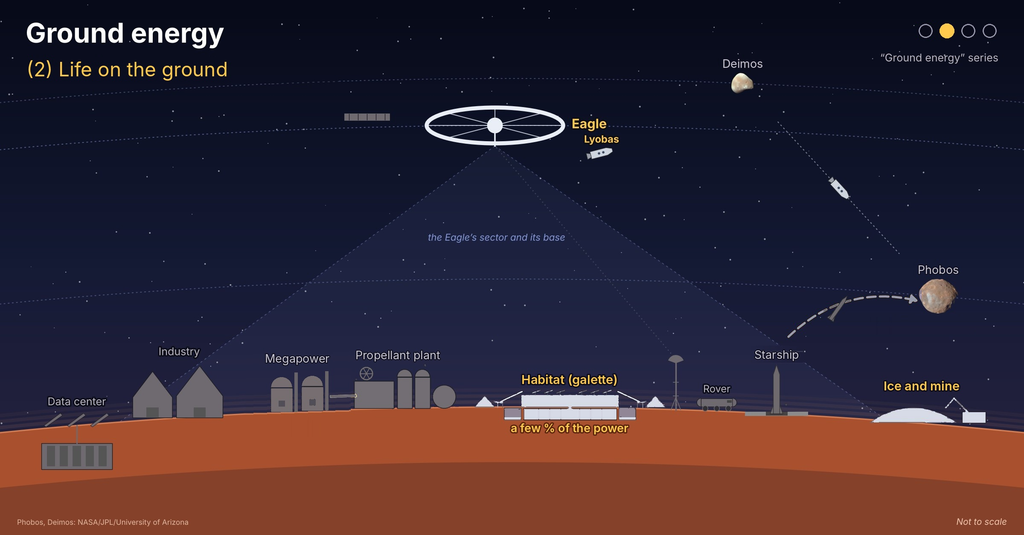
illustration title and above: Ground energy 2: Life on the ground. Graph Made by claude.ai, Pierre Brisson’s concept.
Copyright Pierre Brisson
xxxx
To find another post in this blog which could be of interest for you, click on:
xxxx
And, if you enjoy this blog, subscribe (it’s free)!

