Hera “connects” us once again with the asteroids Didymos and Dimorphos
Last night ESA, represented by the three leading scientists involved (including the mission’s overall lead, Patrick Michel), gave an update on its Hera mission, which arrived on November 4 in the vicinity of the asteroid Didymos (diameter 780 m) and its moon Dimorphos (diameter 150 m).
The probe, which bears the mission’s name, has settled into orbit about 30 km from the two small bodies. Rather than a classic circular orbit, its trajectory around the pair is nearly rectangular (or hyperbolic, with regular maneuvers).
As a reminder, Hera (the goddess of marriage in Greek mythology) was launched on October 7, 2024. The purpose of the mission is to assess the effect of the impact NASA produced on Dimorphos at the conclusion of its DART mission (Double Asteroid Redirection Test). In January 2027, two cubesats, Milani (named after the planetary scientist Andrea Milani) and Juventas (Hera’s daughter), will be released to make close-up observations, and one of them will also land. For two months, Juventas will probe Dimorphos to a depth of about a hundred meters using a low-frequency radar, before landing on it, measuring its gravity and assessing the consequences.
Without waiting, four important observations have already been made (image resolution 3 m/pixel). All of them point to the very high vulnerability of asteroids.
The first (made immediately after the impact by the cubesat left behind by DART) is the sheer volume of ejecta following the impact.
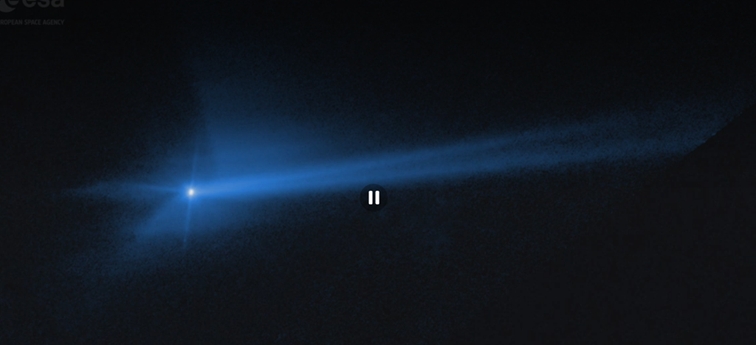
Immediate aftermath of DART’s impact on Dimorphos. Image taken by the Italian CubeSat LICIACube (LEIA and LUKE cameras), released by DART before the impact.
The others have been made since Hera arrived on site:
The second shows that the impact truly left its mark on the body of Dimorphos. A crater that is enormous relative to the size of the asteroid has dug deep into it. In its center one can also see a distinctly more massive rock whose significance is unknown (a boulder that settled back there after the impact? An outcrop of an underlying rocky body?).
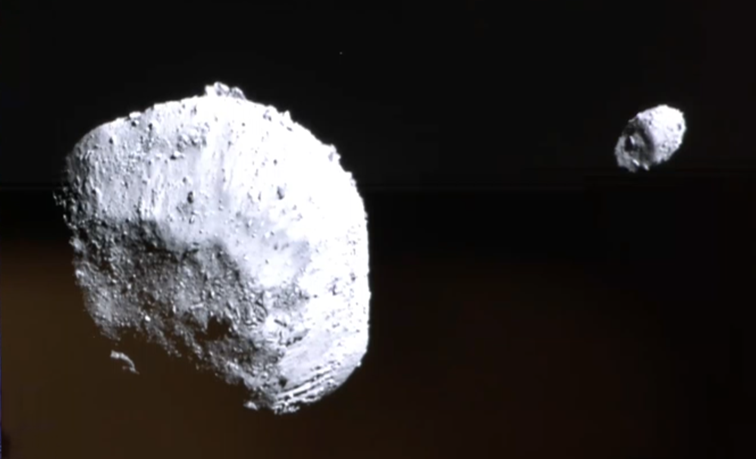
Image taken by Hera. You can see Dimorphos on the right, with one of its faces flattened by the impact and an elongated rock in the middle. Credit: ESA.
The third shows that the rotation of Dimorphos is completely chaotic: it keeps changing its spin axis. We do not know exactly how it rotated before the impact, but it is very likely—because it would be logical—that its rotation was synchronous with its orbit around Didymos. The fact that the impact shortened that orbit by just over 30 minutes (from about 11 h 55 min to about 11 h 23 min) supports this interpretation: the impact broke that synchronism.
The fourth shows, when the light reflected by the two bodies is blocked out, that a great many boulders are scattered throughout their surroundings.
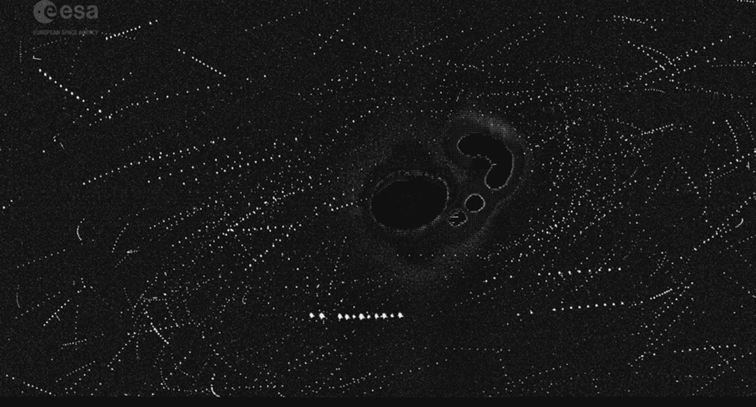
The asteroids’ surroundings polluted by rocks. Hera image.
We can already conclude that a 550 kg impact at 23,000 km/h had very significant consequences, even though it could have been far more powerful (there were no explosives on board DART). This is worth remembering when the time comes to deflect an asteroid of the same type approaching Earth.
The fourth observation is obviously worrying, since it indicates that approaching Dimorphos may be more difficult than expected.
More generally, we are realizing how weakly cohesive these bodies are. This prompts broader reflection on how to approach similar bodies, and I am thinking in particular of Deimos, the smaller of the moons of Mars, which I would like us to use to establish ourselves on Mars. Granted, Deimos is much larger than Dimorphos (Deimos’s diameter is 15 km), or even Didymos, but Hera will provide us with a great deal of information on anchoring and on the dispersal of dust caused by movement or sampling.
illustration title and above: Didymos (on the left) and Dimorphos (on the right, after the DART impact); Photo ESA.
Copyright Pierre Brisson
xxxx
To find another post in this blog which could be of interest for you, click on:
xxxx
And, if you enjoy this blog, subscribe (it’s free)!

