The MMX Mission, First Step Toward Mars
The launch of the MMX (Mars Moons eXploration) mission to Mars, aboard a Japanese H3-24L rocket, was a complete success tonight, October 19.
The launch of the MMX (Mars Moons eXploration) mission to Mars, aboard a Japanese H3-24L rocket, was a complete success tonight, October 19.
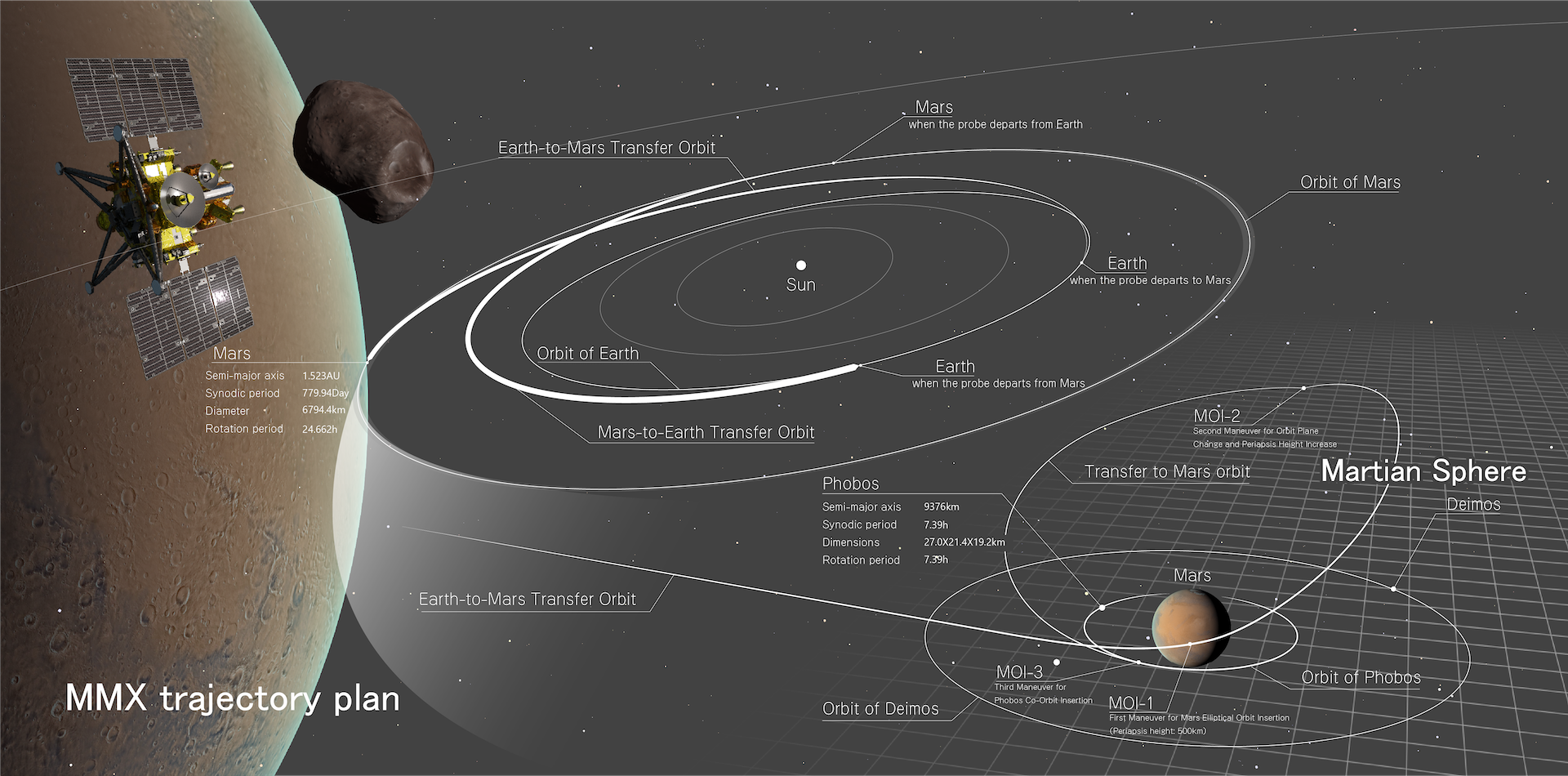
Plein succès cette nuit, 19 octobre à 21h41 (CEST) du lancement vers Mars de la mission MMX (Mars Moons eXploration) à bord d’un lanceur japonais H3-24L. L’objet est d’étudier les deux lunes de Mars, Deimos et Phobos et, en particulier, de collecter des échantillons de Phobos et de les rapporter sur Terre. Elle observera aussi Deimos mais à distance, avec ses instruments embarqués. La mission, conduite par la JAXA, est internationale.
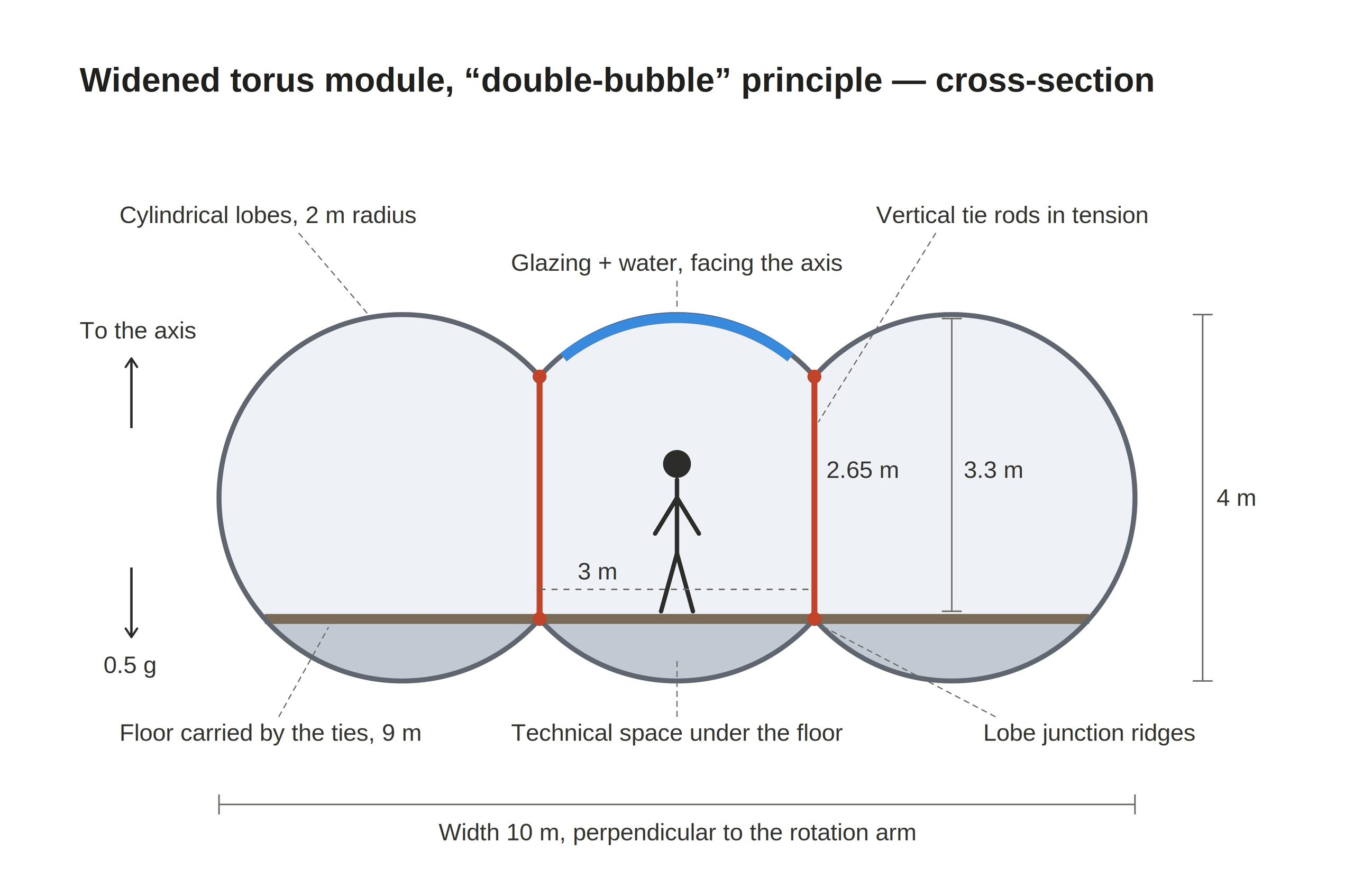
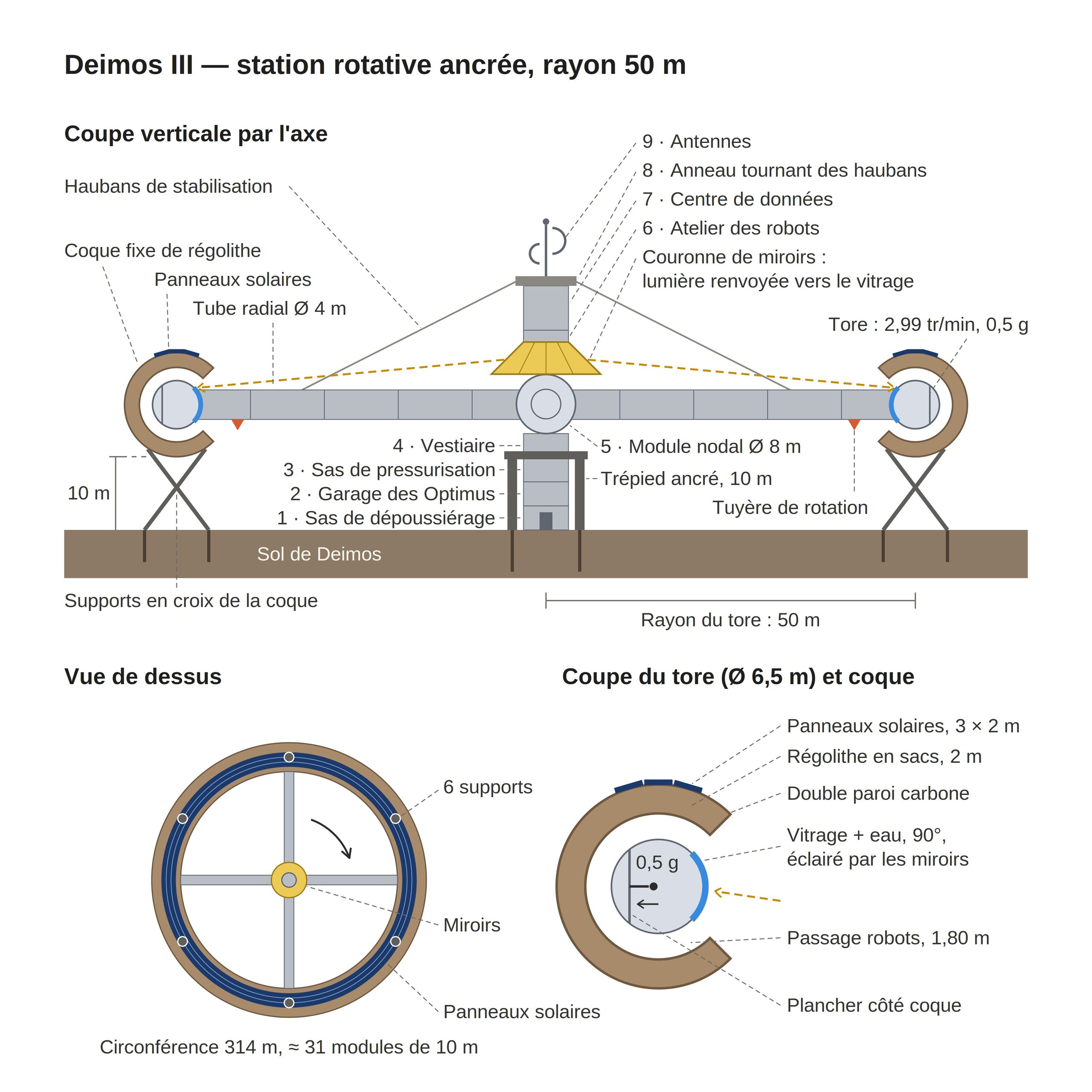
We are referring here to the second generation anchored rotating stations Deimos III and Phobos II on their respective moon. We propose that the cylindrical modules composing their torus could no longer be round as those of Deimos II but « oblong » (with a larger diameter perpendicular to the rotating arm). The result would be a larger volume and a larger floor area in width. We describe them herein.
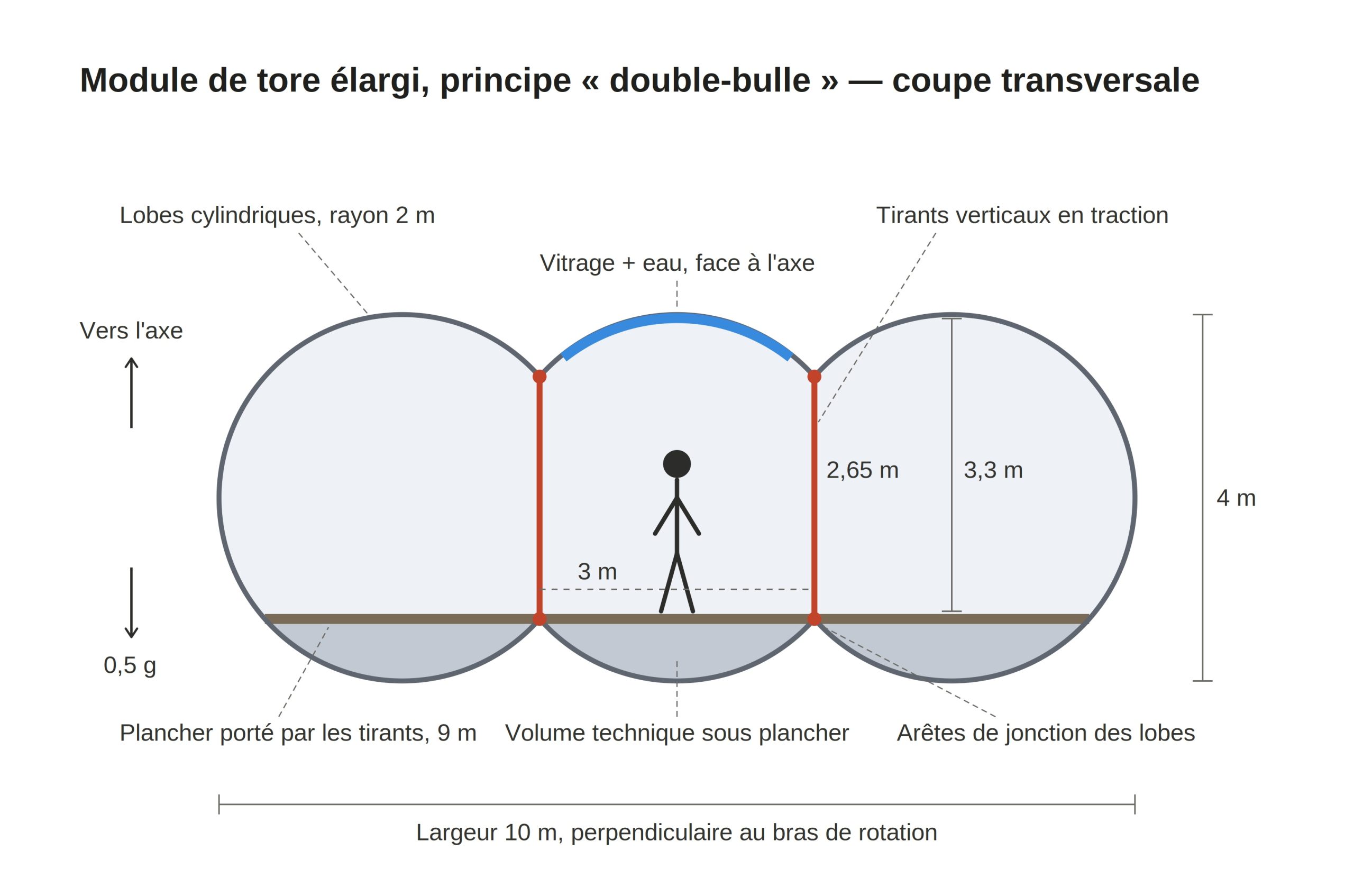
Nous faisons ici référence aux stations rotatives ancrées de deuxième génération Deimos III et Phobos II, situées sur leur lune respective. Nous proposons que les modules cylindriques qui composent leur tore ne soient plus ronds comme ceux de Deimos II, mais oblongs (avec un diamètre plus grand perpendiculaire au bras rotatif). Il en résulterait un volume plus grand et une surface au sol plus large. Nous décrivons ces ci-après.
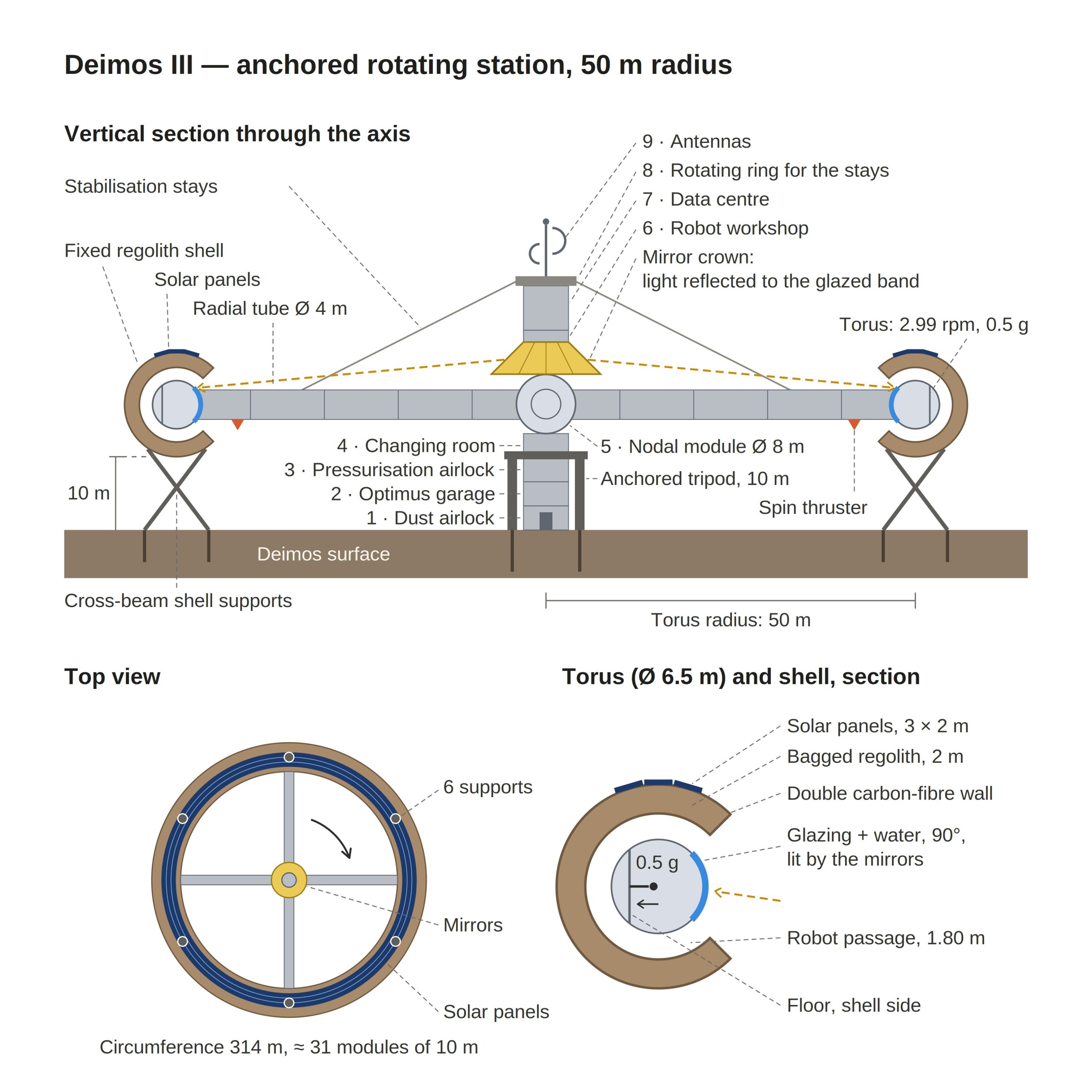
Deimos and Phobos should play an essential part in the permanent human settlement that could develop in the Martian world with a stable habitat in areostationary orbit. At Deimos, the service for arrivals from Earth; at Phobos, the link with the surface of Mars; at both, storage, meetings, consultations and gatherings. The development of these roles induces a need for evolution.
Deimos et Phobos auront un rôle essentiel à jouer dans l’établissement humain permanent qui pourrait se développer dans le monde martien avec habitat stable en orbite aréostationnaire. A Deimos, le service à l’arrivée de la Terre ; à Phobos, la liaison avec la surface de Mars ; aux deux, les stockages, les réunions, les concertations et les rencontres. Il résulte du développement de ces rôles, un besoin d’évolution
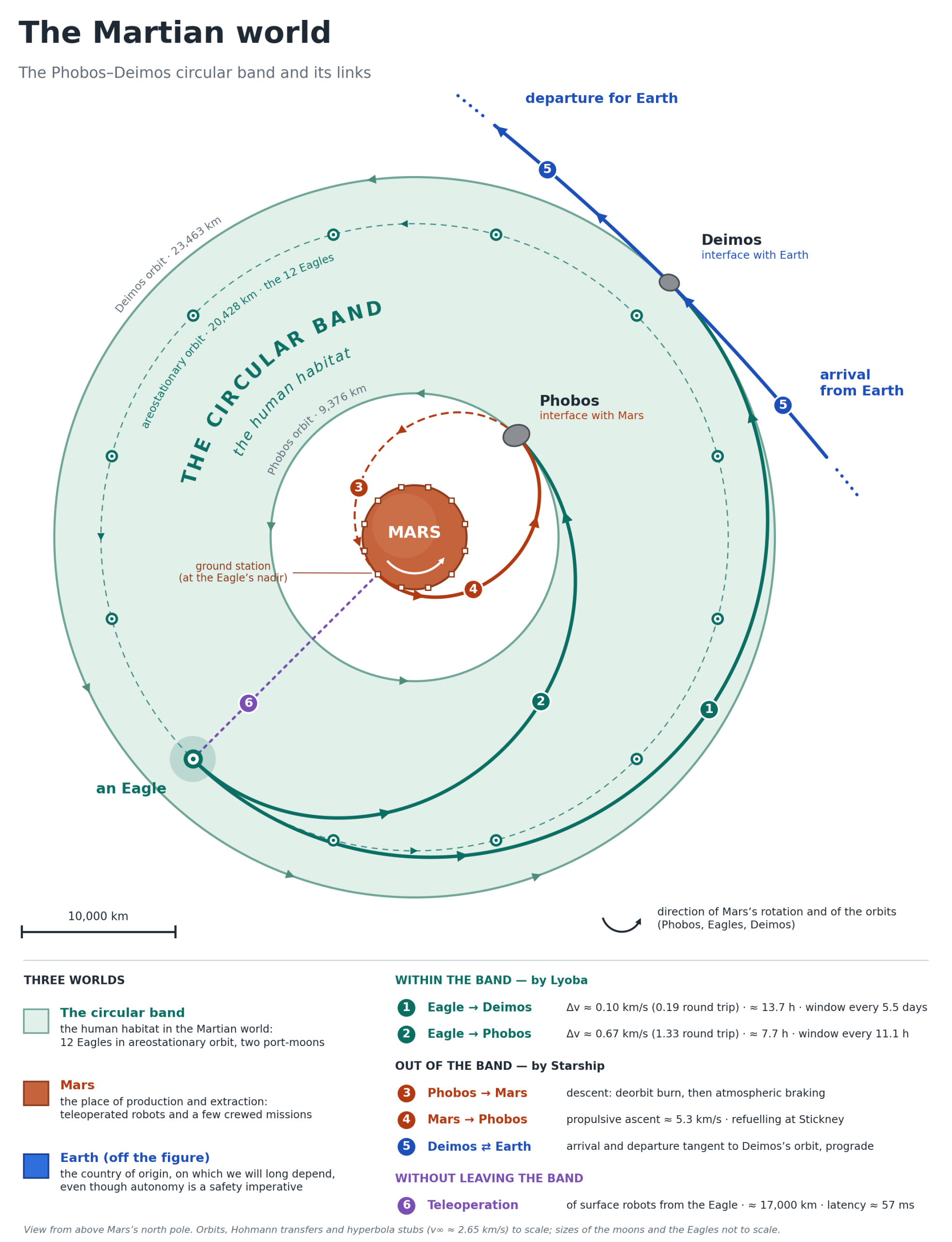
Deimos or Phobos? The answer is not the same depending on whether the dominant constraint is time or propellant — and it leads not to choosing one moon over the other, but to assigning them complementary roles, with a mutual redundancy that is in itself a decisive argument.
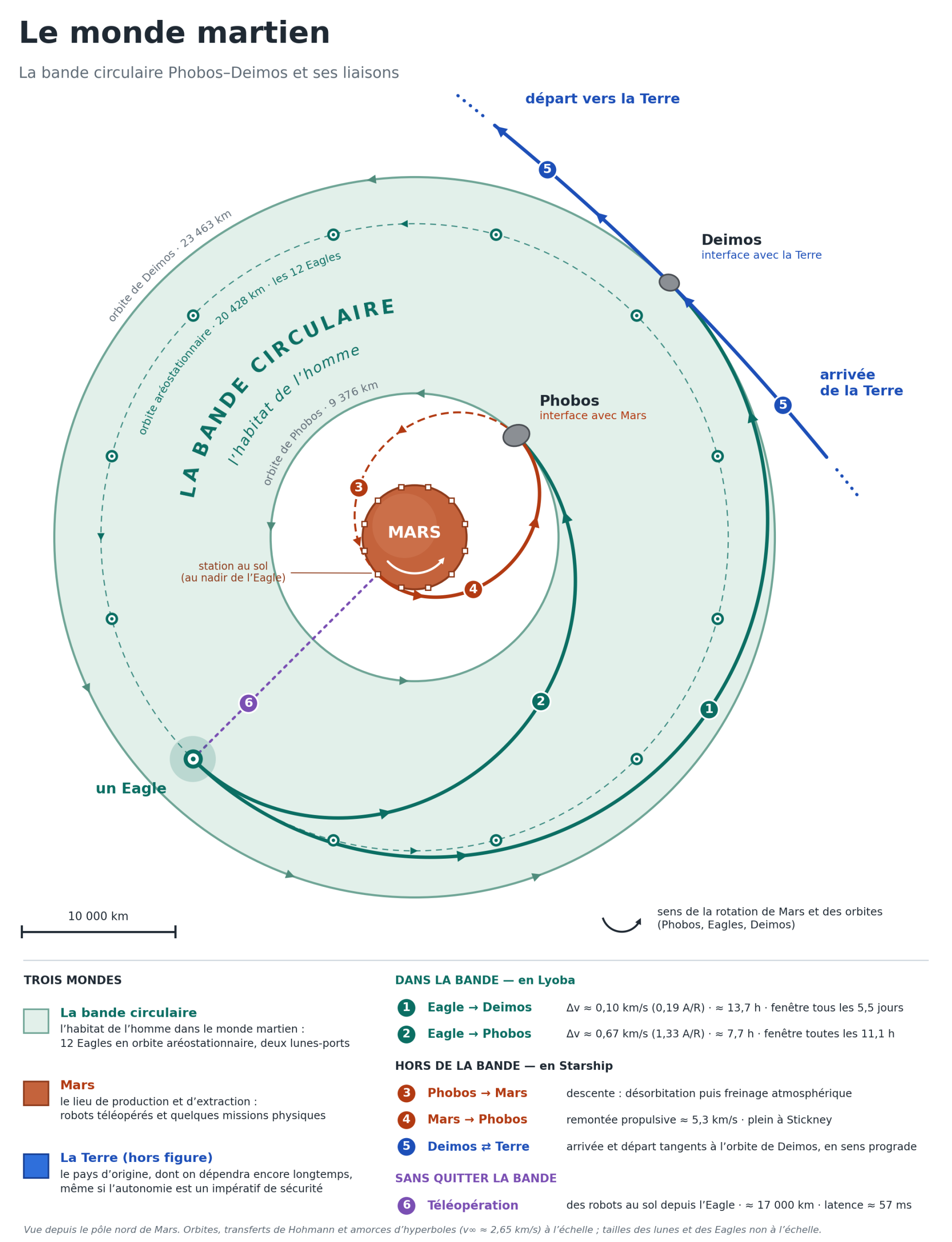
Deimos ou Phobos ? La réponse n’est pas la même selon que la contrainte dominante est le temps ou l’ergol — et elle conduit non pas à choisir une lune contre l’autre, mais à leur attribuer des rôles complémentaires, avec une redondance mutuelle qui est en elle-même un argument décisif.
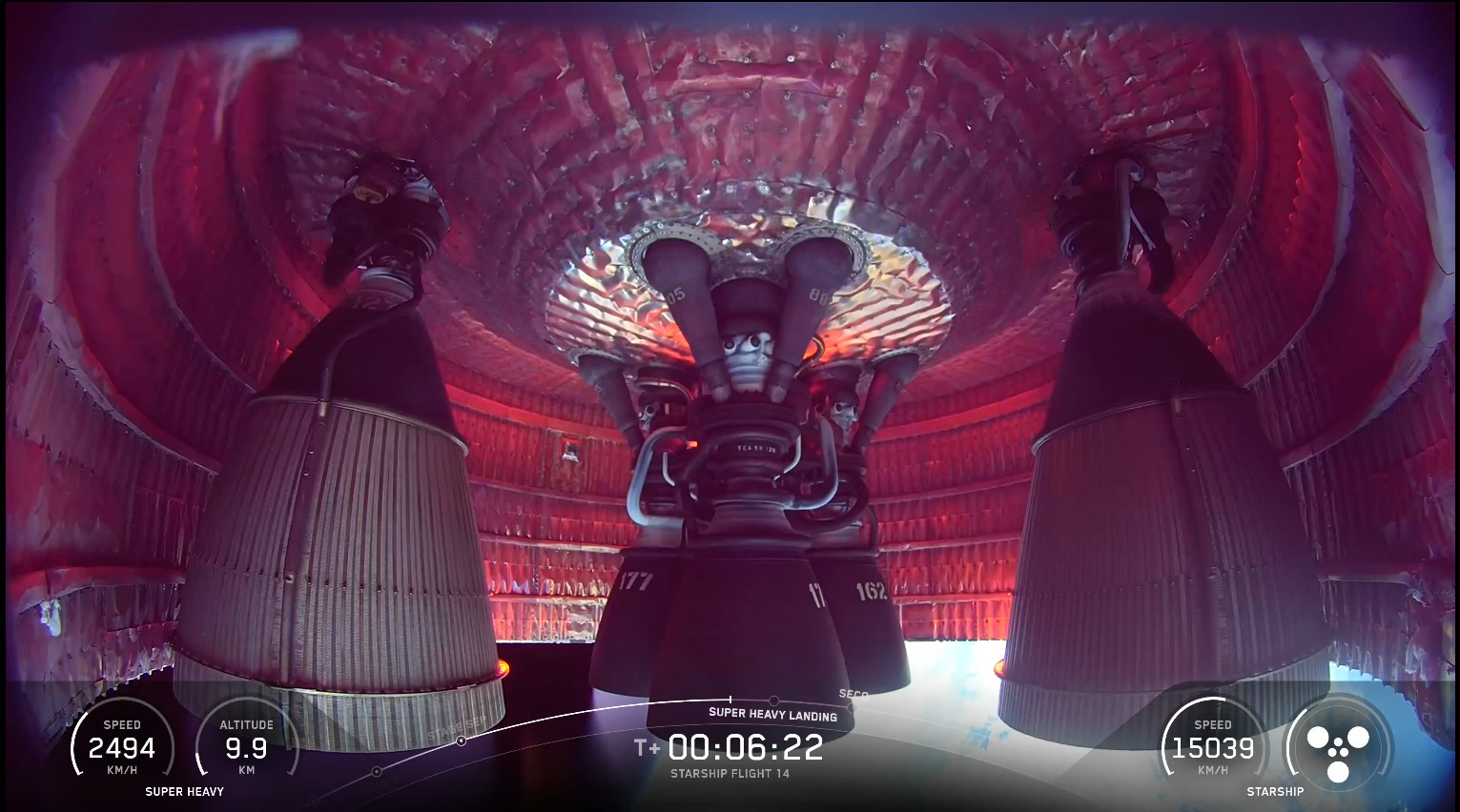
With Flight 14, SpaceX has reached a new milestone Starship’s Flight 14 has just ended, and we had the pleasure of seeing another major milestone
Avec son vol 14, SpaceX a franchi une nouvelle étape Le vol 14 du Starship vient de se terminer et on a pu avoir le


Commentaires récents